
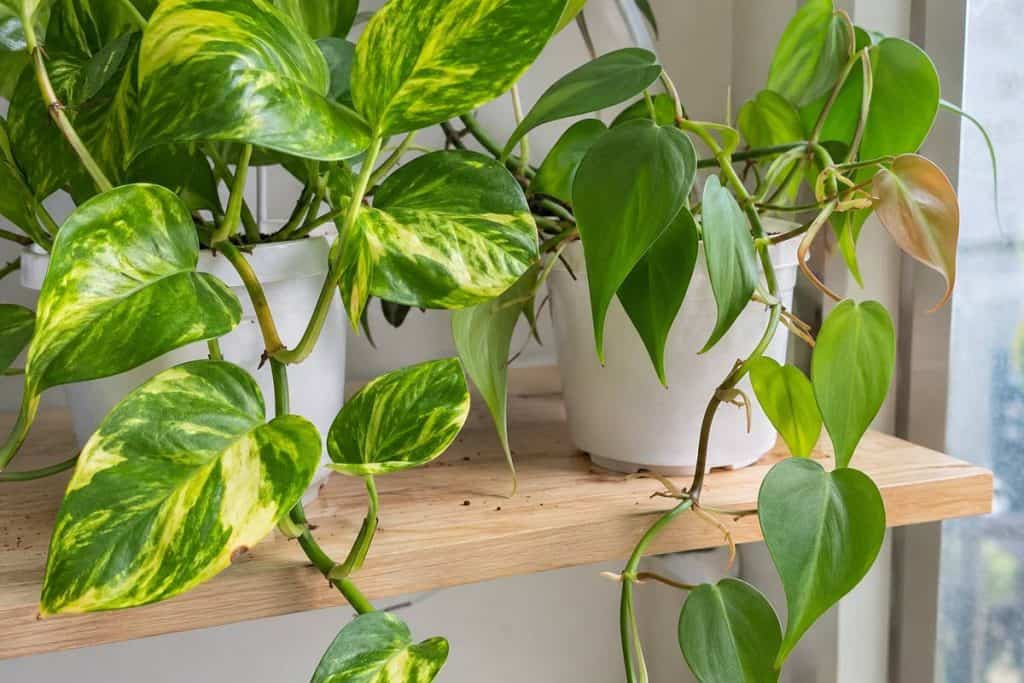
The short answer: a pothos has thicker, waxy leaves with a groove along the top of each leaf stalk, while a heartleaf philodendron has thinner, softer, more heart-shaped leaves on round stalks. The fastest single check is to run a fingertip along the top of a leaf stalk. A groove means pothos.
Both are trailing vines in the same plant family, Araceae, but different genera: pothos is Epipremnum aureum, and the common heartleaf philodendron is Philodendron hederaceum. They’re toxic to pets in the same way and need almost the same care, so a mix-up won’t hurt the plant.
| Clue | Pothos | Heartleaf philodendron |
|---|---|---|
| Leaf feel | Thick, waxy, a little stiff | Thin, soft, smooth |
| Leaf shape | Broad heart, flatter base, short tip | Deep heart, long tapered tip |
| Leaf stalk | Groove along the top | Round all the way around |
| New leaf | Unrolls from the stalk of the last leaf | Grows inside a papery sheath that dries and drops |
| Aerial roots | One thick, stubby root per node | Thin, wiry roots, often several per node |
| New leaf color | Pale green | Often bronze or pinkish |
Why the Labels Get Mixed Up
Garden centers often sell both in matching plastic baskets with tags that just say “tropical foliage,” and a big-box store tag can be wrong. Young plants look the most alike, because the leaves are small and the vines haven’t shown their differences yet. Golden pothos and the plain green heartleaf philodendron are the pair people confuse most. Brasil philodendron, with its lime stripe, gets mistaken for a pothos too.
Whichever one you have, both trail several feet within a couple of years, so a hanging planter or a high shelf shows the vines off and keeps them away from pets.

Clue 1: Feel the Leaf
Rub a leaf between your thumb and finger. A pothos leaf feels thick and slightly leathery, a bit like a plastic plant, and it holds its shape when bent. A philodendron leaf feels thin, soft and papery by comparison. Pothos leaves also have a slight texture, especially on golden and marble types, while philodendron leaves are smooth.
Clue 2: Look at the Shape
Philodendron leaves are a deeper heart with a long, tapered tip that often curls slightly. Pothos leaves are broader, with a flatter base where the leaf meets the stalk and a shorter tip. This clue works best on mature leaves; small new leaves on both plants look similar.
Clue 3: Check the Leaf Stalk
This is the most reliable test. On a pothos, the petiole, which is the short stalk that joins the leaf to the vine, has an indented groove running along its top side. On a philodendron, the petiole is round all the way around. A phone flashlight held at a low angle makes the groove easy to see.
Clue 4: Watch the New Growth
A new pothos leaf unrolls straight out of the stalk of the previous leaf. A philodendron leaf grows inside a cataphyll, a thin sheath that wraps the new leaf, then dries brown and papery and falls off. If you find dry, tan sheaths along the vine, it’s a philodendron. New philodendron leaves often come in bronze or pink before turning green, while new pothos leaves are pale green.
Clue 5: Count the Aerial Roots
Look at the nodes, where leaves join the vine. Pothos usually grows one thick, stubby brown root per node. Philodendron grows thinner, wiry roots, and often more than one per node. On older vines, philodendron roots can look like a small tangle. Give either plant a moss pole and you’ll see the difference clearly, because both use these roots to grip the damp moss as they climb.

Other Look-Alikes on the Same Shelf
A few more vines get sold under the wrong name, and the five clues help with them too.
Satin pothos isn’t a pothos at all. It’s Scindapsus pictus, with matte, dark green leaves splashed with silver, and its leaves feel almost velvety rather than waxy. Cebu Blue is a true pothos from a second species, Epipremnum pinnatum, with narrow, silvery-blue leaves that look nothing like a heart once the plant matures.
On the philodendron side, Brasil philodendron has a lime and yellow stripe down the middle of each leaf, so it often gets labeled as a pothos. Check the stalk: it’s round. Micans philodendron has velvety, bronze-green leaves and the same papery sheaths as heartleaf.
Then there’s Rhaphidophora tetrasperma, sold as “mini monstera,” which has split leaves and belongs to neither group. When in doubt, look for the groove and the sheaths before you trust the tag.
Care Differences That Matter
Day to day, you can care for them the same way: bright indirect light, water when the top 2 inches of mix are dry, and 65 to 85°F. A few small differences:
Philodendron’s thinner leaves curl and droop sooner when the soil dries out, and it handles a dim north room slightly better. Pothos tolerates dry soil longer and takes a little more direct morning sun without scorching. Pothos also usually grows faster in good light. See how fast philodendrons grow for comparison.
Both climb if you give them something to grip, and both make larger leaves when they do. Both also rot in soggy soil, so check the mix before every watering. Our guide on how often to water a philodendron works for pothos too.
Sophia’s tip: if you like both, they share a pot well, since their needs match so closely. See planting pothos and philodendron together for how to keep one from crowding the other.
Propagation is the same for both: a cutting with a node roots in a glass of water in a few weeks. Our guide to propagating heartleaf philodendron walks through it.
Both Are Toxic to Cats and Dogs
Telling them apart won’t change the pet answer. The ASPCA lists pothos as toxic to cats and dogs, and philodendron the same way, because both contain insoluble calcium oxalate crystals that cause mouth pain, drooling and vomiting when chewed. Our post on philodendron and cats covers the symptoms. Hang either one well out of reach, and call your vet or the ASPCA Animal Poison Control Center at (888) 426-4435 if a pet chews it.

Founder & Lead Writer · 9 years growing houseplants · Chicago, IL
I’m Sophia, founder of HousePlantsInfo.com. I’ve grown plants for as long as I can remember and have spent the last 9 years focused on houseplants, now caring for 75+ of them, from easy snake plants and philodendrons to fussier fiddle leaf figs and calatheas. Every guide here is based on what I’ve grown, lost and brought back in a real apartment through dark, radiator-dry Chicago winters. I trained through Houseplant Masterclass, and I check care and pet-safety details against university extension services and the ASPCA before publishing.