
You want a trailing plant for a shelf or a hanging basket, and the garden center has six pothos with six different leaf patterns and prices from $8 to $40.
My pick: golden pothos for almost anyone, because it grows fast, handles a dim room and forgives mistakes better than any fancier type.
Below are the 12 types you’re most likely to find in US stores and online, each tied to the spot it suits best. Most are cultivars of one species, Epipremnum aureum. Two are close relatives sold as pothos. A note near the end covers the plants that carry the name but aren’t pothos at all.
| Type | Best for | Light it actually needs | In low light | Skip it if… |
|---|---|---|---|---|
| Golden | Beginners | 100 to 500 fc | Survives, turns greener | You want a showy pattern |
| Jade | Dim rooms | 75 to 400 fc | Grows | You want any variegation |
| Neon | A pop of color | 200 to 500 fc | Survives, darkens | Your room is dim |
| Marble Queen | Bright spots | 250 to 500 fc | Survives, reverts | You overwater |
| Pearls and Jade | Small shelves | 250 to 500 fc | Survives, slows | You want fast trailing |
| N’Joy | Compact pots | 250 to 500 fc | Survives, slows | You want long vines fast |
| Glacier | Speckled looks | 250 to 500 fc | Survives | You can’t tell it from Pearls and Jade |
| Manjula | Statement plant | 300 to 500 fc | Struggles | You have a north window |
| Jessenia | Subtle variegation | 150 to 500 fc | Grows, fades | You want bold contrast |
| Global Green | Low-light variegation | 100 to 400 fc | Grows | You want white or yellow |
| Cebu Blue | Climbing | 200 to 500 fc | Survives | You only want a hanging plant |
| Baltic Blue | Big split leaves on a pole | 250 to 500 fc | Survives | You won’t add a pole |
The light figures are foot-candles at leaf level. For reference, a spot 3 feet from an east window on a clear day gives roughly 250 to 500, and the middle of a north-facing room may give under 100. A light meter held where the leaves will sit gives you the number for your own spot in a few seconds.
Best for Beginners: Golden Pothos
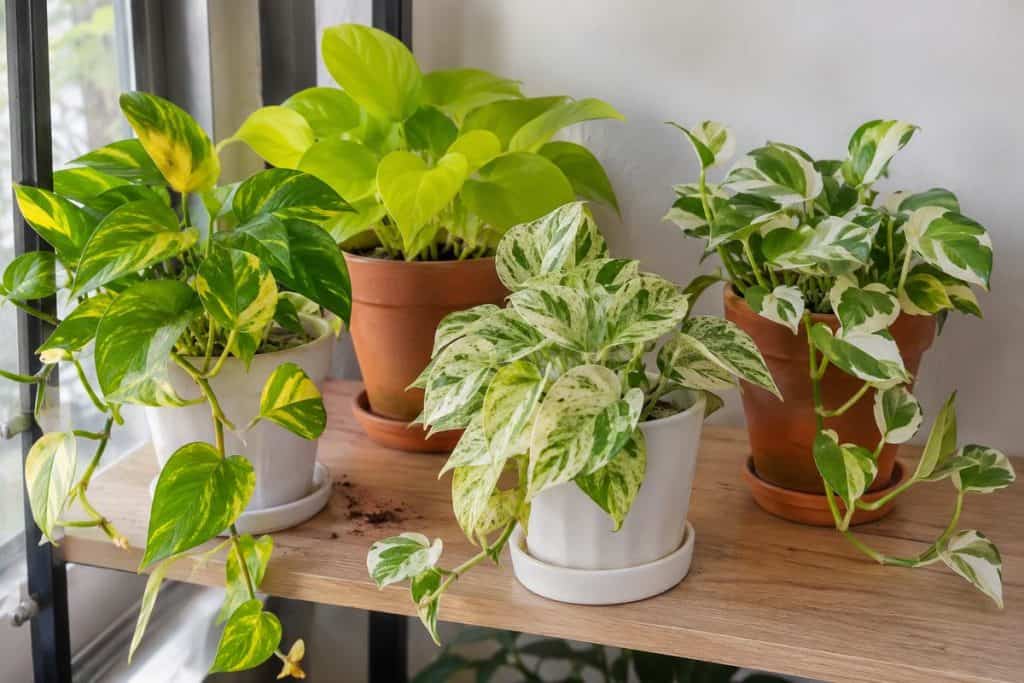
This is the classic: heart-shaped green leaves streaked with yellow, on vines that can add 6 to 12 inches a month in summer. It suits anyone buying their first plant, a dorm room, an office, or a hanging basket that gets watered whenever someone remembers. A starter golden pothos in a 4- or 6-inch pot costs under $15 at most stores and fills out in one season.

It grows best in bright indirect light but keeps going on as little as 100 foot-candles. The trade-off is color: in a dim corner, new leaves come in mostly green. Skip it only if you want a striking pattern; it’s common for a reason, and some people find it plain.
Best for a Dim Room: Jade Pothos
Jade pothos has solid, deep green leaves with no variegation at all. With more chlorophyll than the variegated types, it handles low light better than any other pothos here, down to about 75 foot-candles, and it grows quickly. Put it on a bookcase across the room from a north window or in a bathroom with a small frosted window.
The downside is that it looks like a basic green vine. If you’re filling a dark corner, that doesn’t matter. Our list of plants for cold, dark rooms has more options for tough spots.
Best for a Pop of Color: Neon Pothos
Neon has solid, bright chartreuse leaves, almost electric when new, settling to a softer lime as they age. It brightens a shelf of darker plants better than anything else in this list. It grows at a moderate pace, somewhat slower than golden.
It needs real light to keep that color, at least 200 foot-candles. In a dim room, new leaves come in darker and duller, and the vines stretch. Direct afternoon sun bleaches it pale, so an east window or a few feet back from a south or west window is ideal. Skip it if the plant will live far from a window.
Best for a Bright Window: Marble Queen
Marble Queen has heavily marbled leaves, often more creamy white than green. It’s one of the most striking pothos, and also one of the fussier ones. The white parts have no chlorophyll, so the plant grows slowly and needs bright indirect light, about 250 to 500 foot-candles, to keep its pattern. In low light it reverts, putting out greener leaves.
Those pale patches also brown more easily from overwatering, fertilizer salts, or dry heat from a radiator. Water only when the top 2 inches of mix are dry. Skip it if you tend to water on a schedule or have only a north window.
Best for a Small Shelf: Pearls and Jade
Pearls and Jade is a compact cultivar bred from Marble Queen. Its leaves are smaller than golden’s, mostly green, with white and gray-green flecks and streaks concentrated toward the edges. It stays bushy and slow, which suits a narrow shelf, a desk, or a terrarium-style display.
It needs bright indirect light to keep the speckling and to grow at a reasonable pace. Expect a few inches a month in summer, not a foot. Skip it if you want a vine that drapes to the floor within a year.
Best for a Compact Pot: N’Joy
N’Joy has small, slightly pointed green leaves with crisp, clean white patches, not speckles. The contrast is sharp, which makes it easy to tell apart from Pearls and Jade, where the white is blurred and flecked. It stays tidy and slow-growing, so one plant looks full in a 4-inch pot for a long time.
Like other white-variegated types, it needs about 250 to 500 foot-candles and dislikes soggy soil. The white sections brown at the edges in dry winter air near a heater. Skip it if you want fast, long vines.
Best for a Speckled Look: Glacier
Glacier looks like a cousin of Pearls and Jade and N’Joy, with small leaves covered in silvery-green and white flecks. It tends to have more speckling spread across the leaf than Pearls and Jade, and fewer solid white patches than N’Joy. Plants are often mislabeled between the three, so buy the one whose leaves you like rather than worrying about the tag.
Care is the same as for the other compact variegated types: bright indirect light, careful watering, and patience. Skip it if you’ll be bothered by not knowing exactly which of the three you own.
Telling the Look-Alikes Apart
Three groups cause most of the confusion. Check the leaf pattern against this key before you trust a tag.
| If the leaf shows… | It’s probably… |
|---|---|
| Yellow streaks on green | Golden |
| Lime or chartreuse streaks on green | Jessenia |
| Light olive center, dark green edges | Global Green |
| Solid chartreuse, no streaks | Neon |
| Mostly cream, marbled with green | Marble Queen |
| Crisp white patches with clean edges | N’Joy |
| White and gray-green flecks, mostly near the edges | Pearls and Jade |
| Silvery flecks spread across a small leaf | Glacier |
| Wide, wavy leaf with patches of cream and silver | Manjula |
| Narrow, silvery blue-green leaf | Cebu Blue |
| Dark blue-green leaf, splits on a pole | Baltic Blue |
Variegation shifts with light and age, so look at three or four mature leaves, not the newest one. A golden pothos in a dim room can look almost like jade, and a stressed Marble Queen can put out a leaf that looks like N’Joy.
Best Statement Plant: Manjula
Manjula has wide, heart-shaped leaves with wavy edges that curl slightly, splashed with cream, white, silver and green in patches that differ on every leaf. It’s a patented cultivar and usually costs more than the common types. It grows slowly and tends to stay mounded rather than trailing long.
It needs the brightest spot on this list, about 300 to 500 foot-candles, to keep its pattern and grow at all. In low light it stalls and drops leaves. The pale patches scorch in direct afternoon sun, so an east window is ideal.
Skip it if your best window faces north. A grow light bulb in a desk lamp, about 12 inches above the plant for 12 to 14 hours a day, helps if your window is weak.

Best for Subtle Variegation: Jessenia
Jessenia looks like a golden pothos with lime-green streaks instead of yellow. The variegation is gentle, which suits anyone who finds golden too busy and neon too bright. It grows a little slower than golden, at a moderate pace.
It handles medium light well, down to about 150 foot-candles, but the streaks fade toward plain green in a dim room. Skip it if you want bold contrast; from across a room, it can read as solid green.
Best for Variegation in Low Light: Global Green
Global Green has dark green edges with a lighter, olive and lime center on each leaf. Because so much of the leaf is green, it handles lower light far better than the white-variegated types, down to about 100 foot-candles, while still showing a pattern. It grows at a steady, moderate pace.
It’s a good choice for a north window, a shelf a few feet from an east window, or an office. Skip it if you’re after white or yellow tones; the pattern is all shades of green.
Best for Climbing: Cebu Blue
Cebu Blue is a different species, Epipremnum pinnatum. Young leaves are narrow and arrow-shaped, with a silvery, blue-green sheen. On a hanging vine, the leaves stay small. Given a moss pole to climb, mature leaves grow larger and can eventually develop splits, which is the main reason people grow it.

It grows at a moderate to fast pace in bright indirect light. Skip it if you only want a trailing plant, because it looks its best climbing.
Best for Big Split Leaves on a Pole: Baltic Blue
Baltic Blue is another Epipremnum pinnatum cultivar, with darker, blue-green leaves than Cebu Blue. It tends to grow faster and produce splits in its leaves sooner once it climbs. Give it a pole and it splits sooner than Cebu Blue does.
It needs bright indirect light, 250 to 500 foot-candles, and a pole to show off. Skip it if you won’t give it something to climb, because on a hanging vine it looks like a plain green pothos.
Names That Aren’t Separate Types
Some names on store tags aren’t distinct cultivars. “Hawaiian pothos” usually describes a golden pothos with large leaves, often grown on a pole. “Snow Queen” and “Harlequin” are often labels for very white forms of Marble Queen. You aren’t getting a wrong plant, just a trade name.
Satin pothos and Trebi aren’t pothos at all. Both are Scindapsus pictus, with matte, dark green leaves splashed with silver, and they need a little more humidity and drier soil than true pothos. They’re sold next to pothos because they look and grow similarly.
Price and Where You’ll Find Them
Golden, jade, neon and Marble Queen are the everyday types. You’ll find them at big-box garden centers, hardware stores and most grocery stores, usually $8 to $20 for a 6-inch hanging basket. Pearls and Jade, N’Joy, Global Green and Jessenia show up at larger garden centers and from online growers for a little more.
Manjula, Cebu Blue, Baltic Blue and Glacier are easier to find at independent plant shops or online, where a small pot can cost $20 to $40.
Whatever you buy, check the plant before you pay. Look under the leaves and along the stems for white fluff or webbing, pass on plants with mushy stems at the soil line, and choose one with several vines coming from the pot rather than one long vine. A fuller pot fills a hanging basket months sooner.
Keeping the Pattern
Variegated types revert when they don’t get enough light, because the plant grows greener leaves to catch more of what light there is. Move the plant closer to the window first. New leaves usually show the pattern again within a few weeks, though leaves that already turned green stay green.
A vine that keeps making solid green leaves even in good light has reverted, so trim it back to the last well-variegated leaf. The opposite problem happens too: a shoot that comes in almost all white looks striking but has little chlorophyll, grows weakly, and often browns. Keep it for show if you like, but it won’t carry the plant.
Care That Works for All of Them
Every type here wants the same basics: bright indirect light, water when the top 2 inches of mix are dry, a fast-draining mix, temperatures between 65 and 85°F, and half-strength fertilizer once a month from April through September. The main difference is light. The more white or yellow in the leaf, the brighter the spot it needs and the slower it grows. Solid green types grow fastest and tolerate the dimmest rooms.
They also mix well. A pot with golden, neon and marble cuttings together looks full and bright, as long as it sits in light bright enough for the marble. Our guide to variegated houseplants explains why pale leaves need more light, and you can also plant pothos with philodendron for a mixed basket.
Sophia’s tip: when you buy a variegated type, give it your brightest indirect spot for the first month. A plant moved from a greenhouse into a dim room often reverts within a few leaves, and it’s easier to prevent than to fix.
All Types Are Toxic to Pets
The ASPCA’s devil’s ivy entry lists pothos as toxic to cats and dogs, and that covers every cultivar here. Treat satin pothos as toxic too. Chewing a leaf releases needle-like crystals that sting the mouth and can cause drooling and vomiting. Hang them high, and see how to keep cats from eating houseplants for more ideas.
How to Choose in 30 Seconds
- If your room is dim or you’re a beginner, buy golden or jade.
- If you want color and have an east window, buy neon.
- If you have a bright spot and water carefully, buy Marble Queen, N’Joy or Manjula.
- If you’ll add a moss pole, buy Cebu Blue or Baltic Blue.

Founder & Lead Writer · 9 years growing houseplants · Chicago, IL
I’m Sophia, founder of HousePlantsInfo.com. I’ve grown plants for as long as I can remember and have spent the last 9 years focused on houseplants, now caring for 75+ of them, from easy snake plants and philodendrons to fussier fiddle leaf figs and calatheas. Every guide here is based on what I’ve grown, lost and brought back in a real apartment through dark, radiator-dry Chicago winters. I trained through Houseplant Masterclass, and I check care and pet-safety details against university extension services and the ASPCA before publishing.