
Your pothos lives in a windowless office, a north-facing studio, or a corner that goes dim by 4 p.m. in December, and the vines have gone thin and pale.
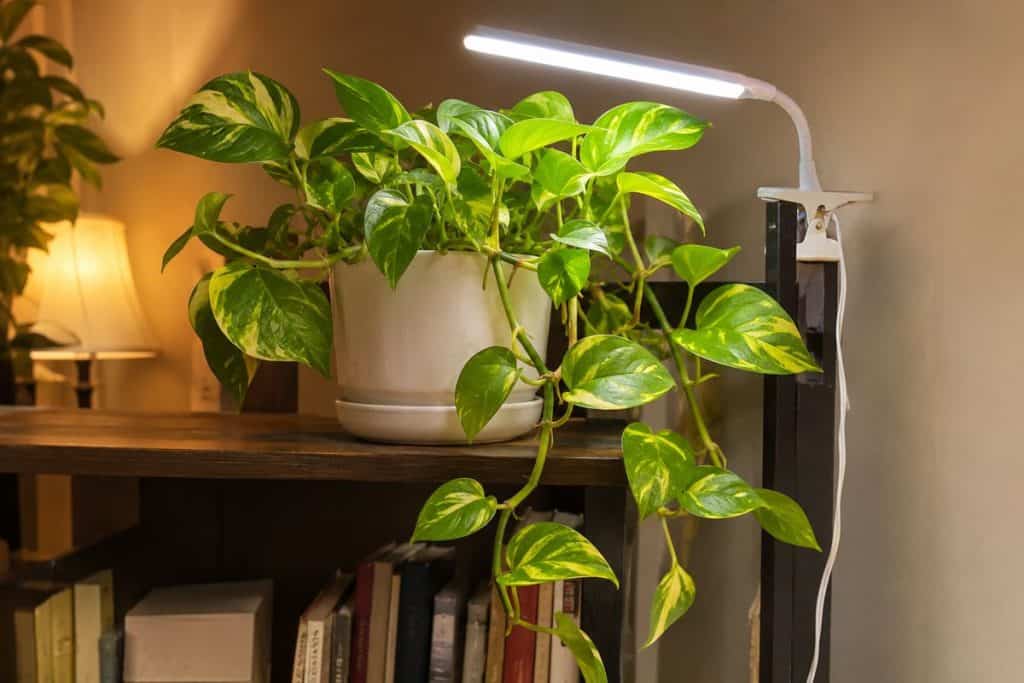
My pick: a white, full-spectrum clip-on LED of 15 to 30 watts, set 8 to 12 inches above the leaves and on a timer for 12 hours a day. It costs about $20 to $30 and fixes most low-light pothos within a month.
The list below goes by situation: what to buy for a shelf, a hanging basket, a plant rack, or a big floor plant, then how to set any of them up.
| Option | Best for | Distance from leaves | Hours a day | Skip it if… |
|---|---|---|---|---|
| Clip-on LED, 15 to 30 W | One plant on a desk or shelf | 8 to 12 inches | 12 | You have 4 or more plants |
| LED bulb, 9 to 15 W, standard E26 base | A lamp or pendant you already own | 12 to 18 inches | 12 | The fixture points away from the plant |
| T5 LED bars, 2 to 4 strips | A shelf with several pots | 6 to 12 inches | 12 | You dislike visible fixtures |
| Floor lamp with stand, 30 to 50 W | A big plant or a corner | 18 to 24 inches | 12 | Space is tight |
| Plant stand with built-in lights | A collection on one rack | Set by the shelf | 12 | You only have one plant |
Best for One Plant on a Shelf: Clip-On LED
A clip-on grow light clamps to a shelf edge or desk and has a flexible neck you can bend over the plant. It’s the simplest fix for one pothos in a dim spot. Look for white light described as full spectrum, roughly 4000 to 6500K, and 15 to 30 watts of actual draw, not the inflated “equivalent” number on the box.

Set the head 8 to 12 inches above the top leaves. One head lights a 6- to 8-inch pot well. Two heads cover a wider plant or a pot with vines spread across a shelf. The honest downside is reach: a trailing pothos with 3-foot vines only gets light near the top, and the lower vines stay in the shade.
Best for a Lamp You Already Own: LED Grow Bulb
If you have a desk lamp, floor lamp or pendant over the plant, an LED grow bulb with a standard E26 screw base turns it into a grow light. A 9- to 15-watt bulb, 12 to 18 inches from the leaves, is enough for a medium pothos.
It’s the cheapest option and blends into a room, because it looks like an ordinary lamp. Choose white bulbs; some still glow pink or purple, which looks odd in a living room and makes it hard to see the plant’s true color. The limit is the fixture: a lampshade that throws light sideways wastes most of it. A gooseneck lamp or an open pendant pointed down works best.
Best for a Shelf of Plants: T5 LED Bars
T5 LED bars are slim strips, usually 1 to 2 feet long, that stick or screw to the underside of a shelf. Two to four strips light a whole shelf of pothos, philodendron and other trailing plants evenly, with no hot spots.

Mount them 6 to 12 inches above the pots. They give the most even light of any option here, which keeps a row of plants growing at the same pace. Many link together and run from one plug. The trade-off is looks: on an open bookcase, you’ll see the strips unless the shelf has a lip.
Best for a Big Plant or Corner: Floor Lamp on a Stand
A grow light on a stand stands about 5 feet tall with one or more adjustable heads. It works for a large pothos on a moss pole, a hanging basket in a corner, or a plant on the floor far from any window.

Set the heads 18 to 24 inches from the leaves for a 30- to 50-watt light. Aim one head at the top of the plant and, if you have a second, at the middle of the vines. It’s the best way to light a tall climbing pothos from top to bottom. It takes up floor space, and cheaper stands can wobble, so set it where nobody will bump it.
Best for a Plant Collection: A Stand With Built-In Lights
If pothos is one of a dozen plants, a shelving rack with grow lights built into each shelf keeps them all lit on one switch. Put the most variegated plants, like Marble Queen or N’Joy, on the top shelf closest to the light, and solid green types lower down. It’s overkill for one plant.
Set It Up in Five Steps
- Pick the spot first: the plant stays where it is, and the light goes over it.
- Measure from the light to the top leaves and set it to the distance in the table.
- Plug the light into a timer set for 12 hours on, for example 7 a.m. to 7 p.m.
- Check the leaves after 2 weeks. Bleached, pale patches mean the light is too close; long gaps between new leaves mean too far.
- Adjust by 2 to 3 inches at a time, then leave it alone.
A plug-in outlet timer matters more than people expect. A pothos needs a dark period, about 8 hours a night, and a light that’s left on around the clock stresses the plant and drives up your electric bill. Our guide to how long to keep grow lights on covers timing for other plants too.
How Much Light Pothos Actually Needs
Pothos is a low-to-medium light plant. It survives on about 75 to 100 foot-candles at the leaf, but it grows full and keeps its variegation at about 200 to 500. In grow-light terms, that’s roughly 40 to 100 micromoles per square meter per second at leaf level for 12 hours. You don’t need to measure that precisely. A phone lux app gives a rough check: 2,000 to 5,000 lux at the leaves is the range.
Golden and jade pothos grow fine at the lower end. White and yellow patches have little chlorophyll, so variegated types need the upper end; variegated houseplants goes deeper.
Settings by Pothos Type
The more white or yellow in the leaf, the closer the light and the longer the day it needs. Start here and adjust after 2 weeks.
| Pothos type | Distance (20 W clip-on) | Hours a day | Notes |
|---|---|---|---|
| Jade, Global Green | 10 to 12 inches | 12 | Grows well at the low end |
| Golden, Jessenia | 8 to 12 inches | 12 | Streaks fade if too far |
| Neon | 8 to 10 inches | 12 to 13 | Turns dull green in weak light |
| Marble Queen, N’Joy, Pearls and Jade, Manjula | 6 to 10 inches | 13 to 14 | Watch white patches for bleaching |
| Cebu Blue, Baltic Blue on a pole | Floor lamp, 18 inches | 12 to 14 | Light the top of the pole |
Heat isn’t a worry with LEDs at these distances, but check once by holding your hand at leaf level for a minute. If it feels warm, move the light up 2 inches.
Grow Light Plus a Window
You don’t have to choose. If your pothos sits near a north window or gets bright light for only a few hours, run the grow light to fill in. In a Chicago winter, when the sun is up for about 9 hours, set the timer to cover the dark hours on either side, so the plant gets about 12 hours total. In summer, near a decent window, you may not need it at all.
Sophia’s tip: in a north-facing room, a grow light on from 6 a.m. to 8 a.m. and 4 p.m. to 8 p.m. in winter often does more for a pothos than moving it across the room. Most outlet timers let you set two on-periods a day.
What It Costs to Run
LEDs are cheap to run. A 20-watt light on 12 hours a day uses about 7.2 kilowatt-hours a month. At a typical US rate of about 17 cents per kilowatt-hour, that’s around $1.25 a month. A 9-watt bulb costs about 55 cents a month. Even a 50-watt floor lamp stays near $3.
Signs the Light Is Right or Wrong
Too little light shows as long bare stems between leaves, new leaves smaller than the old ones, variegation fading to plain green, and soil that stays wet for weeks because the plant uses water slowly.
Too much light, or a light too close, shows as pale, bleached or yellow-white patches on the leaves nearest the light, sometimes with crispy brown edges. The right setup gives compact growth, leaves as large as the plant’s older ones, and steady new growth every week or two in spring and summer.
What I Wouldn’t Buy
- Incandescent or halogen “plant bulbs.” They run hot and give little usable light per watt. Too close, they scorch leaves; far enough to be safe, they barely help.
- Pink or purple-only LEDs for a living room. They do grow plants, but the glow is unpleasant to live with and hides early signs of trouble.
- Lights sold only by “equivalent” wattage. A “1000W equivalent” bulb may draw 15 watts. Check the actual draw on the label.
For tough spots where even a light won’t fit, see our list of plants that don’t need sunlight, and our tips on winter houseplant care.
One note for pet owners: a plant on a lit shelf at cat height is an invitation. Pothos is toxic to pets per the ASPCA, so mount the light and plant high.
Before You Buy: Common Questions
Can a pothos live under a grow light only, with no window?
Yes. Pothos is one of the easiest plants to grow entirely under artificial light. Give it 12 to 14 hours a day at the distances in the chart, and it grows normally in a windowless office or bathroom. Plants with no window may need watering a little less often, since the light adds little heat.
Will a regular LED desk lamp work?
A bright white LED lamp helps a little, but most household bulbs are designed for reading, not plants, and give far less light than a grow bulb of the same size. If you already have the lamp, swap in a grow bulb rather than buying a new fixture.
Should the light go above or to the side?
Above. Light from one side makes vines lean and grow toward it, leaving the far side thin. If a side position is your only option, turn the pot a quarter turn every week so all the vines get a share.
Will a grow light dry the soil faster?
Yes, a little. More light means the plant grows and drinks more, so a pothos that needed water every 2 weeks in a dim corner may need it every 8 to 10 days under a light. Check the soil every 3 to 4 days for the first 2 weeks to learn the new pace.
How long until I see a difference?
New growth should look more compact within 3 to 4 weeks, with leaves as large as the older ones. Leaves that grew small and pale in low light stay that way, so judge by the new leaves. Variegation returns only on leaves that form after the change.

Founder & Lead Writer · 9 years growing houseplants · Chicago, IL
I’m Sophia, founder of HousePlantsInfo.com. I’ve grown plants for as long as I can remember and have spent the last 9 years focused on houseplants, now caring for 75+ of them, from easy snake plants and philodendrons to fussier fiddle leaf figs and calatheas. Every guide here is based on what I’ve grown, lost and brought back in a real apartment through dark, radiator-dry Chicago winters. I trained through Houseplant Masterclass, and I check care and pet-safety details against university extension services and the ASPCA before publishing.