
Your fiddle leaf fig is standing by the window with limp, droopy leaves, crispy brown edges, and soil that has pulled away from the sides of the pot.
The short version: If you are wondering how to fix an underwatered fiddle leaf fig, start by soaking the root ball thoroughly until the soil is evenly moist, then let it drain completely.
Trim only fully dead tissue, move the plant away from heat sources, and switch to watering when the top 2 to 3 inches of soil are dry.
This guide covers how to confirm the plant is thirsty, how to rehydrate it safely, what to prune, and how to keep it from drying out again.
Check These First
- Push a finger 2 to 3 inches into the soil. If it is dry and dusty all the way down, underwatering is likely.
- Lift the pot or tip it slightly. A severely dry fiddle leaf fig in a plastic pot feels surprisingly light.
- Look at the edge of the pot. A visible gap between the soil and the pot wall means the root ball has shrunk from dryness.
- Check what is near the plant. A radiator, heating vent, or sunny south window within 2 to 3 feet can dry soil out in days.
- Look at the drainage tray. If water ran straight through in seconds the last time you watered, the soil may be repelling water.
How Do You Know Your Fiddle Leaf Fig Needs Water?
A fiddle leaf fig needs water when the top 2 to 3 inches of soil are dry and the pot feels noticeably lighter than it does right after watering. Leaf symptoms come later, so checking the soil is the most reliable signal.
Test the soil, not the calendar
Fixed schedules fail because indoor conditions change through the year. A plant that needs water every 7 days in a warm, bright July might only need it every 12 to 14 days in a dim November.
A soil moisture meter gives you a quick reading at root depth, which is helpful for large floor pots where your finger cannot reach far.
Push the probe about halfway down the pot, between the stem and the rim, and water when it reads in the dry to low-moist range.
A plain wooden chopstick or dowel works too. Push it to the bottom of the pot, leave it for a minute, and pull it out. Dark, damp soil clinging to it means wait; a clean, dry stick means it is time to water.
Learn the weight of your pot
Lift or tilt the pot right after a thorough watering and remember how heavy it feels. Check again every few days. Once you know the difference between wet and dry weight, you can judge watering needs in seconds.
Watch how the plant holds its leaves
A well-hydrated fiddle leaf fig holds its leaves firm and fairly upright, with a slightly leathery feel. When water runs low, leaves soften and start to angle downward.

This is an early warning, but by the time the drooping is obvious, the soil has usually been dry for a while.
Sophia’s tip: Mark a small piece of tape on the pot at the soil line and note the date each time you water.
After a month you will see your real interval for that window, and you can adjust it when the heat comes on in fall.
Underwatered Fiddle Leaf Fig Symptoms to Look For
The classic signs are drooping, crispy brown leaf edges, curling, and dry soil that shrinks from the pot. Lower leaves may yellow and drop as the plant sacrifices older growth to save water.
Drooping and limp leaves
Fiddle leaf figs rely on water pressure inside their cells to hold their large leaves out. When that pressure drops, the whole canopy sags. Drooping from thirst usually improves within a day or two of a deep watering.
Crispy brown edges and dry patches
Underwatering browning tends to start at the leaf edges and tips and feels dry and papery. It often appears as a light tan or medium brown band.
This differs from the dark, soft brown spots in the middle of leaves that usually point to root rot from too much water.
Curling leaves
Leaves may curl inward or cup along the midrib to reduce water loss.
Curling has several possible causes, including low humidity, cold drafts, and too much direct sun, so read more on why the leaves of your fiddle leaf fig tree are curling up if watering does not resolve it.
Yellowing and dropping lower leaves
A thirsty plant may pull resources from its oldest leaves, which turn yellow and fall.
Yellowing is also common with overwatering and nutrient problems, so compare the pattern against the guide on why the leaves of your indoor potted fiddle leaf fig tree are turning yellow.
Signs that are usually not from dryness
Holes, ragged tears, and pinpoint speckling are rarely caused by underwatering alone. These usually come from physical damage, pests, or old injuries on new leaves. If you see them, check the guide on fiddle leaf fig leaves with holes and their causes and solutions.
Underwatering or Overwatering? How to Tell Them Apart
The soil tells you which problem you have: bone-dry soil with crispy symptoms means underwatering, while soggy or sour-smelling soil with soft, dark spots means overwatering. Both cause drooping and leaf drop, which is why they are easy to confuse.
| Sign | Underwatered | Overwatered |
|---|---|---|
| Soil | Dry 3+ inches down, pulling from pot edges | Damp or wet for days, may smell musty |
| Leaf browning | Light brown, crispy, starts at edges | Dark brown or black, soft, often mid-leaf |
| Leaf texture | Thin, papery, limp | Soft, sometimes with yellow halos around spots |
| Leaf drop | Older lower leaves first | Leaves drop from anywhere, sometimes still green |
| Pot weight | Very light | Heavy |
| Roots | Dry, shriveled, but firm and light-colored | Brown or black, mushy, may slip apart |
When in doubt, check the roots
If the soil reading is confusing, slide the plant out of its pot. Healthy roots are firm and tan to white.
Dry but alive roots look thin and brittle on the outside yet bend rather than snap. Mushy, dark roots mean rot, and adding water would make things worse.
Mixed signals are common
A plant can show old overwatering damage and new underwatering stress at the same time, especially if someone cut back on watering after a rot scare. Treat the current soil condition first, then manage the leaves.
How to Fix an Underwatered Fiddle Leaf Fig, Step by Step
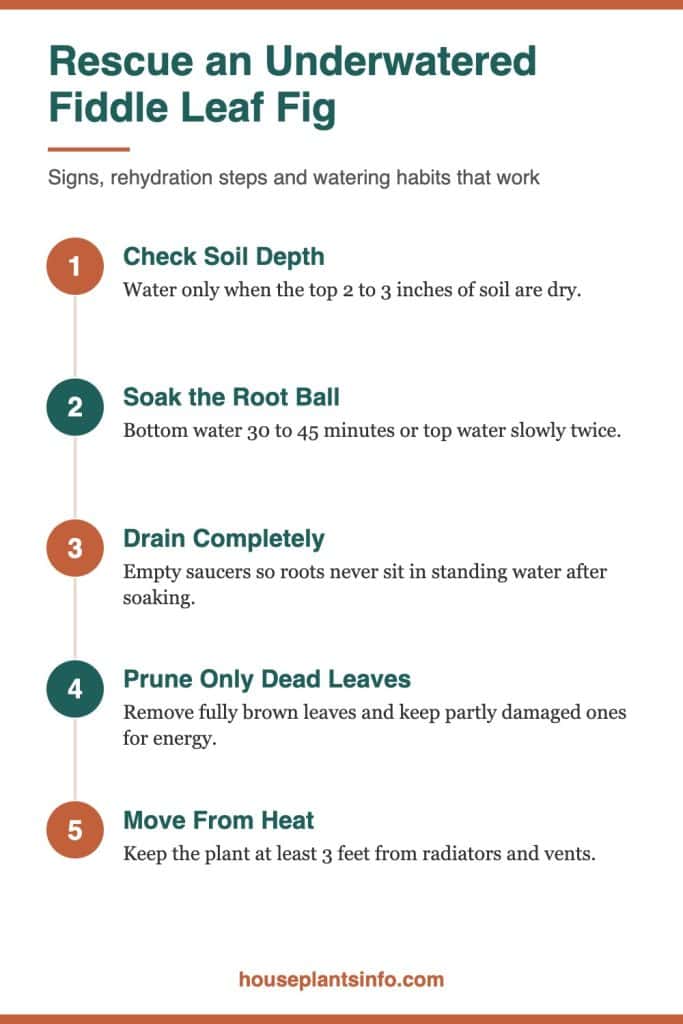
To fix an underwatered fiddle leaf fig, rehydrate the entire root ball slowly and thoroughly, drain it fully, then keep the plant in steady bright, indirect light while it recovers. One deep soak works better than several small splashes.
Step 1: Loosen the soil surface
Very dry potting mix, especially peat-heavy mixes, can become water-repellent. Water then runs down the gap along the pot wall and out the bottom, leaving the center dry.

Gently poke a few holes into the top few inches with a chopstick to help water soak in.
Step 2: Water slowly from the top
Pour room-temperature water slowly over the whole soil surface, pausing to let it absorb. Keep going until water flows from the drainage holes. Wait 10 to 15 minutes, then water again, since the first pass often only wets the outer layer.
Step 3: Bottom water if the soil still resists
If the pot is small enough to move, set it in a sink, tub, or basin with 2 to 4 inches of room-temperature water. Let it soak for 30 to 45 minutes, until the soil surface feels damp.
This draws moisture up through the entire root ball.
For heavy floor pots, you can place the plant in a bathtub and repeat slow top watering two or three times over an hour.
Step 4: Drain completely
Lift the pot out and let it drain for at least 15 to 30 minutes. Empty the saucer or cachepot afterward. Fiddle leaf figs dislike sitting in standing water, and a rescue soak should never turn into a root rot problem.
Step 5: Put the plant back in the right spot
Return the plant to a location with bright, indirect light, ideally 3 to 6 feet from an east or south window, or right beside a west window with a sheer curtain. Keep it at least 3 feet from radiators, heating vents, and AC outlets.
Step 6: Wait before watering again
After a deep soak, do not water again until the top 2 to 3 inches are dry. Rescue watering often leads to overcorrection, and a freshly rehydrated plant can tip into soggy soil quickly.
Sophia’s tip: If water rushes out the bottom within seconds, that is a sign the mix has shrunk away from the pot. Press the soil gently back against the pot wall after the soak so the next watering spreads evenly through the root ball.
How long recovery takes
Mild drooping usually improves within 24 to 72 hours of a thorough watering. Crispy brown edges will not turn green again, but healthy tissue stops browning further. New growth that confirms full recovery typically appears in 3 to 8 weeks, depending on season and light.
Should You Prune Damaged Leaves After Underwatering?
Prune only leaves or tissue that are fully dead, and wait a week or two after rehydrating before cutting anything else. Partly damaged leaves still photosynthesize and help the plant recover.
What to remove
- Leaves that are entirely brown, dry, and crisp
- Leaves that are more than about half dead or completely yellow
- Leaves hanging loosely that drop with a light touch
What to leave alone
Leaves with only brown edges or small dry patches are still useful. Fiddle leaf figs grow slowly and do not replace leaves quickly, so removing too many can stall recovery.
How to trim cleanly
Use clean, sharp scissors or pruners wiped with rubbing alcohol. For a fully dead leaf, cut the petiole close to the stem without nicking the trunk.
For brown edges, you can trim along the leaf’s natural shape, leaving a thin line of brown so you do not cut into living tissue.
Handle the sap carefully
Cut stems release a milky white latex sap that can irritate skin and eyes. Wear gloves if you have sensitive skin, and wipe sap off floors or furniture right away.
A note on pets and kids
The ASPCA lists Ficus species such as the weeping fig and edible fig as toxic to cats and dogs, and the fiddle leaf fig contains the same irritating sap.
Chewing can cause mouth irritation, drooling, and vomiting, so keep pruned leaves and the plant itself out of reach of pets and small children.
Why Your Fiddle Leaf Fig Keeps Drying Out
Repeated underwatering usually comes from indoor heat, a root-bound plant, a pot that is too small, fast-draining mix, or very bright light that increases water use. Fixing the cause stops the cycle.
Forced-air heat and radiators
Winter heating can drop indoor humidity to 20 to 30 percent and dry soil much faster than in summer. A plant within a couple of feet of a radiator or floor vent may lose moisture in half the usual time.
Moving it even 3 feet away makes a real difference.
Dry winter air
Fiddle leaf figs do best around 40 to 60 percent humidity. A room humidifier nearby or grouping plants together helps more than spraying the leaves.
For a closer look at whether spraying helps, see the article on whether misting your fiddle leaf fig is a good idea.
A root-bound plant
When roots fill the pot, there is little soil left to hold water, and the plant dries out within days. Signs include roots circling the bottom, roots poking from drainage holes, and water running straight through.
Repot in spring or early summer into a pot only 1 to 2 inches wider than the current one.
The wrong pot or mix
Unglazed terracotta wicks moisture from the soil and dries faster than plastic or glazed ceramic. Very chunky mixes with lots of bark drain quickly too.
These are good choices for people who tend to overwater, but if your plant is always thirsty, a plastic nursery pot inside a decorative cachepot may suit it better.
More light means more water
A fiddle leaf fig in strong light, or under a grow light for 12 hours or more, grows actively and uses more water. That is a good thing, but it means checking soil more often during bright months.

AC drafts in summer
Air conditioning also dries the air, and a constant cold breeze from a window unit can stress leaves while drying soil unevenly. Keep the plant out of the direct airflow.
How to Water a Fiddle Leaf Fig Going Forward
Water deeply until it drains, then wait until the top 2 to 3 inches of soil are dry before watering again.
In most homes that works out to every 7 to 10 days in spring and summer and every 10 to 14 days or more in winter, but always check first.
A seasonal guide
| Season | Typical interval | What changes indoors |
|---|---|---|
| Spring | Every 7 to 10 days | Longer days, growth restarts |
| Summer | Every 5 to 10 days | Strong light, AC dries air |
| Fall | Every 10 to 14 days | Shorter days, heat may turn on |
| Winter | Every 10 to 14+ days | Low light but dry heated air |
Water thoroughly every time
Small sips only wet the top layer and leave the lower roots dry, which encourages shallow roots and uneven drying. Each watering should moisten the whole pot until excess drains out the bottom.
Use room-temperature water
Cold water straight from the tap in winter can shock roots of tropical plants. Let it sit out for a few hours, which also lets some chlorine dissipate.
If your tap water is very hard, occasional flushing with plenty of water helps prevent mineral buildup in the soil.
Keep an eye out for pests on stressed plants
Drought-stressed plants in dry, heated rooms are more prone to spider mites. Look for fine webbing and pale stippling on leaf undersides.
If you find them, wipe leaves with a damp cloth and consider whether neem oil is good for your fiddle leaf fig as a follow-up treatment.
Hold off on fertilizer during recovery
A rehydrated plant with stressed roots cannot use extra nutrients well, and fertilizer salts can burn dry roots. Wait until you see new leaves forming, then resume a diluted liquid fertilizer during spring and summer.
Keep the plant in one place
Fiddle leaf figs react to change by dropping leaves. After a rescue, keep the plant in the same spot and resist rotating more than a quarter turn every few weeks for even growth.
Sophia’s tip: In winter, set a reminder to check the soil twice a week rather than watering on a set day. Heating cycles vary so much that a plant near a radiator can go from moist to dry in four days during a cold snap.
Your Next Steps
- Check the soil 2 to 3 inches down today and confirm it is dry before treating for underwatering.
- Give the plant a slow, deep soak or a 30 to 45 minute bottom watering, then drain it fully.
- Move it at least 3 feet away from radiators, heating vents, and AC outlets while keeping bright, indirect light.
- Wait a week, then remove only fully dead leaves with clean, sharp scissors.
- Check soil twice a week for the next month to learn your plant’s real watering rhythm.
- Plan a spring repot into a pot 1 to 2 inches wider if roots are circling or water runs straight through.
Common Questions About Underwatered Fiddle Leaf Figs
Can a severely underwatered fiddle leaf fig come back?
Yes, as long as the stems are still flexible and the roots are firm rather than brittle and hollow. Scratch the bark lightly near the base; green tissue underneath means it is alive. Even a plant that dropped most of its leaves can push new growth in a few weeks with steady care.
Will brown, crispy leaves turn green again?
No, dead brown tissue does not recover. The rest of the leaf can stay healthy for months, so you can leave it or trim the edges neatly. New leaves will come in undamaged once watering is consistent.
How long should I bottom water a dry fiddle leaf fig?
Soak the pot in 2 to 4 inches of room-temperature water for about 30 to 45 minutes, until the soil surface feels damp. Very large or extremely dry pots may need closer to an hour. Always drain thoroughly afterward and never leave the plant sitting in water.
Why is my fiddle leaf fig still drooping after watering?
Mild thirst usually resolves in 1 to 3 days, so give it time. If drooping continues, the water may have run past a dry root ball, or the roots may be damaged from either drought or rot. Check the soil in the center of the pot and inspect the roots if needed.
Should I repot my fiddle leaf fig right after underwatering it?
Usually not, since repotting adds stress to a plant that is already struggling. Rehydrate it, let it stabilize for a few weeks, and repot in spring or early summer if it is root-bound. The exception is soil that is so compacted or water-repellent it will not absorb water at all.

Hi! I’m Sophia, and I love plants – especially an expert in growing house plants. I stay in Chicago, United States of America, and through my blog and social media platforms, provide tips and tricks on how to grow healthy, vibrant plants indoors. Check out more here.