
Your snake plant has a tall leaf flopping over the side of the pot, or a crowded clump pushing against a north-facing window, and you want to turn it into more plants.
Snake plant cuttings are one of the easiest ways to do that, as long as you get a few details right.
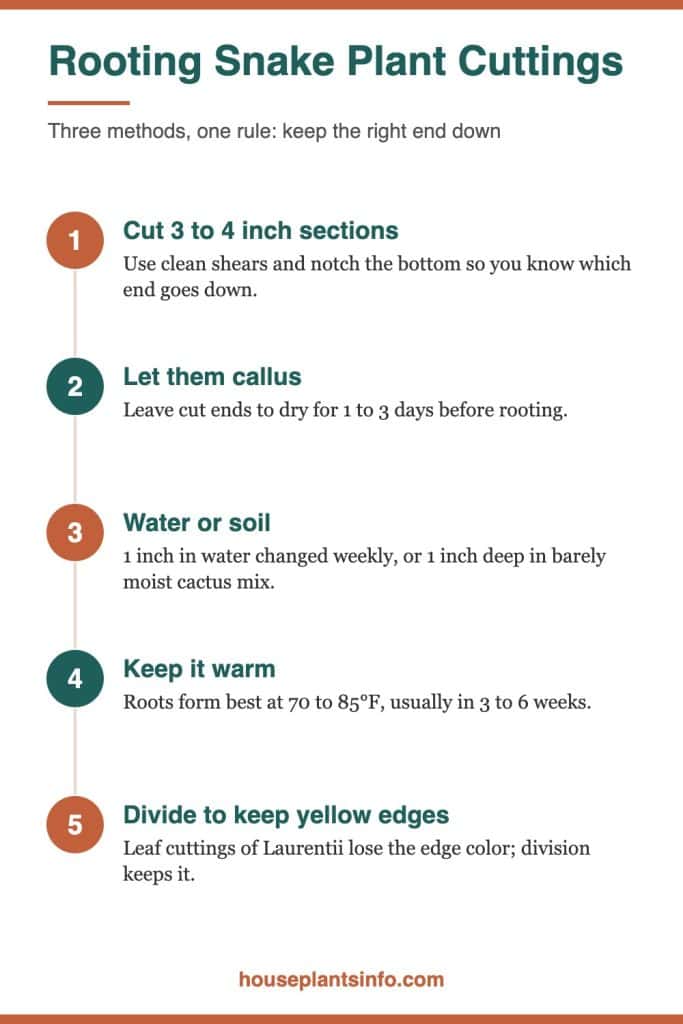
The short version: Cut a healthy leaf into 3 to 4 inch sections, keep track of which end was down, and let the cut ends callus for 1 to 3 days.
Then root them with the bottom inch in water or in slightly moist cactus mix, somewhere bright and between 70 and 85°F.
Roots usually show up in 3 to 6 weeks, and new pups often take 2 to 3 months or longer.
This guide covers each propagation method, how to cut and root leaves, how to divide a plant, what to expect on timing, why cuttings fail, and how to pot up a rooted piece.
At a Glance
| Factor | What it needs |
|---|---|
| Light | Bright, indirect light, a few feet from an east or south window, or under a grow light |
| Water | Bottom 1 inch in water (changed weekly), or soil watered lightly only when dry |
| Temperature | 70 to 85°F for best rooting; avoid cold glass and drafty sills |
| Soil | Well-draining cactus or succulent mix |
| Pet safety | Toxic to cats and dogs (ASPCA) |
| Difficulty | Easy, but slow; patience matters more than skill |
What Are the Ways to Propagate a Snake Plant?
You can propagate a snake plant three ways: leaf cuttings in water, leaf cuttings in soil or cactus mix, and division of the rhizome. Division is the fastest and the only method that reliably keeps the new plant identical to the parent.
Leaf Cuttings in Water
This method lets you watch roots form, which takes the guesswork out of the process. You need a clean glass jar or vase and a spot with steady, bright, indirect light.
Water rooting is a good choice if you tend to overwater soil. The tradeoff is an extra step later, since water roots need time to adjust once you move them into a pot.
Leaf Cuttings in Soil
Here you plant the callused section straight into a pot of cactus or succulent mix. It skips the transition from water to soil, but you cannot see what is happening below the surface.
Soil rooting suits people who prefer to set up a pot and leave it alone. It does punish heavy watering, so it works best if you can hold back.
Division
Division means separating a section of the rhizome, the thick underground stem, along with its leaves and roots. You get a mature-looking plant on day one instead of waiting months for pups.
For any of these methods, the basic tools are sharp, clean pruning shears or a clean knife, plus a bag of cactus or succulent potting mix. A small pot with a drainage hole rounds out the kit.
How to Take a Leaf Cutting the Right Way
Choose a firm, healthy leaf, cut it at the base with clean shears, then slice it into 3 to 4 inch sections. Mark which end of each section was closest to the soil, because a section planted upside down will not root.
Pick the Right Leaf
Look for a leaf that is upright, evenly colored, and firm to the touch. Avoid leaves that are wrinkled, soft, yellowing, or scarred, since a stressed leaf has less stored energy to put into roots.
If your plant has soft or mushy leaves, check whether watering is the problem first. This guide on overwatered vs underwatered snake plant can help you sort out the signs before you take cuttings.
Mature outer leaves are usually the best candidates. Taking one from the edge of the pot also keeps the plant looking balanced.
Make the Cuts
Wipe your shears or knife with rubbing alcohol before you start. Cut the leaf as close to the soil line as you can, so you do not leave a stub behind.
Lay the leaf flat on a clean surface. Cut it crosswise into sections about 3 to 4 inches long, keeping each section in order so you know which end was down.
If you are also tidying up the parent plant, the same cuts work as maintenance. Read more about trimming a snake plant if you want to shape it at the same time.
Mark the Bottom End
The bottom of each section is the end that faced the roots. Roots only grow from that end, so orientation matters.
There are two easy ways to keep track. Cut a shallow V notch into the bottom edge, or draw a small dot on the bottom with a marker.
Sophia’s tip: Lay each section on a paper towel with an arrow drawn pointing down before you walk away. Callusing takes a few days, and similar-looking pieces are easy to mix up.
Let the Ends Callus
Leave the cut sections in a dry spot out of direct sun for 1 to 3 days. The cut ends will seal over and feel dry rather than wet.
This callus helps protect the cutting from rot once it goes into water or soil. Skip the windowsill above a radiator, since hot, dry air can shrivel thin sections.
Rooting Snake Plant Cuttings in Water
Stand each callused section upright with about 1 inch of the bottom in water, place it in bright, indirect light, and change the water weekly. Roots usually appear in about 3 to 6 weeks.
Set Up the Jar
Use a clean glass jar narrow enough to hold the sections upright. You can fit several pieces in one jar if they are not crammed together.

Fill it with room-temperature tap water to a depth that covers only the bottom inch. More water than that leaves too much leaf tissue submerged, which raises the risk of rot.
Choose the Spot
Bright, indirect light is ideal. A few feet back from an east or south window works well, or right beside a north window.
Keep the jar away from cold glass in winter and from AC vents in summer. A spot near forced-air heat can work for warmth, but not directly in the airflow, which dries and stresses the leaf.
If your apartment is dim, a grow light placed about 12 inches above the jars gives steady light. Many growers run one for around 12 hours a day.
Keep the Water Fresh
Change the water once a week. Rinse the jar, check the cut end, and refill to the same 1 inch level.
Fresh water carries more oxygen and keeps bacteria from building up. Cloudy or smelly water is a sign you need to change it more often.
Know When to Move It
Move the cutting to soil when the roots are 1 to 2 inches long. Waiting much longer can make the shift harder, because water roots are more fragile and adapted to constant moisture.
You may also see a small pup forming at the base while it is still in water. That is a good sign, but you do not need to wait for one before potting up.
Rooting Cuttings Directly in Soil
Push the bottom 1 inch of each callused section into slightly moist cactus mix, then water lightly only when the mix dries out. Give it the same bright, warm spot you would give a water cutting.
Prepare the Pot
Use a small pot with a drainage hole. A 4 inch pot holds one to three sections without leaving a large volume of soil that stays wet.
Fill it with cactus or succulent mix. Choosing the right potting soil matters here, because dense, peaty mixes hold water against the cut end for too long.
Moisten the mix lightly before planting. It should feel barely damp, like a wrung-out sponge, not wet.
Plant the Sections
Push each section about 1 inch deep, bottom end down. Firm the mix around it so it stands upright without wobbling.
If a section leans, prop it against the pot rim or a small stake. Movement can break tender new roots.
Water Sparingly
Water lightly only when the top inch or so of mix is dry. During cool months, that might mean waiting a week or two between waterings.
Unrooted cuttings cannot take up much water. Extra moisture just sits around the cut end, which is how most soil cuttings rot.
Sophia’s tip: Water with a squeeze bottle or measuring cup around the edge of the pot, not over the cutting. Pour just enough to dampen the mix, then let it drain fully.
Check Progress Gently
After about 4 weeks, tug very lightly on a section. Slight resistance means roots are forming.
Avoid pulling cuttings up to look. Each disturbance can tear new roots and set the clock back.
Dividing a Snake Plant for Faster Results
Division is the fastest way to get a new snake plant, and it keeps the plant identical to the parent. You separate a clump of leaves with its own rhizome and roots, then pot it on its own.
When to Divide
Divide when the plant is crowded, roots are pushing against the pot, or pups have formed around the main clump. Spring and summer are the easiest seasons, since warmth helps the plant settle.
Water the plant a day or two before dividing. Slightly moist roots slip apart more easily than bone-dry ones.
How to Divide
Slide the plant out of its pot and brush away loose soil. Look for natural breaks where a pup or clump connects to the main rhizome.
Pull the sections apart by hand where you can. Where they will not separate, cut through the rhizome with a clean knife, making sure each piece keeps at least a few leaves and healthy roots.
Let any large cut on the rhizome dry for a day before potting. Then plant each division in cactus mix at the same depth it grew before.
Why Division Keeps Variegation
Variegated types, such as Laurentii with its yellow edges, usually lose that edge color when grown from leaf cuttings. New pups from a leaf section often come up plain green.
Division moves part of the original plant, so the yellow edges stay. If keeping the variegation matters to you, I recommend dividing instead of cutting.
How Long Until Roots and New Pups?
Roots usually appear in about 3 to 6 weeks, and new pups often take 2 to 3 months or longer. Temperature and light set the pace more than anything else.
Typical Timeline
| Stage | Typical timing |
|---|---|
| Callusing | 1 to 3 days |
| First roots (water) | About 3 to 6 weeks |
| Roots ready for soil | When 1 to 2 inches long |
| First pup | Often 2 to 3 months or longer |
| Division settling in | A few weeks, with new growth often sooner than from cuttings |
What Speeds It Up
Rooting is best at 70 to 85°F. Warm room air with bright, indirect light gives cuttings the best shot at steady progress.
A grow light helps in dim apartments and during short winter days. A heat mat under the jar or pot can also help in a cool room, as long as the soil does not stay soggy.

For established plants, the same conditions apply. This guide on how to make a snake plant grow faster covers light and warmth in more detail.
What Slows It Down
A cold windowsill in winter slows rooting a lot. Glass can drop well below room temperature at night, even when the rest of the room feels comfortable.
Low light slows things too. A cutting tucked in a dark corner may sit unchanged for months.
If a rooted cutting or mature plant seems stuck, see this article on a snake plant not growing for common causes.
Why Cuttings Rot or Fail to Root
Most failed snake plant cuttings rot from soggy soil, sit somewhere too cold or too dark, or were planted upside down. Each cause has a straightforward fix.
Rot From Too Much Water
A rotting cutting turns soft, mushy, or translucent at the base, and may smell sour. In soil, this almost always means the mix stayed wet too long.
Cut above the rotted part with clean shears, keeping track of the bottom end. Let it callus again for 1 to 3 days, then replant in fresh, barely moist cactus mix.
In water, rot often starts when the water level is too high or not changed often enough. Keep it to 1 inch and refresh it weekly.
Too Cold
Cuttings near cold glass, an open window, or an AC vent may sit for weeks without change. They are not dead, just stalled.
Move them to a spot that stays between 70 and 85°F. Pulling jars a foot or two back from winter windows often makes a real difference.
Too Dark
Without enough light, a cutting cannot produce the energy it needs for roots. Progress stalls, and the leaf may slowly fade.
Shift it closer to a bright window or set it under a grow light. Bright, indirect light is the goal, not harsh afternoon sun through south glass.
Planted Upside Down
A section planted with its top end down will never root, no matter how good the conditions are. It may stay firm for months, which makes this problem easy to miss.
If you are unsure which end was which, look for subtle growth lines or leaf tapering. When in doubt, take a fresh cutting and mark it.
Sophia’s tip: If a soil cutting shows no resistance after 8 weeks in warm, bright conditions, gently lift it and look at the base. A clean, dry, rootless end often points to orientation, not watering.
Moving a Rooted Cutting Into Its Own Pot
Once water roots reach 1 to 2 inches, or a soil cutting resists a gentle tug and shows new growth, move it into a small pot of cactus mix. Then water lightly and keep it bright and warm while it adjusts.
Potting Up a Water Cutting
Fill a small pot with drainage holes with cactus or succulent mix. Make a hole about 1 inch deep, set the cutting in, and firm the mix around the roots.
Water lightly right after planting. For the first couple of weeks, keep the mix a little more evenly moist than you would for a mature plant, since water roots need time to adapt.
After that, return to normal snake plant watering. Let the mix dry before watering again.
Separating a Soil Cutting
If several sections share one pot, wait until each has rooted and ideally produced a pup. Then tip the pot out and gently tease them apart.
Plant each in its own small pot of cactus mix. Keep the pots in bright, indirect light, away from cold drafts and direct heater airflow.
Ongoing Care
Choose a pot only slightly larger than the root mass. Snake plants are happy a bit snug, and a big pot holds extra water.
The original leaf section usually stays as it is and does not grow taller. New growth comes from pups at the base, which become the actual plant over time.
Snake plants are toxic to cats and dogs according to the ASPCA. Keep jars of cuttings and new pots on a high shelf or in a room pets and young kids cannot reach.
If you enjoy this process, there are many other houseplants that grow from cuttings you can try with the same basic tools.
Your Next Steps
- Pick one firm, healthy outer leaf and clean your shears with rubbing alcohol.
- Cut it into 3 to 4 inch sections and mark each bottom end with a V notch or marker dot.
- Let the sections callus for 1 to 3 days in a dry spot away from radiators.
- Set them in 1 inch of water or 1 inch deep in barely moist cactus mix, in bright, indirect light at 70 to 85°F.
- Divide the plant instead if you have a variegated Laurentii and want to keep the yellow edges.
- Put your cuttings out of reach of cats, dogs, and young kids.
Common Questions About Snake Plant Cuttings
Is Water or Soil Better for Snake Plant Cuttings?
Both work well, so the best choice depends on your habits. Water lets you see roots and suits people who tend to overwater, while soil skips the transition step and suits people who can water sparingly.
Can I Put the Whole Leaf in Water Instead of Cutting It Into Sections?
Yes, a whole leaf can root if you place the bottom end in about 1 inch of water. Cutting it into 3 to 4 inch sections gives you more potential plants from a single leaf, but each piece must stay right-side up.
Why Did My Laurentii Cutting Grow Plain Green Pups?
Variegated types like Laurentii usually lose their yellow edges when grown from leaf cuttings. To keep the variegation, divide the rhizome instead, since division moves part of the original plant.
Do Snake Plant Cuttings Need Rooting Hormone?
Rooting hormone is optional, and snake plant cuttings root without it in good conditions. Warmth between 70 and 85°F, bright indirect light, and careful watering matter far more.
Can I Root Cuttings in Winter?
You can, but rooting is often slower in winter, especially on a cold windowsill. Move cuttings back from the glass, keep them warm, and add a grow light if your days are short and gray.

Hi! I’m Sophia, and I love plants – especially an expert in growing house plants. I stay in Chicago, United States of America, and through my blog and social media platforms, provide tips and tricks on how to grow healthy, vibrant plants indoors. Check out more here.