
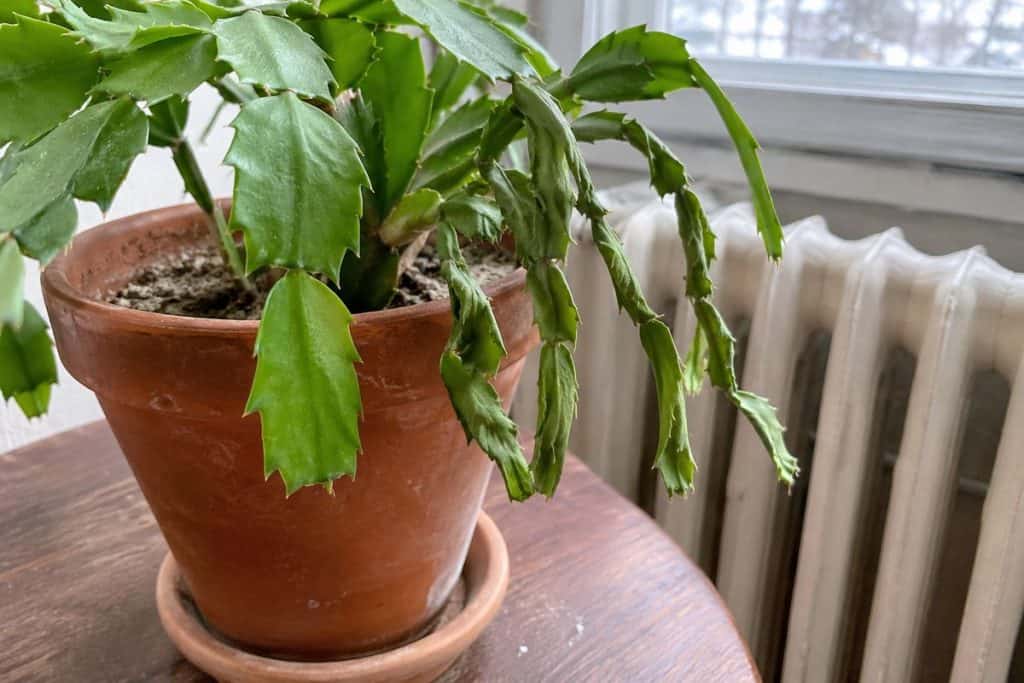
Curling on a Christmas cactus shows up as flat segments cupping inward along their length, often on several stems at once, and sometimes with a slight wrinkle or a dull look.
Most likely cause: the segments are short of water, either because the soil has been dry too long or because damaged roots can’t drink.
The segments are where this plant stores water, so they flatten when full and cup inward as they empty. Push a finger 1 inch into the soil. Bone dry means thirst. Wet, with soft segments, means the roots are the problem. Damp but fine soil sends you to the heat, light and pest causes below.
| What you see | Likely cause | Jump to |
|---|---|---|
| Curled, thin segments; dry soil pulling from the pot | Too dry | Cause 1 |
| Curled and soft or limp; soil wet for days | Root rot | Cause 2 |
| Sudden curling near a radiator, vent or cold window | Temperature stress | Cause 3 |
| Curling with red tint or crispy edges on the sunny side | Too much sun | Cause 4 |
| Twisted, distorted new growth; speckles or cotton | Pests | Cause 5 |
| Slow curling; roots packed or soil rock-hard | Root-bound or compacted mix | Cause 6 |
| Mild curling in winter with the heat on | Dry indoor air | Cause 7 |
How curling differs from its cousins: wrinkled segments have fine creases and are a later stage of thirst, covered in why a Christmas cactus looks wrinkled. Limp segments hang down and point more to roots, as in why Christmas cactus leaves go limp.
Cause 1: The Soil Stayed Dry Too Long
How to confirm: the mix is dry an inch down, the pot feels light when you lift it, and the soil has shrunk away from the sides. Water runs straight through and out the bottom without soaking in.
The fix: dry, peat-heavy mix repels water, so a normal watering just runs down the gap. Set the pot in a bowl of room-temperature water for 20 to 30 minutes until the surface darkens, then let it drain fully. After that, water whenever the top inch is dry. Near a radiator that may be about weekly, but let the soil decide; a moisture meter takes the guessing out of it.

How long recovery takes: curled segments flatten within 3 to 7 days. If they don’t flatten after a week of moist soil, the roots are damaged; go to Cause 2. Our guide on how often to water a Christmas cactus has a seasonal chart.
Cause 2: Root Rot From Too Much Water
How to confirm: the segments curl but also feel soft, the soil is wet 3 or more days after watering, and it may smell sour. The plant curls for the same reason as a thirsty one, because dead roots can’t move water. The root check and rescue steps are covered in depth in why Christmas cactus leaves go soft.
The fix: stop watering, cut away rotted roots, and repot into fresh, fast-draining mix in a pot that only just fits the root ball. Step-by-step help is in overwatered Christmas cactus care. If the stem is soft where it meets the soil, root 3 or 4 firm segments from the tips instead.
How long recovery takes: 3 to 6 weeks for new roots; curled segments may stay curled and drop, while new ones come in flat.
Sophia’s tip: never water a curled plant just because it looks thirsty. Check the soil first. Watering a plant that’s curling from rot is the fastest way to lose it.
Cause 3: Heat, Cold and Sudden Swings
How to confirm: a digital hygrometer with a built-in thermometer, left beside the pot for a day, shows both the temperature swings and how dry the air gets. The curling usually appeared within a few days of a change: the heat coming on in October, a move next to a radiator or vent, a night against cold window glass, or a window air conditioner blowing on it in summer.

The fix: keep it at 65 to 75°F by day and no colder than 55°F at night, at least 3 feet from radiators and heat vents, and 6 inches back from the glass on winter nights. Below 50°F it starts to suffer, and above 90°F growth stops. Once it’s in a steady spot, leave it there; repeated moves add stress.
How long recovery takes: 1 to 2 weeks once the plant is stable and watered properly. Cold-damaged segments that turned soft won’t recover.
Cause 4: Light That’s Too Strong or Too Weak
How to confirm: too much sun shows as curling on the side facing the window, often with a red or purple tint and crispy edges, after a hot sunny week. Too little light shows as thin, pale segments that curl and stretch, far from any window.
The fix: give it bright light without hot afternoon sun; morning light is the safest bet. A dim plant needs a brighter spot or a small grow light 12 inches above it.
How long recovery takes: 2 to 4 weeks for new growth to come in flat. Scorched segments stay marked.
Cause 5: Pests Feeding on the Segments
How to confirm: curling from pests is uneven and often twists the newest growth and buds. Use a flashlight on the joints and undersides. Fine pale speckles and faint webbing mean spider mites; white cotton means mealybugs; silvery streaks with black dots mean thrips.
The fix: start with a lukewarm shower to knock off mites, pick off mealybugs with an alcohol-dampened swab, and then coat every surface with insecticidal soap, repeating each week while you still find live insects. Keep it away from your other plants until you see nothing new for 2 weeks. More on the cottony kind in can a Christmas cactus get mealybugs.
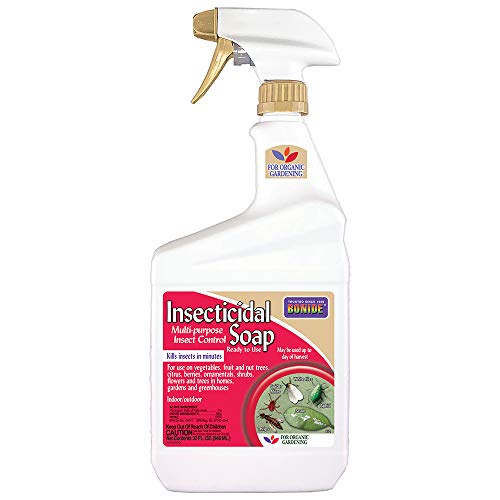
How long recovery takes: 3 to 4 weeks to clear; twisted segments stay twisted, and new ones grow normally.
Cause 6: Root-Bound Pot or Rock-Hard Mix
How to confirm: the plant has been in the same pot for 3 years or more, roots poke out of the drainage hole, and the mix has turned dense and hard. Water sits on top or runs down the sides without wetting the middle. White crust on the soil means salts from tap water and fertilizer are building up, which also makes roots struggle.
The fix: in spring, after flowering, move it into a pot just 1 to 2 inches wider with fresh, fast-draining mix, and loosen circling roots gently. This plant likes a snug pot, so don’t jump several sizes. Timing is covered in when to transplant a Christmas cactus. Between repots, an occasional long soak in the sink washes out built-up salts.
How long recovery takes: 4 to 8 weeks.
Cause 7: Dry Winter Air
How to confirm: mild curling in December to February, with the heat running, and nothing else wrong. Indoor air in a heated apartment often drops to 20 to 30 percent humidity, while this forest cactus does best at 40 to 60 percent. A digital hygrometer next to the plant tells you where you are.
The fix: group it with other plants, set it on a tray of pebbles with water below the pot base, or run a cool-mist humidifier in the room. Misting does little; the moisture is gone in minutes.
How long recovery takes: 1 to 2 weeks once humidity is back above 40 percent.
Stopping It From Coming Back
Most curling comes back for the same reason it started, so the habit that matters is feeling the soil an inch down before you water, every time.
Soak a pot that has shrunk away from its sides instead of pouring water over it, keep the plant clear of radiators and winter glass, and find it one bright spot to stay in. Christmas cactus is non-toxic to cats and dogs according to the ASPCA, so a curious pet nosing the pot is not a worry.

Founder & Lead Writer · 9 years growing houseplants · Chicago, IL
I’m Sophia, founder of HousePlantsInfo.com. I’ve grown plants for as long as I can remember and have spent the last 9 years focused on houseplants, now caring for 75+ of them, from easy snake plants and philodendrons to fussier fiddle leaf figs and calatheas. Every guide here is based on what I’ve grown, lost and brought back in a real apartment through dark, radiator-dry Chicago winters. I trained through Houseplant Masterclass, and I check care and pet-safety details against university extension services and the ASPCA before publishing.