
Your Christmas cactus sits on the windowsill with its last faded blooms, roots poking out of the drainage hole and the soil drying faster than it used to.
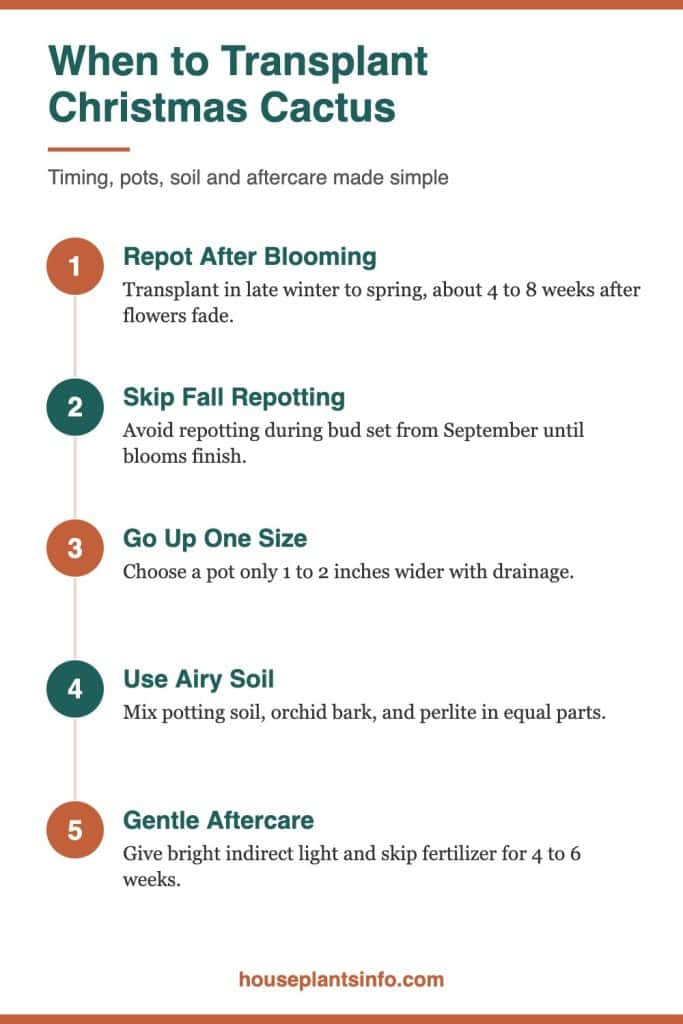
The short version: The best time for when to transplant Christmas cactus is in late winter to spring, roughly 4 to 8 weeks after it finishes blooming.
Repot every 2 to 3 years, move up only 1 to 2 inches in pot size, and never repot while buds are forming in fall.
This guide covers timing, warning signs, pot and soil choices, a step-by-step transplant method, aftercare, and how to fix transplant stress.
At a Glance
| Factor | What it needs |
|---|---|
| Best timing | Late winter to spring, after flowering ends |
| Frequency | Every 2 to 3 years; it likes being slightly snug |
| Soil | Fast-draining mix with bark and perlite, pH about 5.5 to 6.5 |
| Light | Bright, indirect light; avoid direct sun for 1 to 2 weeks after repotting |
| Water | Water when the top 1 inch of soil is dry |
| Temperature | 60 to 75°F, away from radiators and cold drafts |
| Pet safety | Non-toxic to cats and dogs per the ASPCA |
When to Transplant Christmas Cactus for the Best Results
Transplant in late winter or spring, once the plant has finished flowering and rested for a few weeks. This window lines up with the start of active growth, so new roots form quickly in fresh soil.
Why After Flowering Works Best
Christmas cactus blooms from late fall into winter, then slows down for a short rest. Once you see small, bright green new segments appearing at the stem tips, the plant is ready to grow roots too.
For most indoor plants, that means February through April. If your plant blooms late or reblooms in spring, wait until those flowers drop. You can read more about the rest period in this guide on what to do with Christmas cactus after flowering.
Times to Avoid
Avoid repotting from about September through the end of bloom. During this period, the plant is setting buds in response to longer nights and cooler temperatures, and disturbance often makes it drop them.
Midsummer repotting is possible but less ideal. Apartment heat, AC drafts, and strong afternoon sun add stress while roots are recovering.
How to Tell the Plant Is Ready
Check the soil before you plan the move.
A soil moisture meter pushed into the root zone helps you see whether the mix is staying soggy, which can signal broken-down soil, or drying out in a day or two, which suggests the pot is packed with roots.

If you grow under a grow light in a dim Chicago winter, new growth may start a little earlier. Use the new segments as your cue rather than the calendar alone.
Sophia’s tip: Mark the date blooms finish on a sticky note on the pot. Count 4 to 8 weeks forward, and plan your repotting for that window.
Signs Your Christmas Cactus Needs a New Pot
A Christmas cactus needs a new pot when roots fill the container, water runs straight through, or the soil has broken down into a dense, sour mix. Size alone is not a reason, since this plant blooms best when slightly root-bound.

Root and Pot Clues
- Roots growing out of the drainage hole or circling on the soil surface.
- The root ball lifts out in one solid block shaped like the pot.
- The plant is top-heavy and tips over easily.
- The plastic pot bulges or a clay pot has cracked.
Soil and Watering Clues
- Water rushes through in seconds without soaking in.
- Soil dries within 1 to 2 days even in cool weather.
- The mix stays wet for more than a week and smells musty.
- A white crust of mineral salts covers the soil or pot rim.
Growth Clues
A plant that has stopped producing new segments in spring, despite good light and regular feeding, may have run out of root space. Pale, thin growth can also point to exhausted soil.
If you see only one mild sign, such as a few roots at the drainage hole, it can usually wait another season. Several signs together mean it is time.
How Often Should You Repot a Christmas Cactus?
Repot a mature Christmas cactus every 2 to 3 years, and young or fast-growing plants every 1 to 2 years. Older, very large plants can go 3 to 4 years with a fresh top layer of soil in between.
Why It Prefers a Snug Pot
Christmas cactus is an epiphyte. In its native habitat, it grows in tree crevices and on rocks with small pockets of loose, organic debris around its roots.
In a pot, that translates to a preference for limited space. A slightly crowded root system tends to encourage flowering, while an oversized pot holds extra moisture and invites root rot.
Refreshing Without Repotting
If the plant is healthy but the soil looks tired, you can top-dress instead. Scrape away the top 1 inch of old mix and replace it with fresh potting blend.
You can also lift the plant, gently loosen the outer roots, add fresh soil, and return it to the same pot. This refreshes nutrients without changing pot size.
| Plant Situation | Repotting Interval |
|---|---|
| Young plant or rooted cutting | Every 1 to 2 years |
| Established mature plant | Every 2 to 3 years |
| Large, older plant | Every 3 to 4 years, top-dress in between |
| Soil broken down or rotting | As soon as the plant stops blooming |
What Size and Type of Pot Works Best?
Choose a pot only 1 to 2 inches wider than the current one, with at least one drainage hole. Shallow to medium-depth pots suit the plant’s fine, spreading roots better than deep ones.
Getting the Size Right
A small step up keeps the soil-to-root ratio balanced. Too much extra soil stays wet after watering, which is a common cause of soft, limp segments and rot.
For a plant in a 4-inch pot, move to a 5- or 6-inch pot. For a 6-inch pot, go to 7 or 8 inches.
Choosing a Material
- Terracotta: Porous clay breathes and dries faster. Good if you tend to overwater or keep the plant in a cool room.
- Plastic: Holds moisture longer. Useful near a radiator or forced-air vent where soil dries quickly.
- Glazed ceramic: Attractive and heavier, so it resists tipping. Make sure it has a real drainage hole.
The lead-in labels above are styled as plain text in most layouts, so focus on the material that matches your room’s conditions.
Decorative Cachepots
If you love a pot without drainage, use it as a cover. Keep the plant in a plastic nursery pot inside it, and empty any water that collects at the bottom after each watering.
Sophia’s tip: Set a cachepot on a few small pebbles or a plastic riser inside, so the inner pot never sits in drained water.
What Soil Mix Does a Christmas Cactus Need?
Christmas cactus needs a light, airy, fast-draining mix that holds some moisture. It is a tropical forest cactus, so pure desert cactus soil is usually too lean and gritty on its own.
A Simple Homemade Blend
A reliable starting recipe uses three parts:
- 1 part regular indoor potting mix
- 1 part orchid bark or fine bark chips
- 1 part perlite or pumice
This gives structure from the bark, drainage from the perlite, and moisture retention from the potting mix. Roots get both air and water.
Adjusting for Your Space
In a dry apartment with forced-air heat, add a little extra potting mix or a handful of coco coir to hold moisture longer. In a cool, humid room or a bathroom window, add more perlite or bark.
Christmas cactus prefers slightly acidic soil, around pH 5.5 to 6.5. Most bark-based mixes naturally sit in this range.
Soils to Avoid
- Garden soil, which compacts and may carry pests.
- Heavy moisture-retaining mixes with wetting agents, used alone.
- Straight sand-heavy desert cactus mix with no organic matter.
| Ingredient | Role in the Mix |
|---|---|
| Indoor potting mix | Holds moisture and nutrients |
| Orchid bark | Creates air pockets like a tree crevice |
| Perlite or pumice | Speeds drainage and prevents compaction |
| Coco coir (optional) | Adds moisture retention in dry rooms |
How to Transplant a Christmas Cactus Step by Step
To transplant, water a day ahead, ease the plant out, loosen and inspect the roots, then set it at the same depth in fresh mix. The whole process takes about 15 to 20 minutes.
Before You Start
Water the plant lightly 1 to 2 days before repotting. Slightly moist roots slide out more easily and handle disturbance better than bone-dry or soggy ones.
Gather your new pot, fresh soil mix, clean scissors or pruners, and newspaper or a tray. Wipe blades with rubbing alcohol to avoid spreading disease.
The Repotting Process
- Add a layer of fresh mix to the new pot so the top of the root ball will sit about 1 inch below the rim.
- Turn the old pot on its side, support the base of the stems, and slide the plant out. Squeeze plastic pots or run a butter knife around clay ones if it sticks.
- Gently loosen the outer roots with your fingers, shaking off old, crumbly soil.
- Inspect the roots. Healthy roots are firm and white to tan. Trim any that are black, mushy, or smell rotten.
- Set the plant in the new pot at the same depth it grew before. Burying stem segments invites rot.
- Fill around the sides with fresh mix, tapping the pot to settle it. Press lightly, but do not pack it down.
Handling Root Rot During Repotting
If more than a third of the roots are mushy, remove all old soil and cut away damaged roots. Let the plant sit out of soil for a few hours so cuts can callus.
Then pot it into a smaller container with very airy mix. If roots are nearly gone, take healthy stem cuttings of 2 to 3 segments as backup, since they root easily in moist mix.
Watering After Potting
Opinions vary, but I prefer waiting 2 to 5 days before watering if you trimmed roots. This lets cuts heal. If roots were healthy and undisturbed, a light watering right away is fine.
How Should You Care for It After Transplanting?
After transplanting, keep the plant in bright, indirect light, water lightly, and skip fertilizer for about 4 to 6 weeks. Most plants settle in within 2 to 4 weeks.
Light and Placement
Place it 2 to 4 feet from an east-facing window, or set back from a south or west window behind a sheer curtain. Avoid direct afternoon sun while roots recover.
Keep it away from radiators, forced-air vents, and AC drafts. Steady temperatures between 60 and 75°F help new roots form.
Watering Rhythm
Water when the top 1 inch of soil feels dry. In spring, that often means every 7 to 14 days, depending on pot size, light, and how dry your apartment air is.
Water thoroughly until it drains, then empty the saucer within 15 minutes. Fresh, airy soil drains well, but soggy saucers still cause rot.
Humidity
Christmas cactus enjoys moderate humidity, around 40 to 60 percent. Winter heating in a city apartment can drop indoor air far below that.
A small humidifier nearby or a pebble tray under the pot helps. Grouping plants together also raises humidity slightly.
Feeding
Fresh mix contains enough nutrients for the first several weeks. Resume a balanced, diluted houseplant fertilizer once you see steady new growth. This guide explains when to fertilize Christmas cactus through the year.
Sophia’s tip: Turn the pot a quarter turn each time you water after repotting, so new growth fills in evenly instead of leaning toward the window.
Transplant Shock Symptoms and How to Fix Them
Mild transplant shock is normal and usually shows as slight drooping, a few dropped segments, or color changes for 1 to 3 weeks. Most cases fix themselves with stable light, careful watering, and patience.
Limp or Wrinkled Segments
Some limpness right after repotting is common because damaged roots take up less water. If it lasts beyond 2 to 3 weeks, check the soil.
Wet soil plus soft segments suggests rot, while dry soil points to underwatering. This article on Christmas cactus leaves soft walks through each cause.
Red, Purple, or Pink Tints
Stress from root disturbance, bright sun, or cold often turns segments reddish or purple. Move the plant to softer light and keep it warm.
If you are wondering why are Christmas cactus leaves turning red, the causes overlap with transplant stress. A lighter blush often signals the same issue; see this guide on Christmas cactus leaves turning pink.
Dropped Segments or Buds
A few dropped segments are normal after handling. Heavy drop usually means the plant was moved during bud set, sits near a draft, or is overwatered.
Keep the plant in one spot and avoid moving it again. Healthy fallen segments can be rooted in moist mix as new plants.
| Symptom | Likely Cause | Fix |
|---|---|---|
| Drooping for a week | Normal root adjustment | Bright indirect light, wait |
| Soft, mushy base | Overwatering or rot | Let soil dry, check roots |
| Wrinkled, thin segments | Underwatering | Water thoroughly |
| Reddish or purple tint | Sun, cold, or root stress | Move to softer, warmer light |
| Bud drop | Repotted during bud set | Leave it alone until next season |
Pet Safety
Christmas cactus is listed as non-toxic to cats and dogs by the ASPCA. Chewing may still cause mild stomach upset, so keep fresh potting mix and perlite away from curious pets and kids.
Your Next Steps
- Note when your plant finishes blooming and plan repotting 4 to 8 weeks later.
- Check for roots at the drainage hole and how fast the soil dries.
- Pick a pot only 1 to 2 inches wider, with a drainage hole.
- Mix potting soil, orchid bark, and perlite in equal parts.
- Place the repotted plant in bright, indirect light away from heat vents.
- Wait 4 to 6 weeks before resuming fertilizer.
Common Questions About When to Transplant Christmas Cactus
Can I transplant a Christmas cactus while it is blooming?
It is best to wait, since repotting during bloom often causes flowers and buds to drop. If the plant is sitting in rotting soil, an emergency repot is still worth it. Otherwise, let the blooms finish first.
Do Christmas cactus like to be root-bound?
Yes, they prefer being slightly snug in their pots. A mildly crowded root system tends to encourage flowering. Only repot when roots clearly fill the container or soil has broken down.
Should I water a Christmas cactus right after repotting?
If roots were healthy and undisturbed, a light watering right away is fine. If you trimmed roots, wait 2 to 5 days so the cuts can heal. Then return to watering when the top inch of soil is dry.
Can I use regular cactus soil for a Christmas cactus?
Plain desert cactus mix is usually too gritty and drains too fast on its own. Blend it with regular potting mix and orchid bark for better moisture balance. A bark and perlite blend mimics the plant’s natural growing conditions.
How long does a Christmas cactus take to recover from transplanting?
Most plants settle in within 2 to 4 weeks. You will know it has recovered when segments firm up and new growth appears at the tips. Stable light and careful watering speed the process.

Hi! I’m Sophia, and I love plants – especially an expert in growing house plants. I stay in Chicago, United States of America, and through my blog and social media platforms, provide tips and tricks on how to grow healthy, vibrant plants indoors. Check out more here.