
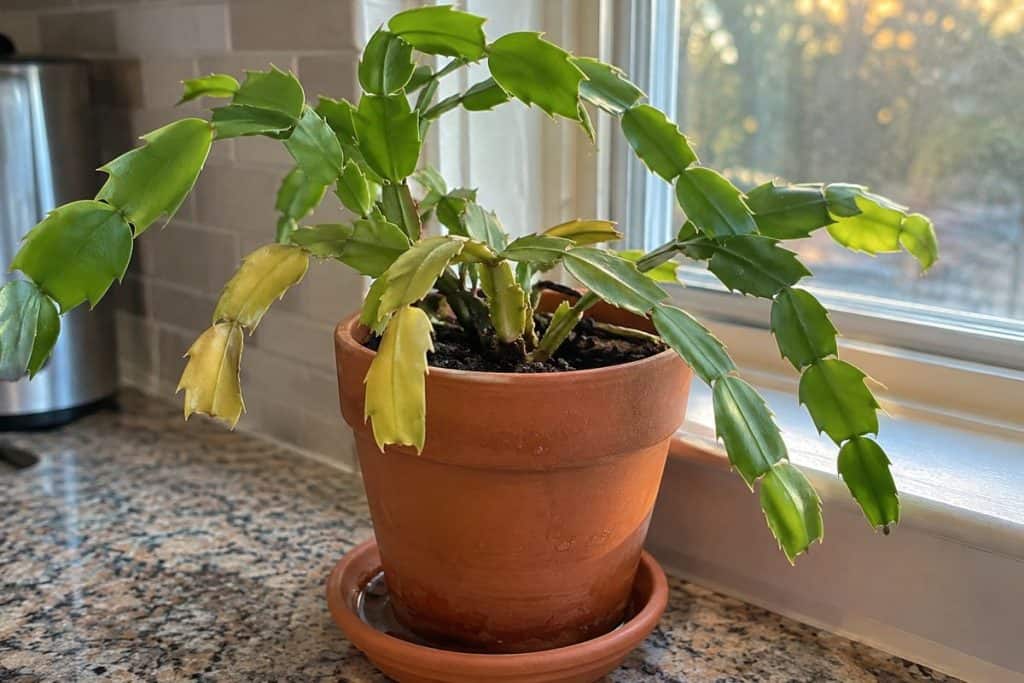
Yellow segments on a Christmas cactus usually show up on the older growth near the soil first, and whether they feel soft, thin or firm tells you what went wrong.
Most likely cause: soil that stays wet for days, which damages the roots so the segments can’t take up water or nutrients.
Squeeze a yellow segment gently between two fingers. Soft and mushy points to too much water and rot. Thin, limp and wrinkled points to thirst. Firm but pale or washed out points to light, food or roots that have run out of room.
| What you see | Likely cause | Jump to |
|---|---|---|
| Yellow, soft segments at the base; soil wet for days | Too much water, root rot | Cause 1 |
| Bleached, pale yellow on the window side, sometimes red edges | Too much direct sun | Cause 2 |
| Even, pale yellow on older segments of an unfed plant | Hunger or low magnesium | Cause 3 |
| Yellow, wrinkled, thin segments; soil pulling from the pot | Too dry for too long | Cause 4 |
| Slow yellowing, roots out of the drainage hole, white crust | Root-bound or old, salty mix | Cause 5 |
| Yellow patches with cotton, bumps, speckles or sticky residue | Pests | Cause 6 |
| Pale, thin, stretched new growth far from a window | Not enough light | Cause 7 |
| Sudden yellowing after a cold night or near a heater | Temperature stress | Cause 8 |
Cause 1: Too Much Water and Root Rot
How to confirm: the yellow starts at the base and the segments feel soft. The soil is still damp 3 or 4 days after watering, or water sits in the saucer. Tip the plant out and look at the roots: firm and pale is good, while dark, slimy roots that smell sour are rotting. A plant that wilts while its soil is wet has root damage.
The fix: stop watering and let the top 2 inches dry. If some roots are rotten, cut them back to firm tissue with clean scissors, shake off the old wet mix, and repot into fresh, fast-draining mix in a pot with a drainage hole. Remove soft yellow segments at a joint.
From then on, water only when the top inch is dry. A moisture meter is worth it in winter, because forced-air heat dries the surface while the bottom of the pot stays soggy.

How long recovery takes: 3 to 6 weeks for new roots; new green segments usually by spring.
If more than half the roots are mush, root a few firm segments instead. The full rescue is in overwatered Christmas cactus care, and the right rhythm by season is in how often to water a Christmas cactus.
Cause 2: Too Much Direct Sun
How to confirm: the yellow looks washed out or bleached, it’s worst on the side facing the window, and it appeared after a sunny week or a move to a brighter spot. A red or purple cast around the yellow means the light is still too strong; see why Christmas cactus leaves turn red.
The fix: move it to bright, indirect light, such as a spot that gets only morning sun, or filtered light through a sheer curtain on a sunnier window. If it summers outdoors, keep it in full shade under a porch roof.
How long recovery takes: mildly pale segments green up in 2 to 4 weeks. Bleached, tan patches stay.
Cause 3: A Hungry Plant or Low Magnesium
How to confirm: the yellowing is even and pale rather than patchy, it’s worst on the older segments, and the plant hasn’t been fed in a year or more. Plants still in the dense store mix they came in, or in the same pot for 3 years or longer, are the usual cases.
The fix: feed once a month at half strength from April through August with a balanced houseplant food or a liquid cactus fertilizer, then stop by September so the plant can set buds. Holiday cacti are often said to need more magnesium than most houseplants, and a common remedy is 1 teaspoon of Epsom salt in a gallon of water, given once a month in spring and summer, in a different week from the fertilizer.

Use that remedy with care. Too much magnesium can block calcium uptake, so skip it if your fertilizer already lists magnesium, never use it in fall or winter, and stop if you don’t see greener new growth within 2 months. See when to fertilize a Christmas cactus for a season-by-season schedule.
How long recovery takes: new segments come in green within 4 to 8 weeks of feeding; old pale segments improve only a little.
Sophia’s tip: don’t feed a yellow plant before ruling out wet soil. Fertilizer on rotting roots burns them further, so check Cause 1 first and feed only once the soil dries on a normal schedule.
Cause 4: Too Dry for Too Long
How to confirm: yellow segments that are also thin, limp and wrinkled. The soil is bone dry and has pulled away from the edge of the pot, and water runs straight down the gap and out the bottom. This is common next to radiators and heat vents in winter. Our post on why a Christmas cactus looks wrinkled covers the thirst side in detail.
The fix: set the pot in a bowl of room-temperature water for 20 to 30 minutes so the mix soaks up from the bottom, then let it drain. After that, water when the top inch is dry, which near a radiator may be about once a week; let a finger or a meter decide, not the calendar. Move it at least 3 feet from radiators and vents.
How long recovery takes: segments plump up in 3 to 7 days. If they don’t, the roots have died back; check them as in Cause 1.
Cause 5: Root-Bound or Tired Old Mix
How to confirm: the yellowing came on slowly over months. Roots poke out of the drainage hole or circle the bottom of the pot, water runs through without soaking in, and there’s a white crust on the soil or pot rim. That crust is salt from tap water and fertilizer, and hard water in much of the Midwest and Southwest builds it up fast.
The fix: a Christmas cactus likes a snug pot, so only repot every 2 to 3 years, in spring after flowering, into a pot 1 to 2 inches wider. Use a fast-draining blend, like cactus and succulent mix with a handful of orchid bark; the right soil for a Christmas cactus gives ratios.

Between repots, rinse out the salts a few times a year by pouring plain water through the pot until it runs clear. Hold off on fertilizer for a month after repotting.
How long recovery takes: 4 to 8 weeks for new growth. Timing details are in when to transplant a Christmas cactus.
Cause 6: Pests, Including Ones in the Soil
How to confirm: look in the joints between segments and on the undersides with a flashlight. White cotton means mealybugs. Small brown bumps that lift off with a fingernail are scale. Fine pale speckles with faint webbing mean spider mites. Sticky residue on the segments or the shelf below is honeydew from sap-feeding insects. If the plant yellows all over and nothing is visible above ground, check the roots for white, waxy patches: root mealybugs.
The fix: wipe off mealybugs and scale with rubbing alcohol on a cotton swab, then follow with insecticidal soap, sprayed weekly until a month passes with no new insects. For spider mites, rinse the plant in the shower first. Root mealybugs need the old soil washed off the roots and a clean pot with fresh mix. Keep the plant away from your others until it’s clean. More in can a Christmas cactus get mealybugs.
How long recovery takes: 3 to 4 weeks to clear the pests; damaged segments stay yellow.
Cause 7: Not Enough Light
How to confirm: the newest segments are pale, thin and stretched, growth is slow, and the plant hasn’t bloomed. It sits more than 6 feet from a window, or by a north window shaded by another building.
The fix: move it to an east window, or within 3 feet of a south or west one. In a dim apartment, a small LED grow light 12 inches above the plant for 12 hours a day works through spring and summer. Cut the light to 10 hours from mid-September so it can set buds.
How long recovery takes: new segments come in a deeper green within 4 to 6 weeks. Pale stretched segments stay pale, and you can trim them after flowering.
Cause 8: Cold Glass, Drafts and Heat Vents
How to confirm: the yellowing appeared within a few days of a cold snap, a night against a winter window, or a move next to a heat vent. Cold-damaged segments may also turn soft or translucent where they touched the glass.
The fix: keep it at 65 to 75°F by day with nights no colder than 55°F, at least 6 inches from window glass on winter nights, and at least 3 feet from radiators, heat vents and drafty doors. Below 50°F it yellows and drops segments, and frost kills it.
How long recovery takes: 2 to 4 weeks for mild cold stress; soft, cold-damaged segments should be removed.
Yellowing That’s Normal
Not every yellow segment is a problem. A few old segments at the base yellow and drop as the plant ages, and that’s fine if the rest is firm and green. A plant often yellows a little for 2 to 3 weeks after coming home from the store, because it’s adjusting to lower light and drier air.
Some yellowing also shows up after a heavy bloom, as the plant rests. If only 1 or 2 segments are affected and new growth is green, wait and watch.
What Recovery Looks Like
| Time | What to expect |
|---|---|
| Week 1 | Soil drying on schedule; no new soft segments |
| Weeks 2 to 4 | Mildly pale segments start to green; pests gone after repeat sprays |
| Weeks 4 to 8 | New green segments at the tips |
| Month 3 | Trim any segments still yellow, at a joint |
Sun-pale and hungry segments often green up partly once the cause is fixed. Segments that went yellow from rot, cold or long thirst stay yellow, and the plant will drop them on its own or you can twist them off.
The ASPCA lists Christmas cactus as non-toxic to cats and dogs, so fallen yellow segments aren’t a pet hazard, though they’re best swept up.
When It’s Not Worth Saving
Stop nursing the whole plant when the main stem is soft and dark at the soil line, when nearly every root comes away brown and slimy, or when yellow segments keep collapsing a week after you fixed the watering. At that point the roots can’t recover.
Twist off 3 or 4 firm, green segments from the tips, let them dry overnight, and root them in fresh mix. You’ll have a new plant blooming within 1 to 2 years.
Stopping It From Coming Back
- Water only when the top inch is dry, and empty the saucer within 15 minutes.
- Keep it in morning sun or filtered light, never hot afternoon sun.
- Feed half strength monthly from April through August, then stop.
- Repot every 2 to 3 years into a snug pot with fresh mix.
- Look under the segments for pests whenever you water.

Founder & Lead Writer · 9 years growing houseplants · Chicago, IL
I’m Sophia, founder of HousePlantsInfo.com. I’ve grown plants for as long as I can remember and have spent the last 9 years focused on houseplants, now caring for 75+ of them, from easy snake plants and philodendrons to fussier fiddle leaf figs and calatheas. Every guide here is based on what I’ve grown, lost and brought back in a real apartment through dark, radiator-dry Chicago winters. I trained through Houseplant Masterclass, and I check care and pet-safety details against university extension services and the ASPCA before publishing.