
You bought a “Christmas cactus” at the grocery store, it bloomed before Thanksgiving, and now you’re not sure what you own.
My pick: for most people the Thanksgiving cactus is the better buy, because it blooms reliably in November, comes in more colors and forgives an imperfect fall routine.
There are three holiday cacti, all Brazilian forest cacti in the genus Schlumbergera. Below, each one gets its own section, then how to identify yours with or without flowers.
| Type | Botanical name | Segment edges | Flowers | Blooms | Start long nights |
|---|---|---|---|---|---|
| Thanksgiving cactus | Schlumbergera truncata | 2 to 4 pointed, claw-like teeth | Held sideways, yellow pollen | Mid-November to December | Mid-September |
| Christmas cactus | Schlumbergera × buckleyi | Smooth, rounded scallops | Hang down, purplish-pink pollen | Mid-December to January | Early October |
| Easter cactus | Schlumbergera gaertneri | Rounded, with short brown bristles at the tips | Flat, star-shaped, open by day | March to May | Cool winter rest from December |
Best for November Color: Thanksgiving Cactus
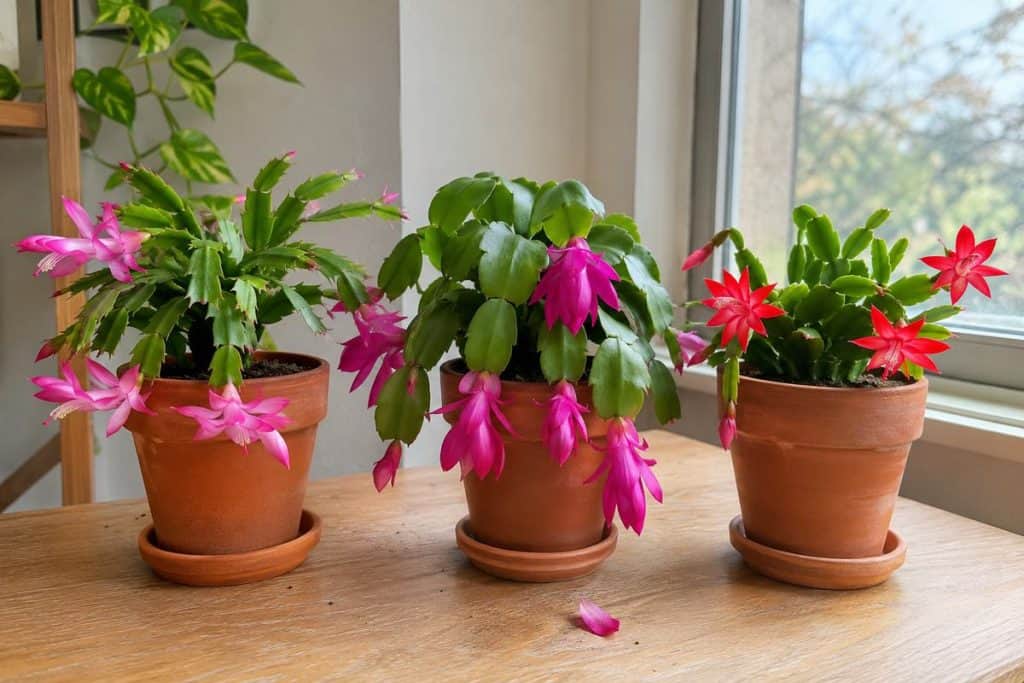
This is the plant most US stores sell as “Christmas cactus”. The segments end in sharp points, and each edge has 2 to 4 claw-like teeth, which is why it is also called crab cactus. Flowers come in white, pink, red, salmon, lavender and even yellow, and they stick out from the stem tips at an angle.
It suits anyone who wants a full plant of blooms by Thanksgiving week and an easy start. Most assorted four-pack plants sold online belong to this group too, despite the holiday name on the box.

Skip it if you want flowers right on December 25. It can rebloom lightly in late winter, but its main show is usually over by mid-December.
Its one downside: buds form early, so the long nights have to start by mid-September. Leave it in a living room with lamps on until October, and you will get few buds.
Best for Blooms on the Holiday Itself: True Christmas Cactus
Schlumbergera × buckleyi is a cross of S. truncata and S. russelliana, bred in England in the mid-1800s. Its segments have smooth, rounded scallops with no points. Flowers hang down from the tips like small lanterns, mostly in magenta and rose, with purplish-pink pollen.
It’s the right choice if you want blooms from mid-December into January. Many long-lived family plants, passed down for decades, turn out to be this type.
Skip it if you want unusual colors. The range is narrow, and it is sold far less often, so you may need a specialty nursery or a cutting from a friend.
The downside: it blooms later, so a plant that misses its long nights in October has little time to catch up before the holidays.
Best for Spring Flowers: Easter Cactus
The Easter cactus is a different plant, long sold as Hatiora or Rhipsalidopsis gaertneri and now placed in Schlumbergera. Its segments are shorter and rounder, with small ripples on the edges and short brownish bristles at the tips. The flowers are flat, star-shaped and symmetrical, in red, pink, orange, lavender or white, and they open in daylight and close at night.
It suits people who already have a holiday cactus and want color in March to May. Skip it if you tend to overwater, because it rots faster than the other two; pot it in a cactus and succulent mix with extra perlite.

Its routine is different. Buds form after a cool, short-day winter: about 8 to 12 weeks of long nights with nights around 50 to 55°F, starting in December. A digital thermometer on the sill shows whether a spot really stays that cool overnight.
How to Tell Them Apart Without Flowers
Look at the outer edge of a mature segment in good light:
- Two to four sharp teeth along each side, with pointed tips: Thanksgiving cactus.
- Smooth, shallow scallops with blunt, rounded ends: Christmas cactus.
- Short, thick segments with tiny ripples and brown bristles at the tip: Easter cactus.
Check several segments, because new growth can look softer than mature growth. A plant with mildly pointed scallops is often a hybrid between the first two; treat it like a Thanksgiving cactus and start its long nights in mid-September.
How to Tell Them Apart by the Flowers
Thanksgiving flowers stick out roughly level with the stem and show yellow pollen. Christmas cactus flowers droop and show purplish-pink pollen. Easter cactus flowers are flat stars that face outward and close each evening.
Bloom timing is the easiest clue of all. A plant that flowers in November is almost certainly a Thanksgiving type, whatever the tag says. If yours bloomed early or not at all, the reasons are in why a Christmas cactus is not blooming.
Named Cultivars and Their Groups
Garden centers sell cultivars by color rather than by type. Many with “Christmas” in the name have pointed Thanksgiving-type segments, so trust the segment edges over the label. Yellow-flowered plants such as ‘Gold Charm’ and variegated ones such as ‘Madame Butterfly’ belong to the Thanksgiving group.
Two rarer species turn up with collectors. Schlumbergera russelliana, one parent of the Christmas cactus, blooms in late winter. Schlumbergera orssichiana has some of the largest flowers in the genus and can bloom more than once a year.
Buying One in the US
Thanksgiving types fill grocery stores, Trader Joe’s and big-box garden centers from late October, usually labeled “Christmas cactus” or simply “holiday cactus”. True Christmas cactus is rare at big stores; independent nurseries and plant swaps are the better bet. Easter cactus shows up in March, often sold in bloom for the holiday.
Pick a plant with firm, flat, glossy segments and plenty of tight buds, with only a few flowers open. Turn a few stems over and look in the joints for white cotton, which means mealybugs. Avoid plants with limp or wrinkled segments, which have usually dried out on the shelf.
Sophia’s tip: ask for a paper sleeve or a box if it’s below 40°F outside. A short, wrapped walk to the car is fine, but a plant left in a cold car while you finish shopping can drop its buds the following week. Once home, pick its spot and leave it there; don’t repot until spring.
Care Is Almost the Same for All Three
All three are jungle cacti, not desert cacti. They want bright indirect light, water when the top inch of mix is dry, and a fast-draining blend. A cactus and succulent mix with a handful of orchid bark works for all of them; see the best soil for a Christmas cactus for ratios.
The real differences are timing and watering:
- Thanksgiving and Christmas cacti need 6 weeks of 12 to 14 hour nights and cool temperatures in fall, as in how to make a Christmas cactus bloom.
- Easter cactus needs its cool, dim rest in winter and drier soil during it.
- After flowering, all three get a short rest with less water, covered in what to do after a Christmas cactus flowers.
Any of them roots easily from 2 or 3 segments, so trading cuttings is the cheapest way to collect all three. Rooting a Christmas cactus in water works for each.
Pet owners can relax about all three. The ASPCA lists the Christmas cactus, including the plant sold as Easter cactus, as non-toxic to cats and dogs.
How to Choose in 30 Seconds
- If you want color by Thanksgiving and an easy plant: Thanksgiving cactus.
- If you want flowers on Christmas morning: a true Christmas cactus, checked for smooth scallops.
- If you want a spring bloomer and keep a cool room in winter: Easter cactus.
- If you already own one and it blooms in November: it’s a Thanksgiving cactus, and that’s fine.

Founder & Lead Writer · 9 years growing houseplants · Chicago, IL
I’m Sophia, founder of HousePlantsInfo.com. I’ve grown plants for as long as I can remember and have spent the last 9 years focused on houseplants, now caring for 75+ of them, from easy snake plants and philodendrons to fussier fiddle leaf figs and calatheas. Every guide here is based on what I’ve grown, lost and brought back in a real apartment through dark, radiator-dry Chicago winters. I trained through Houseplant Masterclass, and I check care and pet-safety details against university extension services and the ASPCA before publishing.