
You are looking at a pothos trailing off a bookshelf, a snake plant by the radiator, and maybe a few more pots crowding the windowsill, and you wonder if they are freshening the air you breathe.
Knowing how much oxygen does a house plant produce helps you set realistic expectations for that green corner.
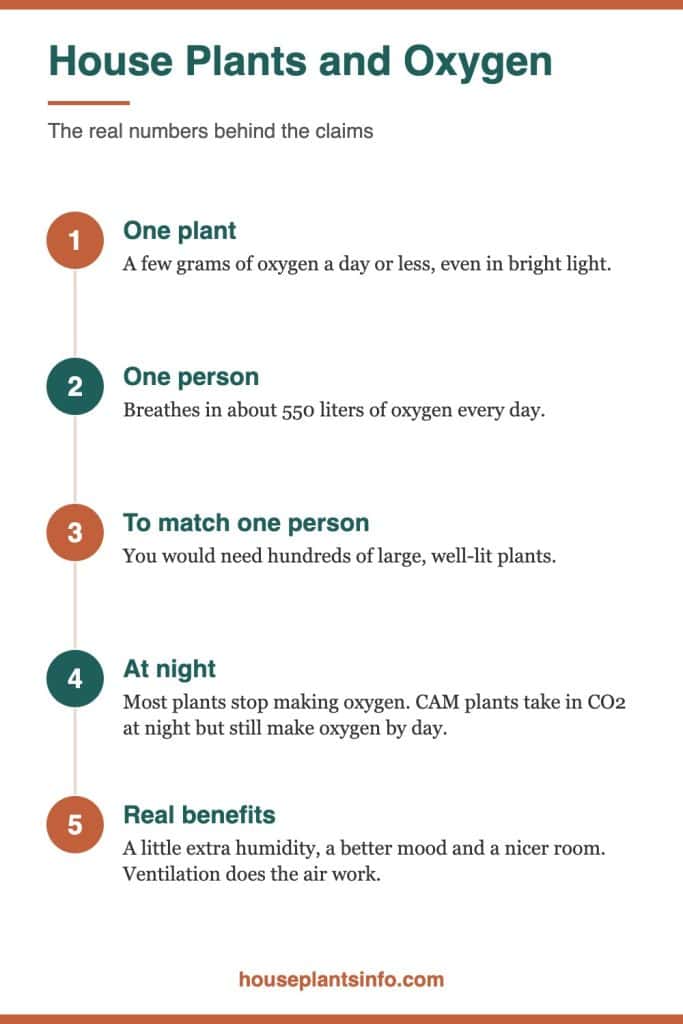
The short version: A typical potted houseplant makes only a few grams of oxygen per day or less, even in bright light.
An adult breathes in about 0.7 to 0.8 kilograms of oxygen daily, so houseplants do not noticeably change indoor oxygen levels. Ventilation does that job.
This guide covers the real numbers, how photosynthesis works, what happens at night, the NASA study, and what plants actually do for your home.
At a Glance
| Factor | What it needs |
|---|---|
| Light | Bright, indirect light or a grow light; more light means more photosynthesis and more oxygen |
| Water | Steady moisture suited to the species; a thirsty, wilting plant closes its pores and slows oxygen output |
| Temperature | Roughly 65 to 80°F for most common houseplants; cold drafts and hot radiators slow growth |
| Humidity | Moderate levels around 40 to 60 percent keep leaves working well |
| Pet safety | Check each plant; many popular “oxygen” plants are toxic to cats and dogs per the ASPCA |
| Difficulty | Easy to keep alive, but no plant count makes a measurable oxygen difference |
How Much Oxygen Does One House Plant Make?
One average houseplant produces a small amount of oxygen, on the order of a few grams per day or less in bright light. That is a tiny fraction of the roughly 550 liters of oxygen one adult breathes in every day.
What Controls the Output
Three things set a plant’s oxygen production: leaf area, light and growth rate. A large fiddle leaf fig in a bright south window will make more oxygen than a small succulent on a dim north sill.
A fast-growing plant is fixing more carbon, which means it is releasing more oxygen.
Light matters most indoors. Light intensity drops sharply as you move away from the glass, so a plant 6 feet from a window may get only a small share of the light it would get right beside it.
A grow light can raise photosynthesis for plants in dim rooms, especially during short Chicago winter days. A soil moisture meter helps you avoid both drought stress and soggy roots, since either problem slows growth and the oxygen that comes with it.
Putting a Gram in Perspective
Oxygen is light, so grams add up to a surprising volume. One gram of oxygen takes up roughly 0.7 liters at room temperature. A plant making 3 grams a day releases a little over 2 liters of oxygen.
Compare that with your own breathing. At about 550 liters a day, one adult uses roughly 250 times what that plant produces. The gap is wide even before you account for nighttime respiration.
| Source | Approximate daily oxygen |
|---|---|
| Typical potted houseplant in bright light | A few grams or less (about 1 to 3 liters) |
| Large, well-lit houseplant | Somewhat more, still only a few grams |
| One adult’s oxygen intake | About 0.7 to 0.8 kilograms (about 550 liters) |
Why Your Room Doesn’t Run Short Anyway
Indoor air holds plenty of oxygen. Air is about 21 percent oxygen, and a 12 by 12 foot bedroom with an 8 foot ceiling holds over 32,000 liters of air. Normal air exchange through doors, windows, gaps and ventilation keeps refreshing that supply.
Sophia’s tip: If a room feels stuffy, crack a window an inch or run the bathroom or kitchen exhaust fan for 15 minutes. Fresh air exchange changes the room far faster than adding pots ever could.
How Photosynthesis Produces Oxygen
Plants make oxygen as a byproduct of photosynthesis, which only runs while light reaches the leaves. They take in carbon dioxide and water, use light energy to build sugars, and release oxygen.
The Basic Chemistry
The simplified equation is six molecules of carbon dioxide plus six molecules of water, powered by light, become one sugar molecule and six molecules of oxygen. The oxygen comes from splitting water inside the leaf.
That sugar fuels growth. So the oxygen a plant releases is tied directly to how much new tissue it is building, which explains why a slow-growing plant releases so little.
Where the Gas Exchange Happens
Leaves have tiny pores called stomata, mostly on their undersides. Carbon dioxide enters through these pores, and oxygen and water vapor exit through them.
When a plant is stressed by drought, heat from a nearby radiator or a blast of dry forced air, it often closes its stomata to save water. Closed pores mean less carbon dioxide coming in and less oxygen going out.
Why Indoor Light Limits Everything
Even a bright window delivers far less light than open sky outdoors. Window glass, screens, curtains and distance from the pane all cut intensity.
Most houseplants are understory species adapted to shade. They survive on modest light, but survival mode means slow growth and low oxygen output. That is one reason indoor plants stay well below what the same species might do outdoors.
Do Plants Make Oxygen at Night?
Most plants do not make oxygen at night. Without light, photosynthesis stops, and the plant keeps respiring, which uses a little oxygen and releases a little carbon dioxide.
Respiration Never Stops
Plants respire around the clock, just like animals. They break down sugars for energy, consuming oxygen and giving off carbon dioxide. During the day, photosynthesis outpaces respiration, so the plant is a net oxygen producer.
At night, respiration is the only process running. A houseplant becomes a very small net consumer of oxygen until morning light returns.
Should You Worry About Plants in the Bedroom?
No. The amount of carbon dioxide a houseplant releases at night is tiny, far less than a sleeping person or pet produces. Keeping plants in your bedroom is fine for healthy adults and children.
The old idea of moving plants out of a sickroom at night has no practical basis in a normal home. The quantities simply are not large enough to matter in either direction.
How Many Plants Would It Take to Matter?
Estimates suggest it would take hundreds of large, well-lit houseplants to supply one person’s daily oxygen. No ordinary apartment or house can hold that many plants in good enough light.
Running the Rough Numbers
If one adult uses about 550 liters a day and a strong houseplant produces a couple of liters, you would need somewhere in the range of 250 or more thriving plants. That assumes every plant sits in bright light all day.
Then subtract nighttime respiration, cloudy days and winter’s short daylight. The real number climbs higher, and the plants would need a greenhouse-level light setup to keep up.
Light Is the Real Bottleneck
A typical apartment has limited window space. A south or west window might support a few strong plants within 3 feet of the glass, while plants deeper in the room get much less light.
Grow lights help individual plants, but lighting hundreds of large plants would take serious electricity and space. It is not a realistic way to change oxygen levels.
Ventilation Does the Heavy Lifting
Homes exchange air with the outdoors constantly through ventilation, leaks around windows and doors, and mechanical systems. That exchange keeps oxygen near normal levels and carries off carbon dioxide.
The EPA recommends ventilation and controlling pollution sources as the main ways to improve indoor air. Plants are pleasant company, but they are not a substitute for fresh air.
Sophia’s tip: In winter, when windows stay shut and the heat runs nonstop, open a window for 5 to 10 minutes once or twice a day. Move tropical plants away from that window first so cold air doesn’t hit their leaves.
What About the Famous Air-Cleaning Study?
The 1989 NASA clean air study tested plants in small sealed chambers, not in homes. Later research found that in real homes you would need a huge number of plants to match normal ventilation for removing VOCs.
What the Study Actually Did
Researchers placed plants inside small, airtight chambers and introduced volatile organic compounds such as benzene and formaldehyde. Over time, the levels inside those chambers dropped.
The study was aimed at life support ideas for sealed spaces. A small sealed box is very different from a living room with doors opening, air leaking and a furnace cycling.
Why the Results Don’t Scale to Your Living Room
In a home, outdoor air replaces indoor air far faster than a few pots can remove pollutants. Later analyses estimated you would need dozens to hundreds of plants per square yard of floor space to equal ordinary air exchange.
That does not mean plants do nothing to compounds in the air. It means the effect is too small to notice at normal plant densities.
If you want to see which plants show up on popular lists and why, read our guide on what houseplants clean the air.
Where the Myth Came From
Plant lists from the study circulated widely, and the idea of “air-purifying plants” stuck. Many plant tags and articles still repeat it without the sealed-chamber context.
It is a nice story, but the honest framing is simpler. Enjoy your plants for what they are, and use ventilation and source control for air quality. Plants should never be relied on for any health condition.
Plants That Are Said to Release Oxygen at Night
Some plants are often said to release oxygen at night, but that claim is a misunderstanding. These are CAM plants, which take in carbon dioxide at night and still release their oxygen during the day.
How CAM Plants Actually Work
CAM stands for crassulacean acid metabolism, a water-saving strategy. These plants keep their stomata closed during hot daytime hours and open them at night, when less water escapes.
They store the carbon dioxide they absorb overnight as an acid. When light returns, they close their pores and run photosynthesis, releasing oxygen during the day. The amounts are tiny either way.
Common CAM Houseplants
| Plant | CAM behavior | ASPCA pet status |
|---|---|---|
| Snake plant | Opens pores at night | Toxic to cats and dogs |
| Jade plant | Opens pores at night | Toxic to cats and dogs |
| Aloe | Opens pores at night | Toxic to cats and dogs |
| Moth orchid | Many orchids use CAM | Non-toxic to cats and dogs |
| Bromeliads | Many use CAM | Generally non-toxic to cats and dogs |
| Many cacti | CAM plants | Varies by species; spines can injure pets |
Snake plants are the most common example. Their thick leaves handle dry indoor air well, and you can read more about their needs in our article on snake plant humidity.
Cacti also get “night oxygen” claims. Our guide answering are cactus good for air quality explains why their effect on your air is minimal.
A Note on Pet Safety
Several of these popular plants are toxic to pets. The ASPCA lists snake plant, jade plant and aloe as toxic to cats and dogs, so place them on high shelves or in rooms pets can’t reach.
Moth orchids and most bromeliads are listed as non-toxic. If you share a dim apartment with a cat, browse our picks for low light plants that are safe for cats.
What Houseplants Really Do for Your Home
Houseplants add a little humidity through transpiration, can lift your mood, and are genuinely enjoyable to grow. Those are real benefits, even if oxygen and air purification are not among them.
A Small Humidity Contribution
Plants pull water from the soil and release most of it as vapor through their leaves. A group of healthy, leafy plants can raise humidity slightly in the air right around them.
That small bump can help during dry winters, when forced-air heat and radiators can drop indoor humidity below 30 percent. Clustering plants together creates a modestly more humid pocket that benefits the plants themselves.
Sophia’s tip: Group humidity-loving plants like calatheas and ferns 2 to 3 feet away from radiators and heat vents, and add a small humidifier nearby if your hygrometer reads under 40 percent in winter.
Mood and Stress Relief
Many people find that caring for plants feels calming. Watering, checking new leaves and rotating pots toward the light creates a small, steady routine.
Greenery also softens a room visually. A trailing plant on a shelf or a tall plant in a corner can make an apartment feel more lived-in and restful.
The Enjoyment Factor
Growing plants is a hobby with visible progress. A new leaf unfurling or an orchid spike forming is a real reward for good care.
If you want plants that grow well indoors and give you that satisfaction, our list of the best indoor plants to buy is a good place to start. Choose based on your light, your schedule and your pets.
Choosing Plants for the Right Reasons
I recommend picking plants for how they look, how well they fit your window light and how safe they are around pets and kids. Those choices lead to healthy plants you enjoy for years.
Skip any purchase based on oxygen or air-purifying claims. A plant that thrives in your conditions will give you more than any label promise.
Your Next Steps
- Check each window’s direction and place light-hungry plants within 3 feet of the brightest glass.
- Add a grow light for plants in rooms with north-facing or obstructed windows.
- Open a window or run an exhaust fan daily for fresh air, especially in winter.
- Look up every plant’s ASPCA status and move toxic ones out of reach of pets and kids.
- Group humidity-loving plants together and keep them away from radiators and AC drafts.
- Choose new plants for your light and lifestyle, not for oxygen or purification claims.
Common Questions About House Plants and Oxygen
Can houseplants raise the oxygen level in my apartment?
Not in any measurable way. A typical houseplant makes a few grams of oxygen per day or less, while normal air exchange keeps indoor oxygen near outdoor levels. Ventilation is what maintains your oxygen supply.
Is it safe to sleep with plants in my bedroom?
Yes, for healthy adults and children it is safe. Plants release a little carbon dioxide at night, but the amount is far smaller than what you exhale while sleeping. Just keep toxic plants away from curious pets.
Does a snake plant give off oxygen at night?
No, a snake plant takes in carbon dioxide at night and releases oxygen during the day when photosynthesis runs. It is a CAM plant that opens its pores after dark to save water. The amount of gas exchanged is tiny either way.
Did the NASA study prove plants clean indoor air?
The 1989 NASA clean air study showed plants reduced certain compounds in small sealed chambers. Real homes exchange air much faster than those chambers, so you would need a huge number of plants to match normal ventilation. The results don’t translate to a typical living room.
Can plants help someone with breathing problems?
Houseplants should not be relied on as an oxygen source or air purifier for any health condition. Their effect on indoor air is too small to matter. Anyone with breathing concerns should follow a doctor’s guidance on air quality.

Hi! I’m Sophia, and I love plants – especially an expert in growing house plants. I stay in Chicago, United States of America, and through my blog and social media platforms, provide tips and tricks on how to grow healthy, vibrant plants indoors. Check out more here.