
You are looking at a sunny windowsill lined with spiky, chubby, and rosette-shaped plants, and you are wondering whether they all count as one group.
The short version: No, but they overlap. Every cactus is a succulent, because cacti store water in thick tissue, but most succulents are not cacti.
True cacti belong to one plant family, Cactaceae, and they all have small fuzzy bumps called areoles where spines, flowers, and new stems grow.
This guide covers how to tell them apart, which look-alikes fool people, how their care differs indoors, and which ones are safe around pets.
At a Glance
| Factor | What it needs |
|---|---|
| Light | Desert cacti: 4 to 6+ hours of direct sun. Most succulents: bright light with some direct sun. Forest cacti: bright indirect light |
| Water | Soak, then let soil dry fully. Every 2 to 4 weeks in summer, every 4 to 8 weeks in winter |
| Humidity | Average indoor air of 30 to 50% is fine for most. Forest cacti like a bit more |
| Temperature | 65 to 85°F in the growing season. Many desert cacti prefer 45 to 55°F in winter |
| Soil | Fast-draining gritty mix with 40 to 60% mineral content |
| Pet safety | Varies by plant. Christmas cactus is non-toxic per the ASPCA; jade, aloe, and kalanchoe are toxic |
| Difficulty | Easy, as long as you avoid overwatering and low light |
Are Cactus and Succulents the Same Thing?
Not quite. “Succulent” describes a survival strategy shared by thousands of plants from many families, while “cactus” names one specific family within that larger group.
Succulent Is a Trait, Not a Family
A succulent is any plant that stores water in swollen leaves, stems, or roots so it can survive dry spells.
That trait evolved separately in dozens of plant families, including the stonecrop family (jade, echeveria, sedum), the aloe family, the agave family, and the spurge family (euphorbia).
Because the trait evolved many times, succulents can look wildly different. A trailing string of pearls and a tall snake plant are both succulents, yet they are not closely related.
Cactus Is One Family Inside That Group
Cacti form the family Cactaceae, with roughly 1,750 to 2,000 species. Nearly all are native to the Americas, from Canada down to Patagonia, growing in deserts, grasslands, mountains, and even rainforest canopies.
Most cacti store water in thick stems rather than leaves. Their leaves have mostly been reduced to spines, which shade the stem, reduce airflow across the surface, and discourage animals from chewing.
Checking a Plant You Already Own
If a plant came home without a label, look closely at where the spines or new growth start. A hand lens or your phone camera zoomed in will show whether there is a fuzzy pad at the base of each spine cluster.
Light also matters for identification over time.
A cactus kept far from the glass will stretch and turn pale, which distorts its shape, so a grow light placed 6 to 12 inches above the plant keeps growth compact and true to type through a Chicago winter.

How Do You Tell a Cactus From Other Succulents?
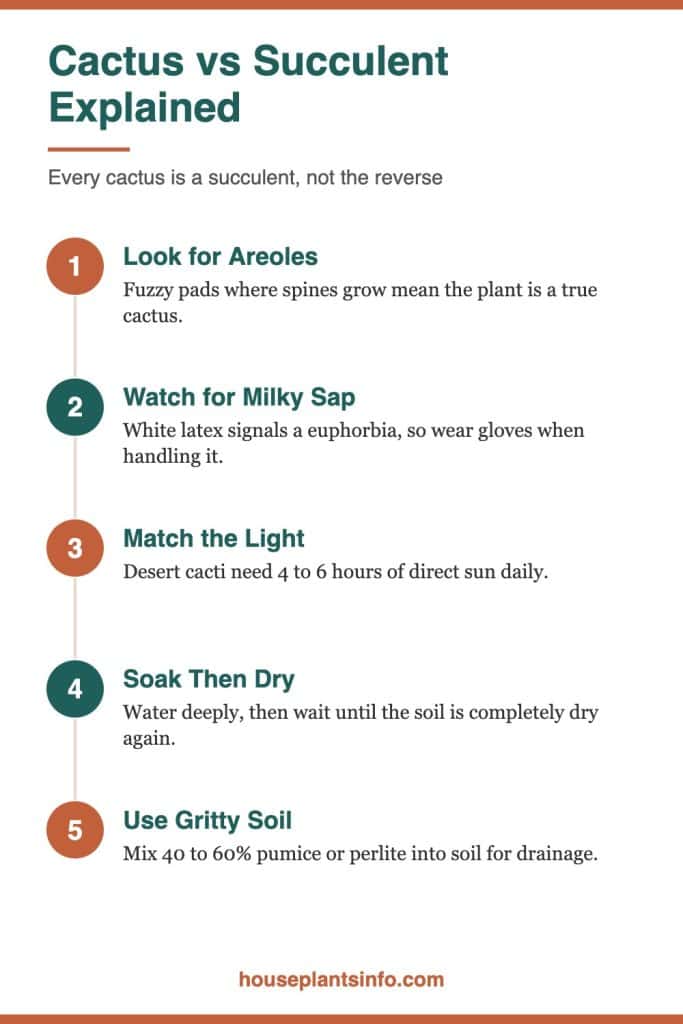
The single reliable test is the areole. If you find areoles, the plant is a cactus; if you do not, it is some other kind of succulent, no matter how spiny it looks.
Look for Areoles
Areoles are small, cushion-like bumps, often fuzzy or woolly, scattered in rows or spirals along the stem. Spines, flowers, branches, and offsets all grow out of them.
Even spineless cacti have areoles. Christmas cactus, for example, has tiny areoles at the tips of its flat segments, which is where its flowers appear.

Spines Versus Thorns and Prickles
Cactus spines grow in clusters from areoles. Many other spiny succulents, like crown of thorns or some euphorbias, have spines that grow singly or in pairs directly from the stem with no fuzzy pad beneath.
Agaves and some aloes have sharp teeth along leaf edges and a hard tip on each leaf. Those are leaf structures, not cactus spines.
Leaves and Sap
Most cacti have no obvious leaves. A few, like Pereskia, still carry true leaves, but they are rare in stores.
Sap is another clue. If a broken stem leaks white, milky latex, you are almost certainly holding a euphorbia, not a cactus. Cactus sap is usually clear and watery.
| Feature | Cactus | Other succulents |
|---|---|---|
| Areoles | Always present | Never present |
| Spines | Grow in clusters from areoles | Absent, single, paired, or leaf teeth |
| Water storage | Mainly in stems | Leaves, stems, or roots |
| Leaves | Usually absent or reduced | Often thick and fleshy |
| Sap | Usually clear | Clear, or milky in euphorbias |
| Native range | Almost entirely the Americas | Worldwide |
| Flowers | Often large, from areoles | Vary widely by family |
Which Plants Look Like Cacti but Are Not?
Several common houseplants are sold as “cactus” even though they belong to other families. Knowing them matters, because a few have irritating sap and some need different care.
Euphorbias
Many euphorbias from Africa and Madagascar evolved columnar, ribbed, spiny bodies that look almost identical to cacti. African milk tree (Euphorbia trigona) and Euphorbia ingens are often labeled cactus in stores.
Their milky sap can irritate skin and is dangerous in the eyes. Wear gloves when pruning or repotting them, and wash your hands afterward.
Aloes, Agaves, and Haworthias
These rosette-forming succulents have fleshy leaves rather than ribbed stems, but their sharp tips and desert look cause confusion. None of them have areoles.
Haworthias are especially easy to grow indoors because they tolerate less direct sun than most desert plants. An east window or a spot a few feet back from a south window often suits them.
Snake Plant and Other Stiff Succulents
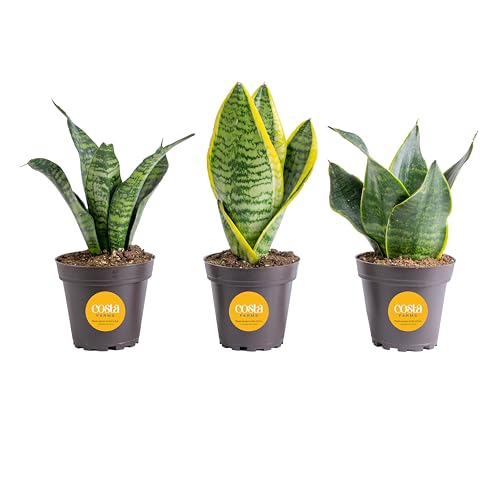
Snake plant, ponytail palm, and ZZ plant store water and tolerate drought, so they are often grouped with succulents. They are not cacti, and they handle lower light much better than true desert cacti do.
Sophia’s tip: Before you buy a “cactus,” snap a firm photo of where the spines attach. If you see no fuzzy pad and the tag says Euphorbia, plan on gloves and a spot out of reach of curious hands.
Do Cacti and Succulents Need Different Light?
They overlap, but desert cacti usually want the most light of any common houseplant. Most leafy succulents want bright light with some direct sun, and forest cacti prefer filtered light.
Desert Cacti
Barrel cacti, golden barrel, bunny ear, old man cactus, and columnar types like Peruvian apple cactus need at least 4 to 6 hours of direct sun.
In a northern apartment, that means a south or west window, placed within 1 to 2 feet of the glass.
Without enough light, cacti stretch into thin, pale growth called etiolation. That stretched growth does not fill back in, so prevention matters more than cure.
Leafy Succulents
Echeveria, jade, sedum, and graptopetalum keep their compact rosettes and colorful tips in strong light. A south or west window works well, and an east window can work for jade and haworthia.
If rosettes open up flat and leaves spread apart, the plant wants more light. Move it closer to the window or add a grow light for 12 to 14 hours a day.
Forest Cacti
Christmas cactus, Easter cactus, Rhipsalis, and orchid cactus grow on trees in tropical forests. Direct midday sun can redden or scorch their segments, so bright indirect light from an east window or a few feet back from a south window is ideal.
Seasonal Adjustments Indoors
Plants that sat happily on a summer windowsill can burn when moved outdoors without a gradual adjustment. Introduce them to outdoor sun over 1 to 2 weeks, starting with morning light.
In winter, cold glass can drop below 40°F on Chicago nights. Keep pots from touching the pane, and keep them away from radiators, which dry the soil unevenly and cook one side of the plant.
Do Cacti and Succulents Need Different Water and Soil?
Both need fast-draining soil and a full dry-out between waterings. The main differences are that desert cacti tolerate longer droughts and often need a drier winter rest, while forest cacti like slightly more consistent moisture.
How to Water Both
Water deeply until it runs out the drainage hole, then let the soil dry completely before watering again. Push a wooden skewer to the bottom of the pot; if it comes out clean and dry, it is time.
In spring and summer, that usually means every 2 to 4 weeks for most cacti and succulents in a bright window. In winter, stretch it to every 4 to 8 weeks, and give many desert cacti barely any water at all.
Forest cacti are the exception. Water them when the top inch or so of soil is dry, and do not let them sit bone-dry for weeks.
Winter Rest for Desert Cacti
Many desert cacti bloom best after a cool, dry winter. If you can give them 45 to 55°F with very little water from roughly November to February, you improve your odds of spring flowers.
A cool, bright windowsill away from forced-air vents often provides this naturally in older apartments. Avoid spots near a heat register, where warm, dry air keeps the plant active without enough light to support growth.
Choosing Soil
Standard potting mix holds too much water for both groups. Cacti and succulents need a gritty blend with 40 to 60% mineral material such as pumice, perlite, or coarse sand.

You can generally use cactus soil for succulents, though many bagged mixes are still peat-heavy and benefit from an extra handful of pumice or perlite. Forest cacti do better with a chunkier, slightly richer mix that includes orchid bark.
Pots and Drainage
Always use a pot with a drainage hole. Unglazed terracotta wicks moisture from the soil and suits heavy waterers or cool rooms; glazed or plastic pots stay damp longer and suit warm, dry apartments.
Sophia’s tip: Water in the morning, empty any saucer within 15 minutes, and skip watering entirely during a cold snap when your window glass feels icy. Cold, wet roots are the fastest route to rot.
Which Cacti and Succulents Grow Well Indoors?
Many species adapt well to apartment life if you match them to your brightest window. Here are reliable choices from both groups.
Cacti Worth Growing
- Golden barrel cactus: slow, round, and tolerant of dry air; needs full sun
- Bunny ear cactus: flat pads with fine glochids that stick to skin, so handle with tongs
- Old man cactus: covered in white hairs that protect it from strong sun
- Christmas and Thanksgiving cactus: forest cacti that flower in late fall and winter
- Peruvian apple cactus: a fast-growing columnar cactus that makes a striking floor plant in a sunny corner
Columnar cacti like Peruvian apple are also easy to propagate. You can grow Peruvian apple cactus from cutting by letting the cut end callus for one to two weeks before setting it in dry, gritty mix.
If your cutting sits for weeks without roots, the cause is usually low warmth, too much moisture, or a cut that was not fully callused. This guide on a Peruvian apple cactus not rooting walks through each fix.
Once it is established, it is worth learning how to care for Peruvian apple cactus as it grows taller, since it will need a heavier pot and occasional rotation toward the light.
Succulents Worth Growing
- Jade plant: tree-like and long-lived, good for south or west windows
- Echeveria: colorful rosettes that need very bright light to stay compact
- Haworthia: small, striped, and tolerant of moderate light
- Aloe vera: fast-growing and forgiving
- String of pearls: trailing, best in bright light with careful watering
- Snake plant: handles lower light than nearly any other succulent
Matching Plant to Window
If you only have a north window, choose snake plant, haworthia, or a forest cactus. For desert cacti and echeveria in a dim apartment, a grow light is not optional; it is what keeps them alive.
What Problems Do Cacti and Succulents Share?
Both groups suffer mostly from the same handful of problems: overwatering, low light, and a few common pests. Catching these early prevents most losses.
Rot From Overwatering
Soft, mushy, brown, or black tissue near the soil line is root or stem rot. It almost always comes from soil staying wet too long, especially in cool rooms or pots without drainage.
Cut away rotten tissue with a clean blade until you see healthy, firm flesh. Let the cut callus for several days, then replant in dry, fresh mix and wait about a week before watering.
Mealybugs and Scale
Mealybugs look like small cottony tufts tucked into spines, leaf joints, and the base of rosettes. If you have wondered can cactus get mealybugs, the answer is yes, and they are one of the most common pests on both groups.
Dab visible bugs with a cotton swab dipped in 70% isopropyl alcohol and repeat weekly until none return. Root mealybugs also exist, so check the root ball when you repot.
Stretching, Sunburn, and Shriveling
Thin, leaning growth signals too little light. Bleached or brown patches on the sun-facing side usually mean sunburn after a sudden move into stronger light.
Wrinkled leaves or a shrunken cactus body often point to thirst, but they can also follow root rot. Check the roots before adding more water.
Sophia’s tip: Rotate each pot a quarter turn every time you water. It keeps columnar cacti growing straight and prevents one side of a rosette from stretching toward the glass.
Are Cacti and Succulents Safe for Pets and Kids?
It depends on the species, so check each plant rather than the group. The ASPCA lists Christmas cactus as non-toxic to cats and dogs, while jade plant, aloe, and kalanchoe are listed as toxic.
Physical Hazards
Even non-toxic cacti cause trouble through spines. Bunny ear and other opuntias carry glochids, tiny barbed bristles that lodge in skin, paws, and mouths and are hard to remove.
Irritating Sap
Euphorbias, including crown of thorns and African milk tree, have milky sap that irritates skin, eyes, and mouths. Keep them on high shelves or in rooms pets cannot reach.
Placement Ideas
Hanging planters, wall shelves, and window ledges above counter height keep plants away from curious cats and toddlers. If a pet chews a plant and shows drooling, vomiting, or lethargy, contact your veterinarian or the ASPCA Animal Poison Control Center.
Your Next Steps
- Check each plant for areoles with a hand lens or phone zoom to confirm whether it is a cactus.
- Move desert cacti and echeveria within 1 to 2 feet of your sunniest south or west window, or add a grow light.
- Repot anything in dense potting mix into a gritty blend with 40 to 60% pumice or perlite.
- Switch to soak-and-dry watering using a wooden skewer, and cut back sharply from November to February.
- Inspect spines, joints, and rosette bases for cottony mealybugs every few weeks.
- Look up each plant’s ASPCA status and move any toxic or spiny ones out of reach of pets and kids.
Common Questions About Cactus and Succulents
Is aloe vera a cactus?
No, aloe vera is a succulent but not a cactus. It belongs to a different plant family and has no areoles, even though its leaf edges carry small teeth.
Can I plant cacti and succulents in the same pot?
Yes, as long as they share similar light and water needs. Pair desert cacti with sun-loving succulents like echeveria or sedum, and keep forest cacti and lower-light succulents like haworthia in separate pots.
Why is my cactus turning yellow?
Yellowing usually comes from overwatering, root rot, or sunburn after a sudden move to stronger light. Check whether the soil stays wet and whether the base feels soft, and adjust watering or placement accordingly.
Do cacti need more water than succulents?
Most desert cacti need slightly less water than leafy succulents, especially in winter. Forest cacti like Christmas cactus need more frequent water than either group, so check the type before setting a schedule.
Can cacti and succulents live in low light?
Most cannot thrive in low light and will stretch or weaken over months. Snake plant, haworthia, and forest cacti handle moderate light best, while desert cacti need direct sun or a strong grow light.

Hi! I’m Sophia, and I love plants – especially an expert in growing house plants. I stay in Chicago, United States of America, and through my blog and social media platforms, provide tips and tricks on how to grow healthy, vibrant plants indoors. Check out more here.