
You’ve got a new cactus, a shelf of pots to choose from, and a vague memory that cacti are supposed to go in clay.
My pick: unglazed terracotta with a drainage hole, for most indoor cacti in most US homes. It dries the soil faster than plastic, and that protects against the most common way cacti die, which is too much water.
But it’s not the right call for everyone, so below are the picks by situation, with who should skip each one.
Updated October 2026: rewritten as a pot-by-pot buying guide, with advice for dry heated winters and humid summers.
| Pot | Best for | How fast soil dries | Skip it if… |
|---|---|---|---|
| Unglazed terracotta | Most cacti, people who overwater | Fastest | You water rarely and your winter air is very dry |
| Plastic nursery pot | Busy people, small cacti, beginners who underwater | Slowest | You water often or your room is cool and dim |
| Glazed ceramic | Display, tall cacti | Slow, like plastic | It has no drainage hole |
| Cachepot with nursery pot inside | Decor without the risk | Depends on inner pot | You won’t remember to empty it |
| Concrete or fiberglass | Big cacti, porches, patios | Medium | You need to move it often |
Best for Most Indoor Cacti: Unglazed Terracotta
Terracotta is porous. Water moves through the clay walls and evaporates from the outside of the pot, so the soil dries from the sides as well as the top. That usually takes a few days off each drying cycle compared with plastic.

For a cactus, that’s the whole point. Cactus roots are shallow and spread wide, and they rot when the soil around them stays wet. A pot that dries faster gives you more room for error.
It also helps in practical ways:
- Weight: a clay pot is heavy, which keeps top-heavy columnar cacti from tipping.
- Feel: you can feel moisture through the pot. Damp clay is darker and cool to the touch.
- Price: basic terracotta is cheap at any garden center or hardware store.
Who should skip it: if you tend to forget watering for a month, and you keep the plant next to a radiator in a dry northern winter, terracotta can dry a small pot out very fast.
That’s survivable for most cacti, but plastic may suit you better.
Best If You Forget to Water: A Plastic Nursery Pot
Plastic doesn’t breathe, so the soil only dries from the top and through the drainage hole. That’s slower, which suits people who water on the light side, small cacti in 2- to 3-inch pots, and very bright, hot windows.
Most cacti you buy come in black plastic, and commercial growers raise them that way for years. Plastic is fine as long as you use a gritty cactus mix and let the soil dry all the way down between waterings.
The guide on how often to water a cactus helps with the schedule.
Who should skip it: anyone who waters “a little every week,” and anyone with a cactus in a cool, dim spot. In those conditions plastic stays wet too long.
Sophia’s tip: black plastic in a hot south or west window can cook shallow roots in summer. If the pot feels hot to your hand in the afternoon, slip it inside a slightly larger clay or light-colored pot to shade it.
Best for Tall or Top-Heavy Cacti: Heavy Glazed Ceramic
Glazed ceramic looks great and it’s heavy, which matters for a 3-foot column or a cactus that leans. But the glaze seals the clay, so it behaves like plastic for drying.
Use it if you want the look and the weight, as long as it has a drainage hole. Pick a wide base over a tall one, and use an extra-gritty mix to make up for the slower drying.
If your cactus already leans or keeps falling over, why is my cactus falling over helps you work out whether the pot or the roots are to blame.
Who should skip it: anyone looking at a ceramic pot with no hole. Drilling one with a diamond bit works, but it’s a project.
Best for Display: A Cachepot With a Nursery Pot Inside
Love a decorative pot that has no drainage hole? Use it as a cover. Keep the cactus in its plastic or terracotta pot with a hole, and set that inside the decorative one.
When you water, take the inner pot out, water it in the sink, let it drain for 15 minutes, and put it back. If that sounds like too much, at least tip out any water sitting in the bottom of the cover after each watering.
Who should skip it: anyone who won’t do that step. Water pooling in a cover pot is one of the most common causes of a cactus turning brown and soft at the base.
Best for Big Cacti Outdoors: Concrete or Fiberglass
For a large cactus on a porch or patio, terracotta can crack in a freeze. In much of the US, leaving wet terracotta outside over winter means a split pot by spring.
Concrete is heavy and stable, and fiberglass gives you a lighter pot that won’t crack, which matters if you bring the plant inside for winter.
Who should skip it: renters who move a lot. A big concrete pot with soil and a cactus in it can weigh more than you want to carry up stairs.
How Your Home Changes the Choice
Where you live and how you heat or cool your home matter as much as the pot.
In a dry heated winter, typical across the Northeast, Midwest and Mountain West, indoor humidity often drops below 30%. Terracotta dries very quickly then. Check small clay pots more often, or move tiny cacti into plastic for the winter.
In humid summers in the Southeast, or in a cool basement apartment, soil stays wet longer. Terracotta is the safer pick there, and you may need a grittier mix too.
With hard tap water, common in the Midwest, Southwest and Texas, clay pots grow a white crust on the outside. It’s mineral salts and it’s cosmetic.
Scrub it off with a stiff brush and a splash of white vinegar when you repot, or water with rainwater now and then.
What I Wouldn’t Buy
- Self-watering pots: they keep the soil damp by design, which is the opposite of what a cactus wants.
- Any pot with no drainage hole, unless you use it only as a cover.
- Oversized pots: a pot 4 inches wider than the plant holds a ring of wet soil that no roots use. Go only 1 to 2 inches wider. Since cactus roots are shallow, depth matters less than you’d think. See how deep cactus roots grow.
- Glass terrariums with lids: they trap humidity, and closed terrariums tend to grow mold. See can a cactus get moldy.
Moving a Cactus Into a Clay Pot
- Do it in spring or early summer, when the cactus is growing.
- Choose a pot 1 to 2 inches wider than the plant, with a hole.
- Give a brand-new terracotta pot a quick soak in water first, so the dry clay doesn’t pull all the moisture from fresh soil.
- Wrap the cactus in folded newspaper or a towel, or wear thick gloves.
- Set it at the same depth it was before, in dry cactus mix.
- Wait about a week before watering.
If you get a spine or glochid in your hand, how to treat cactus pricks covers getting them out.
Pet safety: terracotta is heavy and breaks into sharp pieces. Keep big clay pots on stable, low spots where a cat can’t knock them off a shelf. Most true cacti aren’t on the ASPCA’s toxic plant list, but the spines are a hazard.
How to Choose in 30 Seconds
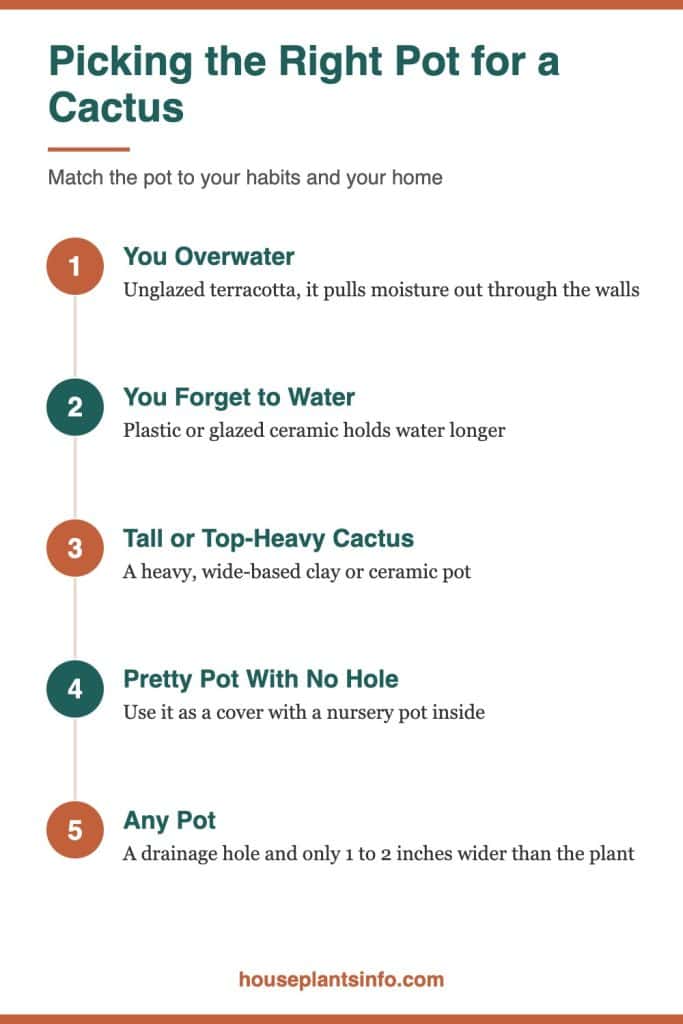
- If you overwater, or your cactus lives in a cool or humid room, choose terracotta.
- If you forget to water, or your room is hot, dry and bright, choose plastic or glazed ceramic.
- If the cactus is tall or tips, choose a heavy pot with a wide base.
- If the pot you love has no hole, use it as a cover with a nursery pot inside.
Before You Buy: Common Questions
Do cactus need pots with drainage holes?
Yes. Without a hole, water collects at the bottom where you can’t see it and rots the roots. A layer of gravel in the bottom doesn’t replace a hole.
Should I soak a clay pot before planting a cactus?
For a brand-new terracotta pot, a 10- to 15-minute soak helps so the dry clay doesn’t wick moisture out of fresh soil right away. Let it dry slightly before you plant.
Is terracotta better than plastic for a cactus?
For most people, yes, because it dries faster. Plastic is better if you water rarely or your home is very hot and dry. How long a cactus can go without water helps you judge which side you’re on.
Can I reuse an old clay pot?
Yes. Scrub off old soil and crust, then soak it for an hour in water with a little bleach (about 1 part bleach to 10 parts water), rinse well, and let it dry.
Why is my terracotta pot growing white or green stuff?
White crust is mineral buildup from hard water or fertilizer. Green is algae, which shows up when the pot stays damp. Neither hurts the cactus, though green growth is a hint you’re watering too often.

Hi! I’m Sophia, and I love plants – especially an expert in growing house plants. I stay in Chicago, United States of America, and through my blog and social media platforms, provide tips and tricks on how to grow healthy, vibrant plants indoors. Check out more here.