
Your cactus sits on the windowsill, and you notice a small round bump at its base that wasn’t there last spring.
If you have wondered how do cactus reproduce, that little bump is one answer, and a flower or a fallen piece of stem can be another.
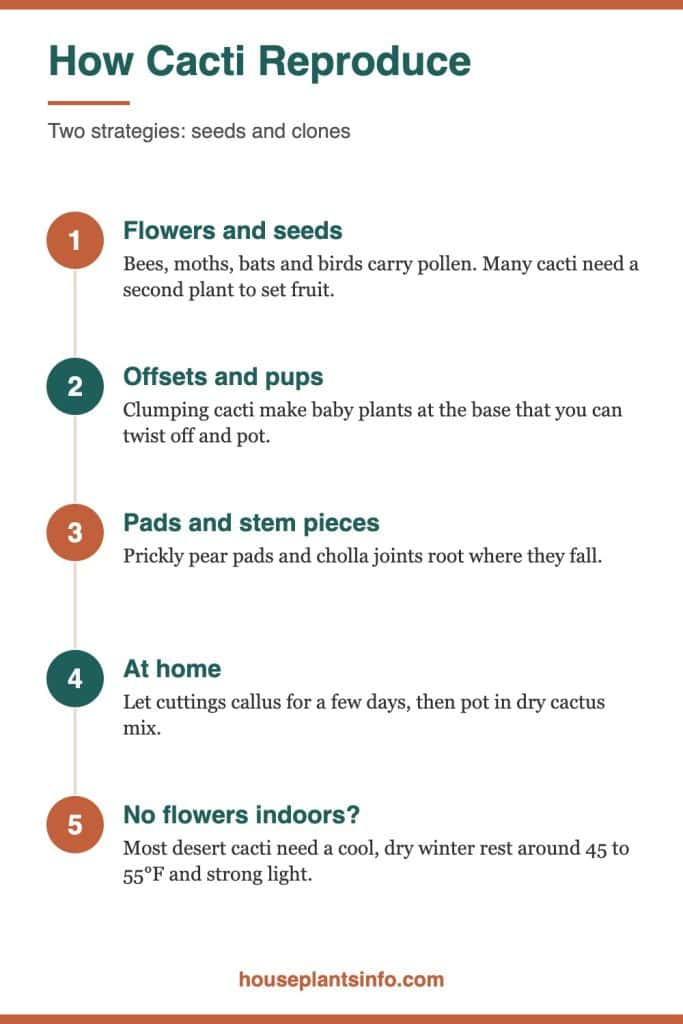
The short version: Cacti reproduce in two ways. Sexually, they make flowers that are pollinated and turn into fruit full of seeds. Asexually, they make offsets (pups), drop stem segments or pads that root, or regrow from broken pieces.
This guide explains each method in nature, how pollination works, and how you can copy these methods in an indoor setting.
At a Glance
| Factor | What it needs |
|---|---|
| Light | Bright light, ideally a south or west window within 1 to 2 feet of the glass, or a strong grow light |
| Water | Soak, then let the mix dry fully; much less in winter |
| Temperature | 70 to 80°F for seed starting; a cool winter rest around 45 to 55°F for many desert species |
| Soil | Fast-draining, gritty cactus mix in a pot with a drainage hole |
| Humidity | Low household humidity is fine for desert cacti; seeds need a humid cover at first |
| Pet safety | Most cacti are not on the ASPCA toxic list, but spines can injure pets |
| Difficulty | Pups and cuttings are easy; seeds are slow and need patience |
How Do Cactus Reproduce in Nature?
In the wild, cacti use both strategies: flowers and seeds for new genetic mixes, and offsets, fallen pads and broken stems for quick local spread. Many species rely on both at once.
Sexual reproduction creates seedlings that differ slightly from their parents. That variety helps a population survive drought, cold snaps and disease over many generations.
Asexual reproduction creates clones. A clone carries the same genes as the parent, so it is already suited to the spot where the parent thrived.
Why Cacti Use Both Methods
Desert life is unpredictable. A year with good rain may bring heavy flowering and seed set, while a dry year may favor plants that spread by pups or broken joints that root without waiting for rain to germinate seeds.
Seeds can wait in the soil until conditions are right. Offsets and stem pieces skip the fragile seedling stage, which gives them a head start in harsh ground.
What You Can Observe Indoors
You can watch many of these processes on your windowsill. A small hand lens or magnifying glass helps you see new areoles, budding pups and flower parts up close.
A soft, small paintbrush is useful too. It lets you move pollen between flowers, which you will read about below.
Reproduction by Flowers and Seeds
Cactus flowers are the plant’s sexual organs, and once pollinated they swell into fruit packed with small seeds. Animals eat the fruit and spread the seeds to new places.
Parts of a Cactus Flower
A cactus flower usually forms from an areole, the fuzzy spot where spines grow. Many have many petals and a ring of pollen-bearing stamens around a central stigma.
The stigma catches pollen. From there, the pollen grows down into the ovary, where seeds form.
From Fruit to Seed
After fertilization, the flower withers and the ovary swells into a fruit. Depending on the species, fruits may be fleshy and colorful, dry, or covered in small spines or bristles.
Each fruit holds many tiny seeds. Prickly pear fruits, for example, are full of hard seeds that pass through animals that eat them.
How Seeds Spread
Birds, rodents, reptiles and other animals eat cactus fruit and leave the seeds elsewhere. Some seeds also wash downhill in rain or are carried by ants.
Most seeds never become plants. Those that land in a sheltered, slightly shaded spot, often under a shrub, have the best chance of surviving their first year.
How Pollination Works for Cacti
Pollination is the transfer of pollen from one flower to the stigma of another, and for cacti it is done by bees, moths, bats, hummingbirds and other birds. Which pollinator visits depends on the species and whether the flower opens by day or night.
Day Bloomers and Night Bloomers
Day-blooming cacti often have bright pink, yellow, red or orange flowers. Bees and hummingbirds visit these flowers during daylight.
Night bloomers tend to have large white or pale flowers with a strong scent. Moths and bats find them in the dark, and many of these flowers last only one night.
Why Many Cacti Need a Partner
Many cacti are self-sterile. That means pollen from the same plant, or from a clone of it, will not set fruit, so they need pollen from a genetically different plant.
This matters indoors. If you own two cacti that came from pups of the same parent, they are clones and may not pollinate each other.
Self-Pollinating Exceptions
Some cacti can set fruit with their own pollen. Others will only produce fruit with help. If you are curious about one popular columnar species, read whether is the Peruvian apple cactus self-pollinating to learn what to expect.
Check your species before you plan on seeds. A quick label check saves you a season of waiting for fruit that may never form.
Sophia’s tip: To hand-pollinate, brush a clean, dry paintbrush over the stamens of one open flower, then dab the stigma of a flower on a different plant. Do it around midday for day bloomers, when the pollen is dry and dusty.
Reproduction by Offsets and Pups
Offsets, often called pups, are small clones that grow from the base or sides of a parent cactus. Over time, they form a clump of plants that share one root area.
Which Cacti Make Pups
Hedgehog cacti and many Mammillaria species are well known for forming clumps of offsets. Some Echinopsis and Gymnocalycium types also pup readily.
A clumping cactus can fill a pot with dozens of heads over the years. Each head is a full plant that can be separated and grown alone.
How Pups Form
A pup starts as a bud from an areole near the base. It grows a small body, then often develops its own roots while still attached to the parent.
In nature, pups may stay attached and form a mound. Some break off when an animal brushes past and roll a short distance before rooting.
When a Pup Is Ready to Remove
A pup is usually ready when it is about one-third to one-half inch across, or larger, and firm. Larger pups root faster and survive better than tiny ones.
Look for pups with a few roots of their own. These settle into a new pot quickly, but rootless pups can still root after callusing.
Reproduction by Stem Pieces and Pads
Many cacti spread when a stem segment, pad or joint breaks off and roots where it lands. This is called fragmentation, and it is one of the fastest ways cacti colonize new ground.
Prickly Pear Pads and Cholla Joints
Prickly pear (Opuntia) pads root readily when they fall on soil. Cholla joints detach easily, often catching on passing animals, and root wherever they drop.
This is why cholla can form dense stands. One plant can surround itself with many clones in a few seasons.
Christmas Cactus Segments
Christmas cactus is a forest cactus, not a desert one, but it reproduces the same way. Its flat stem segments root easily when they snap off and touch moist soil.
Segments with two or three joints root especially well. They make an easy first propagation project for beginners.
Broken Pieces After an Accident
An accidental break is often a chance for a new plant. If a pot tips or a pet knocks a stem loose, read can a cactus regrow if it breaks to see how both the parent and the broken piece can recover.
The parent usually seals the wound and may grow new branches near the break. The broken piece can be callused and rooted like any cutting.
How to Copy These Methods at Home
You can copy every natural method indoors: separate pups, root stem cuttings, sow seeds and, for some cacti, graft. Pups and cuttings are the fastest and most reliable ways to get a new plant.
Separating Offsets
Wear thick gloves or wrap the cactus in folded newspaper. Gently twist off the pup, or cut it free with a clean, sharp knife at the narrowest point.
Set the pup in a dry, bright spot out of direct sun. Let the cut end callus for a few days to a week, until it looks dry and sealed.
Pot it in dry cactus mix, pressing it in just enough to stand. Wait about a week before a light watering, then water normally once it resists a gentle tug.
Rooting Stem Cuttings
Stem cuttings follow the same steps. Cut a healthy stem or pad, let it callus, then set it into dry cactus mix in a small pot with a drainage hole.
Place the pot in bright, indirect light, a few feet from a south or west window. Roots usually form in a few weeks in warm conditions. For step-by-step detail, see this guide on growing cactus from cuttings.
Sophia’s tip: Keep fresh cuttings away from radiators and forced-air vents while they callus. Hot, moving air can dry thin pieces too fast, while a cool, still shelf lets the cut seal evenly.
Sowing Cactus Seeds
Seeds take the most patience. Sow them on the surface of a fine, gritty mix, without burying them, since many need light to sprout.
Keep them warm, about 70 to 80°F, bright and lightly moist. A clear plastic cover or dome holds humidity, which matters in dry winter apartments.
Seedlings grow very slowly and may stay pea-sized for months. You can learn more about how to grow a cactus from seed, and about the first few weeks in this guide to germinating cactus seeds.
Grafting
Grafting is a horticultural method, not a natural one. A grower joins the top of one cactus to the rooted base of another, so they grow as one plant.
The moon cactus is the best-known example. Its colorful top lacks chlorophyll, so it survives only by living on a green rootstock.
Comparing Home Methods
| Method | Speed | Difficulty | Result |
|---|---|---|---|
| Offsets (pups) | Fast | Easy | Clone of parent |
| Stem cuttings or pads | Fast | Easy | Clone of parent |
| Seeds | Very slow | Moderate | New genetic mix |
| Grafting | Moderate | Advanced | Two plants joined |
Why Your Indoor Cactus Isn’t Making Seeds
Most indoor cacti fail to make seeds because they never flower, and they never flower because they miss a cool, dry winter rest and strong light. Even when they bloom, many need pollen from a different plant.
Too Little Light
A cactus a few feet back from a north or east window rarely gets enough light to form buds. Move it to a south or west window, within a foot or two of the glass.
In Chicago-style winters, daylight is short and weak. A full-spectrum grow light set 6 to 12 inches above the plant, on for 12 to 14 hours, can make up the gap.

No Winter Rest
Many desert species need a cool, dry rest around 45 to 55°F to set buds. Warm apartments with forced-air heat keep them growing all winter, so they skip flowering.
Move them to a cool, bright spot, such as a windowsill in an unheated room. Water only lightly, about once a month, until spring. For a full plan, read how to get a cactus to bloom.
Sophia’s tip: A bright windowsill in winter can be 10 or more degrees cooler than the middle of the room. Check it with a simple thermometer, and keep the plant from touching frosty glass.
No Compatible Pollen
Even a cactus in full bloom may not set fruit indoors. There are no bees, moths or bats in most living rooms, and many cacti are self-sterile.
To get seeds, grow two plants of the same species from different sources, then hand-pollinate. Plants grown from pups of one parent are clones and usually will not work.
Plant Is Too Young
Some cacti flower within a few years, while large columnar types may take many years. A young plant simply may not be mature enough to bloom.
Keep it healthy, give it bright light and a winter rest, and let time do the rest. Size and age often matter more than any trick.
A Note on Pet Safety
Most cacti are not on the ASPCA toxic list, so a curious nibble is not usually a poisoning risk. The spines are the real danger, since they can injure paws, mouths and eyes.
Keep spiny plants, fresh cuttings and seed trays on high shelves away from cats, dogs and kids. Callusing pieces left on a low table are easy to knock over or chew.
Your Next Steps
- Check the base of your cactus for pups at least one-half inch across, and separate one with gloves and a clean knife.
- Let any pup or cutting callus for a few days to a week before potting it in dry cactus mix.
- Move your cactus to a south or west window within 1 to 2 feet of the glass, or add a grow light.
- Plan a cool, dry winter rest around 45 to 55°F to encourage flowering next spring.
- Learn whether your species is self-sterile before you try to collect seeds.
- Place spiny plants and propagation trays out of reach of pets and kids.
Common Questions About Cactus Reproduction
Can a Cactus Reproduce Without Flowers?
Yes. Many cacti reproduce asexually through pups, stem segments, pads and broken pieces that root on their own. These new plants are clones of the parent and do not need flowers or pollination.
How Long Does It Take for a Cactus Pup to Root?
Most pups root within a few weeks once potted in dry cactus mix and kept warm and bright. Larger pups and those that already have small roots settle faster than tiny ones.
Do I Need Two Cacti to Get Seeds?
For many species, yes, because they are self-sterile and need pollen from a genetically different plant. Two plants grown from pups of the same parent are clones and usually will not set fruit together.
Are Cactus Seeds Hard to Grow Indoors?
They are not difficult, but they are slow. Sow them on the surface of fine, gritty mix, keep them at about 70 to 80°F under a clear cover, and expect seedlings to stay tiny for months.
Can I Grow a New Cactus From a Broken Piece?
Usually, yes. Let the broken piece callus for a few days to a week, then set it in dry cactus mix and treat it like a cutting, while the parent plant seals its wound and often regrows.

Hi! I’m Sophia, and I love plants – especially an expert in growing house plants. I stay in Chicago, United States of America, and through my blog and social media platforms, provide tips and tricks on how to grow healthy, vibrant plants indoors. Check out more here.