
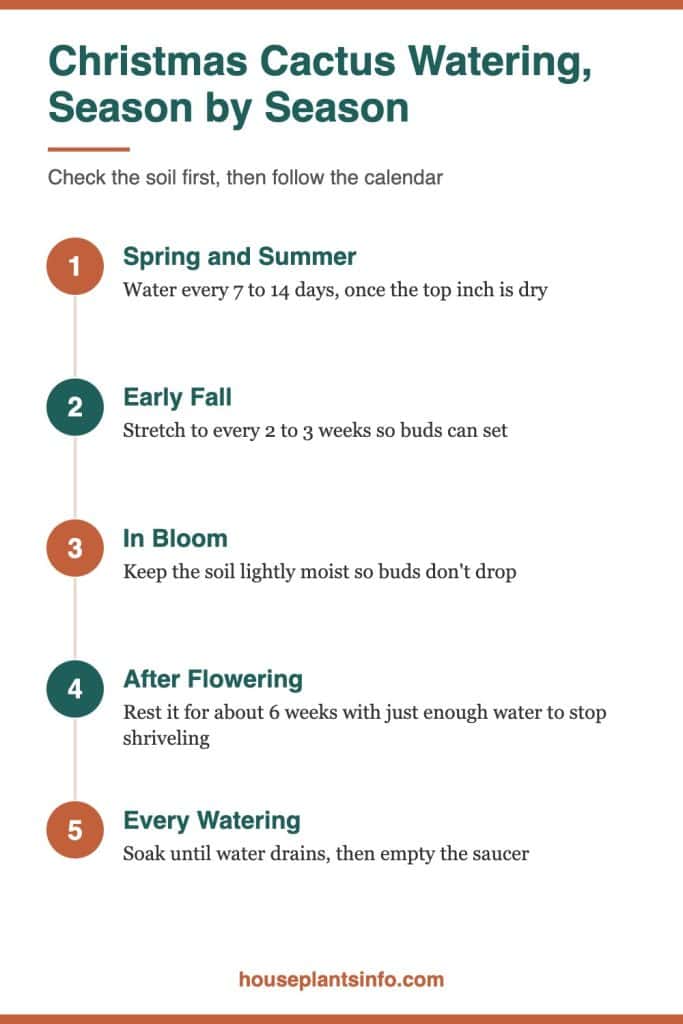
Water a Christmas cactus when the top inch of soil feels dry, which works out to about every 7 to 14 days in spring and summer and every 2 to 3 weeks from fall through winter.
Each time, water until it runs out of the drainage hole, then empty the saucer.
That schedule moves around more than most care tags admit. A 4-inch plastic pot near a forced-air vent in January can dry out faster than a 6-inch clay pot sitting on a cool porch in August.
So treat the numbers below as a starting point, and let the soil have the final say.
Updated October 2026: rewritten with a season-by-season schedule, pot and heating adjustments, and the Thanksgiving cactus timing difference.
| What changes the answer | Water more often | Water less often |
|---|---|---|
| Pot | Small, terracotta, or root-bound | Large, plastic or glazed, freshly repotted |
| Room | Warm, dry furnace air, bright south window | Cool room, north window, humid bathroom |
| Plant stage | Growing in summer, holding open flowers | Resting after bloom, setting buds in fall |
Check the Soil, Not the Calendar
Push a finger into the mix up to the first knuckle. If it’s dry there, water. If it’s still cool and slightly damp, wait three days and check again.
A plain wooden chopstick works too. Leave it in the pot for a minute, pull it out, and look for dark, damp soil clinging to it.
If you’d rather have a number, a cheap soil moisture meter takes the guessing out of it for beginners, as long as you push the probe about halfway down the pot and read it the same way every time.
One more check costs nothing: lift the pot. A freshly watered 6-inch Christmas cactus feels noticeably heavier than a dry one, and after a few weeks you can tell by weight alone.

Christmas cactus is not a desert cactus. It grows on tree branches in Brazilian rainforests, rooted in leaf litter and moss. It wants more water than a barrel cactus and far less than a fern, which is why it confuses people.
The Year-Round Schedule
| Season | What the plant is doing | How often to water |
|---|---|---|
| Spring (March to May) | New segments forming | Every 7 to 14 days |
| Summer (June to August) | Steady growth | Every 7 to 10 days, more on a porch |
| Early fall (September to October) | Setting flower buds | Every 2 to 3 weeks |
| Bloom (November to January) | Flowering | When the top inch is dry, never bone dry |
| Late winter (after bloom) | About 6 weeks of rest | Every 3 to 4 weeks, just enough to keep segments firm |
The fall stretch matters most if you want flowers. Cooler nights around 50 to 55°F, long dark nights and slightly drier soil are what tell the plant to make buds.
If you keep watering it like it’s July, you’ll get more green segments and fewer flowers. The full routine for bud set is in how to make a Christmas cactus bloom.
Your Plant Might Be a Thanksgiving Cactus
Most holiday cactus sold at US grocery stores and big-box garden centers in November are Thanksgiving cactus (Schlumbergera truncata), not true Christmas cactus. Look at the leaf segments. Pointed, claw-like teeth on the edges mean Thanksgiving cactus. Rounded, scalloped edges mean Christmas cactus.
The watering rules are the same. The calendar shifts about four weeks earlier for Thanksgiving cactus, so start the drier fall stretch in early September and expect blooms in mid to late November.
Pot and Soil Change Everything
A dense, peat-heavy potting soil holds water for a long time, and that’s where most Christmas cactus problems start. These plants like a loose mix, roughly two parts regular potting mix to one part perlite or orchid bark.

That lets water run through and leaves air around the roots. More on blends in what soil a Christmas cactus needs.
Pot material matters too.
- Terracotta breathes, so the soil dries a few days faster. It’s good if you tend to overwater.
- Plastic or glazed ceramic holds moisture longer. It’s good if you forget, or if your apartment air is very dry in winter.
- Decorative pots with no hole are the real trouble. If the plant came in one, keep it in its nursery pot inside, and tip out any water that collects after 15 minutes.
Christmas cactus actually likes being slightly root-bound. A snug pot dries evenly, so don’t size up more than an inch at a time.
Sophia’s tip: if your heat comes from radiators or floor vents, keep the plant at least 3 feet away.
Hot, dry air pulls water out of the top of the soil fast while the bottom stays wet, and that uneven drying is a common reason a plant looks thirsty and soggy at the same time.
How to Water It the Right Way
- Use room-temperature water. Cold water straight from the tap in winter can shock tropical roots.
- Pour slowly over the whole soil surface until water comes out of the drainage hole.
- Let it drain for 10 to 15 minutes, then empty the saucer or cachepot.
- Every few months, bottom-water instead. Set the pot in a few inches of water for 20 minutes so the whole root ball rehydrates evenly.
About water type: ordinary tap water is fine for most homes. Skip water from a salt-based softener, because the sodium builds up in the soil.
If you have very hard water and see a white crust on the pot rim, use rainwater or distilled water every third watering to flush it out.
Ice cubes get recommended a lot for holiday plants. They’re not ideal here. Ice delivers cold water to a rainforest plant’s roots and usually doesn’t wet the whole pot.
Signs You’re Watering Wrong
The segments tell you a lot. Firm, plump, glossy green segments mean the watering is about right.
Too much water shows up as limp, soft segments that feel squishy, a dark or mushy base, segments breaking off at the joints, and a sour smell from the soil.
If you see these, stop watering and read how to care for an overwatered Christmas cactus before you do anything else.
Too little water looks wrinkled and thin, with segments that feel leathery and sometimes turn reddish at the edges. Wrinkling is easy to fix with a thorough soak. Our guide on why a Christmas cactus looks wrinkled covers the other causes.
The confusing part is that both problems make the plant limp. Feel the soil.
Dry soil and limp segments means thirst. Wet soil and limp segments means the roots are rotting and can’t take up water.
There’s a side-by-side breakdown in why the leaves on a Christmas cactus go limp.
Watering While It Blooms
Buds and open flowers use more water than the rest of the plant. Don’t let the soil go fully dry while it’s in bloom, or it may drop buds overnight. Check twice a week and water as soon as the top inch is dry.
Also, don’t move it around once buds form. A sudden change in light or temperature drops buds as surely as dry soil does. If flowers are falling despite good watering, why a Christmas cactus drops buds and leaves walks through the other causes.
Pet safety: the ASPCA lists Christmas cactus as non-toxic to cats and dogs. A pet that chews a lot of it may still throw up from the fiber, so keep it on a shelf if your cat treats it as a salad.
The Routine I’d Use
- Every Sunday: finger-test the soil.
- Spring and summer: water when the top inch is dry, usually every week or so.
- September: start stretching to every 2 to 3 weeks, and give it long, dark nights.
- Bloom season: check twice a week, never let it go bone dry.
- After flowering: let it rest about 6 weeks with light watering, then go back to the spring routine. The steps for that rest period are in what to do after a Christmas cactus flowers.
More Christmas Cactus Watering Questions
Should I mist my Christmas cactus?
Misting adds very little. The water evaporates in minutes. If your winter air drops below about 30% humidity, a pebble tray or a small humidifier nearby helps more.
How long can a Christmas cactus go without water?
A healthy plant in a cool room can manage about 3 to 4 weeks, especially in its post-bloom rest. In summer or while it’s in bloom, two weeks of dry soil is pushing it.
Can I water a Christmas cactus from the bottom every time?
You can, but top-water now and then too. Watering only from the bottom never flushes salts down and out, so they build up near the surface over time.
Does a Christmas cactus need less water in a north window?
Yes. Less light means slower growth and slower drying. A north-facing plant often goes 2 to 3 weeks between waterings even in summer.
Should I water right after repotting?
Wait about a week. Repotting tears small roots, and waiting lets them seal over before they sit in wet soil.

Hi! I’m Sophia, and I love plants – especially an expert in growing house plants. I stay in Chicago, United States of America, and through my blog and social media platforms, provide tips and tricks on how to grow healthy, vibrant plants indoors. Check out more here.