
You are looking at a cactus on your windowsill that has gone weeks without a drink, yet it still looks plump, green, and completely unbothered.
If you have wondered how do cactus store water so well, the answer is a set of adaptations that work together from root tip to spine.
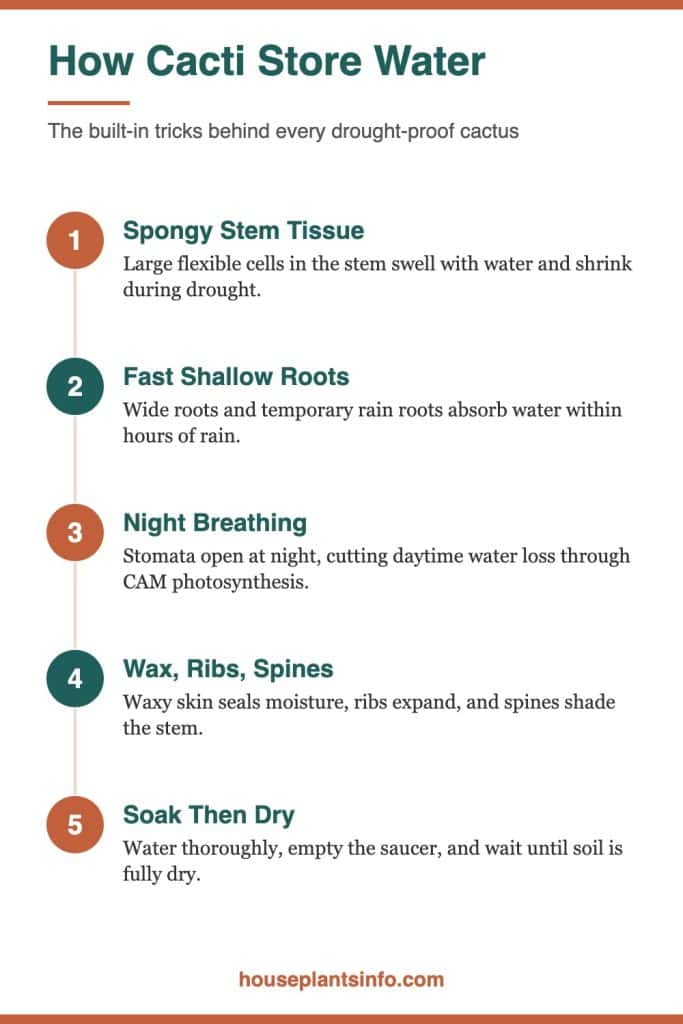
The short version: Cacti store water in thick, spongy tissue inside their stems, made of large cells that swell when water is available and slowly shrink during drought. Wide, shallow roots grab water fast.
A waxy skin, spines instead of leaves, and nighttime breathing keep that water from escaping.
This guide covers each storage trick, how much water a cactus can hold, and what all of it means for watering your cactus indoors.
At a Glance
| Factor | What it needs |
|---|---|
| Light | Bright light; a south or west window within 1 to 2 feet of the glass, or a grow light |
| Water | Soak thoroughly, then let the soil dry completely before watering again |
| Humidity | Low to average household humidity; dry winter air is fine |
| Temperature | 65°F to 85°F in the growing season; 50°F to 60°F winter rest suits many desert species |
| Soil | Fast-draining cactus mix with added grit or perlite, in a pot with a drainage hole |
| Pet safety | Spines are the main hazard; place out of reach of curious pets and kids |
| Difficulty | Easy, as long as you avoid overwatering |
How Do Cactus Store Water Inside the Stem?
Cacti store most of their water in the stem, inside a soft core of large, thin-walled cells called parenchyma. These cells act like tiny water balloons, filling up after rain and slowly releasing water as the plant needs it.
The Water-Holding Tissue
Slice a cactus stem and you will see two zones. The outer green layer, called the chlorenchyma, does the photosynthesis that leaves would normally handle. Beneath it sits the pale, moist storage tissue that holds the reserve.
The storage cells have flexible walls. They can expand dramatically when water arrives and contract without damage when the plant draws on its supply. This flexibility is what lets a cactus survive long dry spells.
Mucilage: The Natural Gel
Many cacti also contain mucilage, a thick, slimy substance made of complex sugars. Mucilage binds water and holds onto it tightly, which slows water loss even when the surrounding air is very dry.
You may notice this gel if you ever cut a prickly pear pad. That sticky texture is part of the plant’s water-saving system, not a sign of rot.
What This Means on Your Windowsill
Because the stem is the water tank, its firmness tells you a lot. A plump, firm stem is well supplied. A slightly soft or wrinkled stem in a dry pot usually means the reserve is running low.
Before you water, check the soil as well as the stem. A soil moisture meter pushed deep into the pot shows whether the root zone is still damp, which matters because the surface dries much faster than the bottom.

If your cactus sits in a dim spot, a grow light helps it use stored water steadily instead of letting soggy soil linger.
Sophia’s tip: Press the stem gently with a fingertip once a week. Learn how it feels when well watered, and you will spot early thirst or early softness from rot long before it shows visually.
How Do Cactus Roots Collect Water So Fast?
Most cacti have shallow, wide-spreading roots that soak up water within hours of rain. They capture as much as possible before the desert sun dries the soil again.
Wide and Shallow Root Networks
Many desert cacti send roots out horizontally, often just a few inches below the surface. In large species like the saguaro, these roots can spread outward roughly as far as the plant is tall.
This design makes sense in a desert, where rain is brief and rarely soaks deeply. A shallow net catches water across a large area during the short window it is available.
Rain Roots
After rainfall, many cacti grow fine, temporary roots known as rain roots, sometimes within a few hours. These absorb water quickly while the soil is moist.
When the soil dries out, the rain roots die back. The plant does not waste energy maintaining roots that have nothing to absorb.
Taproots in Some Species
Some cacti also have a thicker taproot that anchors the plant and can store extra water and starches. Certain small cacti grow a fleshy taproot larger than the visible stem above ground.
Why Roots Matter in a Pot
In a container, those shallow roots sit in a limited soil volume. If the mix stays wet, the roots stay wet too, and they rot quickly because they are built for short bursts of moisture.
This is why a wide, shallow pot with a drainage hole often suits cacti better than a deep one. Less soil below the roots means less water sitting unused at the bottom.
Why Do Cacti Breathe at Night?
Cacti open their pores at night instead of during the day, which cuts water loss dramatically. This process is called CAM photosynthesis.
Stomata and Water Loss
Plants take in carbon dioxide through tiny pores called stomata. Every time those pores open, water vapor escapes. In daytime desert heat, that loss would be severe.
Cacti also have fewer stomata than most leafy plants, and the pores are often set slightly into the skin. Both features help limit evaporation.
How CAM Works
At night, when air is cooler and more humid, cacti open their stomata and absorb carbon dioxide. They store it as an acid inside their cells.
During the day, the stomata close tightly. The plant then releases the stored carbon dioxide internally and uses sunlight to complete photosynthesis without opening its pores.
Indoor Effects
Indoors, CAM is one reason cacti handle dry radiator heat and forced-air furnaces so well. They simply keep their pores closed during the driest hours.
It also explains why cacti grow slowly. Nighttime carbon collection is efficient for water, but it limits how quickly the plant can build new tissue.
What Do Spines, Ribs and Wax Have to Do With Water?
The outer features of a cactus are a water-saving package. Spines replace leaves, ribs let the stem expand, and a waxy coating seals moisture inside.
Spines Instead of Leaves
Cactus spines are modified leaves. Broad leaves would lose large amounts of water through their surface, so cacti reduced them to hard, narrow spines with almost no surface area.
Dense spines also shade the stem and trap a thin layer of still air against the skin. That reduces drying airflow and lowers surface temperature. In some species, spines also help collect moisture from fog or dew.
Spines grow from structures called areoles, which are unique to cacti. Areoles are the small, cushion-like spots where spines, flowers, and new branches emerge.
Ribs and Pleats
Many cacti, including barrel cacti and saguaros, have vertical ribs that work like an accordion. When the plant takes up water, the ribs spread apart and the stem swells. During drought, they fold back in.
This lets the stem change volume without splitting. You can sometimes see deeper grooves on a thirsty ribbed cactus and smoother, fuller ribs after a good watering.
The Waxy Cuticle
The skin of a cactus is covered by a thick, waxy layer called the cuticle. It acts like a seal, slowing evaporation from the stem surface.
On some species the wax gives a bluish or powdery look. Avoid wiping it off when cleaning, since that coating is part of the plant’s protection.
Shape and Surface Area
Rounded and columnar shapes hold a lot of volume compared to their surface area. Less exposed surface means less water escaping, which is why so many cacti look like spheres or thick cylinders.
Sophia’s tip: Dust a cactus with a soft, dry paintbrush instead of a damp cloth. It clears grime from between spines without stripping the waxy coating or leaving moisture at the areoles.
How Much Water Can a Cactus Hold?
A cactus stem can be roughly 80 to 90 percent water by weight when fully hydrated. Large species hold enormous amounts, while small houseplant cacti hold just enough to ride out weeks of drought.
Large Desert Species
A mature saguaro is the classic example. After heavy rain, a large saguaro can absorb roughly 200 gallons of water, and its weight increases noticeably as the ribs expand.
Barrel cacti also store substantial water in their thick, rounded bodies. Their ribs swell visibly after rain.
Typical Houseplant Cacti
Common indoor cacti like bunny ears, golden barrel, or small columnar types hold far less in absolute terms. Relative to their size, though, they are still dense water stores.
| Cactus type | Typical storage behavior | Signs of a full reserve |
|---|---|---|
| Saguaro (outdoor, desert) | Up to roughly 200 gallons in a mature plant | Ribs spread wide and smooth |
| Barrel cactus | Large reserve in a rounded body | Firm, swollen ribs |
| Prickly pear | Water in flat pads, rich in mucilage | Pads flat, firm, upright |
| Small globular cactus | Modest reserve, often with a fleshy root | Plump, firm stem |
| Jungle cacti (Christmas cactus) | Smaller reserve in thin segments | Firm, glossy segments |
Jungle Cacti Are Different
Not all cacti are desert plants. Christmas and Easter cacti come from humid forests, where they grow on trees. Their flat segments store some water, but much less than desert species.
These jungle types need more frequent watering and dislike drying out completely. Treating them like desert cacti is a common mistake.
How Long Can a Cactus Go Without Water Indoors?
A healthy desert cactus indoors can usually go 2 to 4 weeks between waterings in the growing season and 4 to 8 weeks or longer during a cool winter rest. Large, established plants can survive far longer in the wild.
Factors That Shorten or Lengthen the Gap
The time a cactus can coast on stored water depends on several indoor conditions:
- Light: More light means more growth and faster water use. A south-facing window dries the plant quicker than a north one.
- Temperature: Warm rooms speed water use; a cool spot near a winter window slows it.
- Pot material: Unglazed terracotta dries out faster than plastic or glazed ceramic.
- Pot size: Small pots dry quickly; large pots hold moisture longer.
- Heat sources: A radiator or forced-air vent nearby dries soil fast.
Winter Rest
Many desert cacti slow down in winter when days are short and temperatures drop. During this rest they use very little water, and some growers water only once a month or less.
A cool rest around 50°F to 60°F also encourages flowering in many species. If your cactus sits in a warm room under a grow light all winter, it will keep growing and need water more often.

Surviving Neglect Versus Thriving
A cactus can survive months of neglect, but survival is not the same as good health. Long drought causes shrinking, slow growth, and fewer flowers.
The goal indoors is to let the plant use its reserve between thorough waterings, not to test how far it can go.
What Does Stored Water Mean for Your Watering Routine?
Because cacti hold so much water, the biggest risk is overwatering, not underwatering. The best routine is to soak the soil, let it dry completely, and repeat.
The Soak and Dry Method
Water until it runs freely from the drainage hole. Empty the saucer after 15 to 20 minutes so the roots are not sitting in water.
Then wait until the soil is fully dry, top to bottom, before watering again. For a detailed schedule by season, see this guide on how often should I water my cactus.
Signs of Too Much Water
When the storage cells are overfilled and roots sit wet, rot sets in. Watch for:
- Soft, mushy, or translucent spots, often near the base
- Yellowing or blackening at the soil line
- Splitting skin from sudden swelling
- A sour smell from the soil
Signs of Too Little Water
An underwatered cactus draws down its reserve and shows it:
- Wrinkling or puckering of the stem
- Deeper grooves between ribs
- Slight softness without mushiness
- Pads or segments drooping or thinning
A thirsty cactus usually firms up within a few days of a thorough watering. A rotting one does not recover with more water.
Species With Different Needs
Some cacti use water faster than small globular types. Tall columnar cacti grow quickly in good light, so it helps to know how often should I water a Peruvian apple cactus if you grow one.
Jungle cacti store less and prefer lightly moist soil. Check how often do you water Christmas cactus before applying a desert routine to one.
Sophia’s tip: Lift the pot right after watering and again when the soil is bone dry. The weight difference becomes your most reliable watering signal, especially in winter when growth slows.
Pet and Child Safety
For most cacti, the main danger to pets and kids is the spines, which can lodge in skin, mouths, and paws. The ASPCA lists Christmas cactus as non-toxic to cats and dogs. Keep spiny species on high shelves or behind barriers.
Can You Drink the Water Stored in a Cactus?
Generally, no. Cacti do not hold pools of clean water, and the pulp of many species contains acids and alkaloids that can cause vomiting or diarrhea, which worsens dehydration.
Why the Movie Myth Fails
The stored water is bound inside cells and mucilage, not sloshing around in a hollow center. Squeezing pulp produces a bitter, sometimes harmful liquid rather than fresh water.
If you are curious about the risks, read more about whether you can drink water straight from a cactus and why it is a poor survival plan.
Safer Exceptions
Prickly pear fruit and young pads are commonly eaten and provide some moisture once the spines and fine bristles are removed. Bottled cactus water sold for drinking is usually made from prickly pear fruit.
For the details on which species are considered safer and how pulp is extracted, see this article on how to get water from a cactus.
Protected Species
Saguaros are protected in Arizona, and damaging or harvesting one without a permit can bring serious penalties. Their slow growth makes every plant valuable.
Your Next Steps
- Check your cactus stem for firmness and note how it feels when well hydrated.
- Confirm the pot has a drainage hole and the soil is a gritty, fast-draining cactus mix.
- Move the plant within 1 to 2 feet of a bright south or west window, or add a grow light.
- Water thoroughly, empty the saucer, and wait until the soil is completely dry before watering again.
- Cut back watering in winter, especially if the plant sits in a cool spot near the glass.
- Identify whether your cactus is a desert or jungle type, and adjust watering to match.
Common Questions About How Cacti Store Water
Where exactly does a cactus store water?
A cactus stores most of its water in the stem, inside soft parenchyma cells beneath the green outer layer. Some species also store water and starch in a thick taproot.
Why does my cactus look wrinkled?
Wrinkling usually means the plant has used up much of its stored water and needs a thorough soak. If the wrinkled area is also mushy or discolored, check for root rot instead.
Do cactus spines absorb water?
Spines mainly reduce water loss by shading the stem and slowing airflow across its surface. In some species they can help collect moisture from fog or dew, but roots remain the main water source.
Can a cactus store too much water?
Yes. Sudden heavy watering after long drought can cause the skin to split, and soggy soil leads to root rot because cactus roots are built for brief moisture.
Do jungle cacti store water the same way?
Jungle cacti like the Christmas cactus store some water in their flat segments, but far less than desert species. They prefer more frequent watering and should not dry out completely for long.

Hi! I’m Sophia, and I love plants – especially an expert in growing house plants. I stay in Chicago, United States of America, and through my blog and social media platforms, provide tips and tricks on how to grow healthy, vibrant plants indoors. Check out more here.