
A tall Peruvian apple cactus by your window has finally pushed out a fat, pale bud, and you are wondering whether that bloom will turn into fruit on its own.
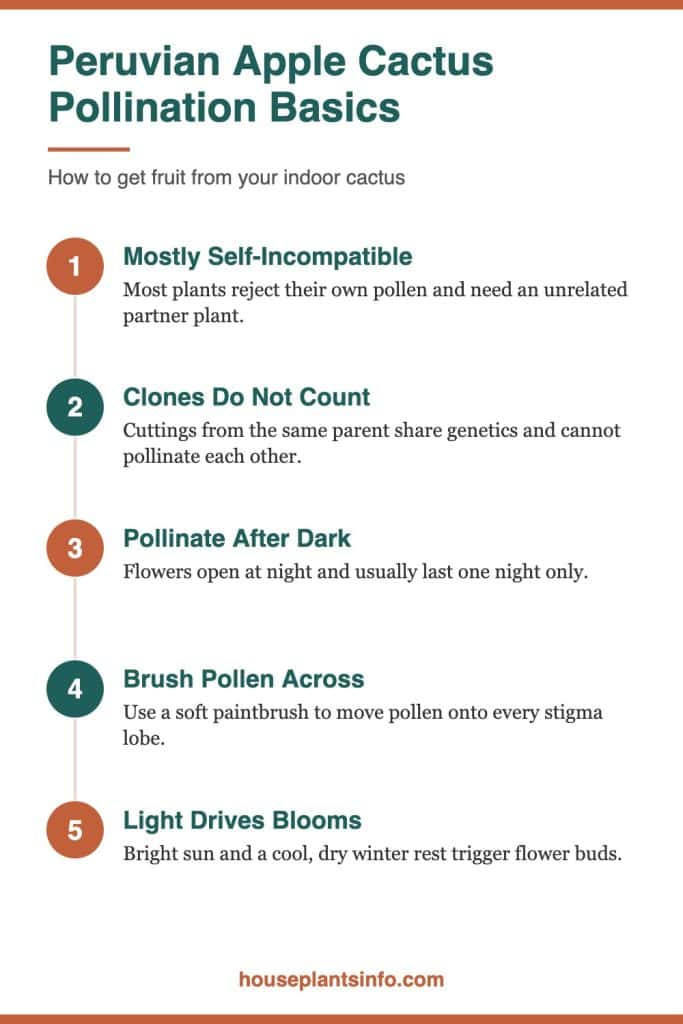
The short version: In most cases, no. The Peruvian apple cactus is largely self-incompatible, so a flower usually needs pollen from a genetically different plant to set fruit, and cuttings taken from the same parent do not count.
Indoors, you will almost always need to hand-pollinate at night with pollen from a second, unrelated plant.
This guide covers how the flowers work, why single plants rarely fruit, how to get indoor blooms, and how to hand-pollinate successfully.
At a Glance
| Factor | What it needs |
|---|---|
| Light | Full sun to very bright light, a south or west window or a strong grow light |
| Water | Deep watering when the mix is fully dry in spring and summer, very little in winter |
| Temperature | 70 to 90°F in the growing season, a cooler 45 to 60°F dry rest in winter |
| Soil | Fast-draining, gritty cactus mix in a pot with a drainage hole |
| Pet safety | ASPCA status not confirmed; the spines are the main hazard |
| Difficulty | Easy to grow, moderate to hard to flower and fruit indoors |
Is the Peruvian Apple Cactus Self-Pollinating?
Generally, it is not. Most Peruvian apple cactus plants (Cereus repandus, often sold as Cereus peruvianus) reject their own pollen, so a flower fertilized only with its own pollen, or pollen from the same plant, usually drops without forming fruit.
What self-incompatibility means
Many cacti have a built-in genetic system that recognizes and blocks pollen carrying the same identity as the flower. The pollen may land on the stigma and even germinate, but it fails to complete fertilization.
This is a natural strategy that encourages genetic diversity. In the wild, it pushes pollinators to carry pollen between separate plants spread across a landscape.
Why some sources say it can self-pollinate
You may see claims that certain plants set fruit alone. Self-compatibility can vary among individual plants and selections, and a few may produce occasional fruit with their own pollen.
Those fruits are often small, with fewer seeds. As a working rule, I recommend assuming your plant needs a partner unless it has already proven otherwise.
What you need to test it at home
If you want to check your own plant, a soft, small paintbrush and a headlamp or flashlight are all you need. Brush pollen from the flower’s own anthers onto its stigma at night and watch what happens over the next week or two.
If the base of the flower swells and stays green, the plant may have some self-fertility. If the flower withers and falls off cleanly within several days, it almost certainly needs cross-pollination.
Why a Single Plant Usually Will Not Set Fruit
A lone plant fails to fruit because it has no compatible pollen source and, indoors, no pollinators. Even a self-compatible flower rarely gets pollinated in an apartment without your help.
No genetic partner nearby
Cross-pollination requires a plant grown from a different seed. Two plants from the same parent are genetic clones, which means the flower treats their pollen exactly like its own.
This catches many growers off guard. If you rooted a stem from a friend’s plant and they rooted another from the same mother, those two will not pollinate each other.
No bats or moths indoors
In its native range in South America, this cactus opens its flowers at night. Bats and large night-flying moths are the main pollinators, drawn to the pale petals and sweet evening scent.
Inside a Chicago apartment, there are no bats, and moths rarely find a single potted cactus. A flower can open and close completely unvisited. Bees outdoors may visit flowers that linger into the morning, but they are less effective.
A very short window
Each flower typically opens after dusk and lasts only one night, sometimes fading by midmorning. If you sleep through it, the chance is gone. That brief timing is the other big reason fruit rarely forms on indoor plants.
How the Peruvian Apple Cactus Flower Works
The flower is large, white, and funnel-shaped, usually around 5 to 6 inches across, with hundreds of pollen-bearing stamens surrounding a central, branched stigma. Knowing these parts makes hand-pollination straightforward.
The parts you will work with
- Stamens: thin, numerous filaments topped with anthers that hold yellow or cream pollen.
- Stigma: the pale, star-shaped or lobed tip in the center, usually standing slightly above the stamens.
- Style: the tube connecting the stigma to the ovary below.
- Ovary: the swollen base of the flower, which becomes the fruit if fertilization succeeds.
Bloom timing and season
Flowering normally happens in late spring and summer, when days are long and warm. A bud can take a few weeks to develop from a small bump on the side of the stem to a full-size, pointed bud ready to open.
Buds usually swell noticeably and loosen at the tip a day or two before opening. That is your signal to plan for an evening session.
What happens after successful pollination
When fertilization works, the petals wither, but the ovary stays firm and green and slowly enlarges. The fruit typically ripens over roughly 1 to 2 months, depending on warmth and light.
Ripe fruit is usually red to pinkish-yellow, smooth, and spineless, with sweet white flesh and tiny crunchy black seeds. Many growers find it splits slightly or softens when ready.
Sophia’s tip: Put a small tag on each flower stem after you pollinate it, marked with the date and which plant supplied the pollen. That way you can match each successful fruit to the right partner next season.
What It Takes to Get Indoor Blooms
You need a mature plant, very bright light, and a cool, dry winter rest. Without those three, pollination never becomes a question because the plant does not flower.
Size and age
Peruvian apple cactus rarely blooms while young. Many plants need to reach several feet tall and several years of age before flowering, and some indoor plants take longer.
Plants started from large, mature cuttings may flower sooner than seedlings. If you plan to grow Peruvian apple cactus from cutting, choose a thick, healthy stem section from a plant that has already bloomed.
Light is the biggest factor indoors
Flowering takes a lot of energy, and window light is often weaker than it looks. An unobstructed south or west window, within a foot or two of the glass, is the minimum for a good chance at buds.
If your windows face north or east, a full-spectrum grow light placed about 12 to 18 inches above the top of the plant for 12 to 14 hours a day can help. Tall columns may need the light angled to reach the upper stem.

Moving the plant outdoors for summer, once nights stay above 55°F, is one of the most reliable ways to trigger blooms. Introduce direct sun gradually over 2 to 3 weeks to avoid sunburn.
The winter rest
A cool, dry rest in winter helps many cacti set flower buds. Aim for roughly 45 to 60°F, bright light, and only occasional, light watering from about November through February.
In an apartment, that might mean a bright spot away from radiators and forced-air vents, or near a cool window that does not drop below freezing. Constant warmth and regular watering in winter tend to produce soft growth instead of buds.
Feeding and watering in the growing season
Water deeply when the mix dries out completely during spring and summer. A diluted cactus fertilizer every 4 to 6 weeks in the growing season supports flowering, and a lower-nitrogen formula is preferable.

For a full routine on light, watering, and repotting, see how to care for Peruvian apple cactus through the year.
How to Hand-Pollinate a Peruvian Apple Cactus
Hand-pollination means collecting pollen from one plant and brushing it onto the stigma of a flower on a different, unrelated plant, on the night it opens. It takes only a few minutes per flower.
What you need
- A soft, small paintbrush or cotton swab, one per pollen source.
- A headlamp or flashlight.
- A small paper envelope or folded paper for collecting pollen.
- Tags or tape for labeling.
Step-by-step method
- Watch for swelling buds and check both plants in the evening.
- Wait until the flower is fully open, usually a couple of hours after dark.
- Gently brush the anthers of the donor flower until the brush is coated with pollen.
- Lightly dab and sweep the pollen across all lobes of the stigma on the receiving flower.
- Repeat in the opposite direction if both plants are blooming the same night, so both can set fruit.
- Label the pollinated flower with the date and pollen source.
Timing tips
Pollinating within the first few hours after the flower opens gives the best chance, while the stigma is fresh and receptive. A second gentle application later the same night does no harm.
Handle the flower carefully. Bruising or snapping the style can end the attempt before it begins.
When your two plants do not bloom together
This is the most common obstacle. Pollen can be collected on the night one plant blooms, folded into a dry paper envelope, and stored in the refrigerator for use within several days.
Viability drops over time and is less reliable after a week or so. Keep the envelope dry, since moisture ruins pollen quickly.
Sophia’s tip: Collect pollen by holding the open envelope directly under the anthers and tapping the stamens with your brush. Pollen falls straight in, and you avoid shaking spines or bumping the stem in the dark.
Fruit Not Forming? Causes and the Fix for Each
If flowers fade and drop without fruit, the cause is usually incompatible pollen, missed timing, or a stressed plant. Most of these are fixable by next season.
Same-plant or clone pollen
Cause: The pollen came from the same plant or a cutting of it. Fix: Find a plant grown from a different seed, and confirm its origin with the grower if you can.
Pollinated too late
Cause: The flower was pollinated the next morning, after the stigma lost receptivity. Fix: Check buds at dusk and pollinate within the first hours after full opening.
Old or damp pollen
Cause: Stored pollen lost viability. Fix: Use fresh pollen when possible, and keep stored pollen dry and cold for no more than several days.
Plant under stress
Cause: Low light, root problems, or a sudden move can cause a plant to abort flowers or young fruit. Fix: Keep conditions steady while fruit develops and avoid repotting during flowering.
Discoloration on the stem can also signal stress worth checking before you count on fruit. This guide to Peruvian apple cactus yellowing explains common causes, and dark, spreading patches are covered in the article on a Peruvian apple cactus turning black.
Watering swings during fruit set
Cause: Long dry spells or soggy soil while fruit swells. Fix: Water deeply when the mix dries, and never let the pot sit in a saucer of water.
| What you see | Likely cause | What to do |
|---|---|---|
| Flower drops within days | Incompatible or no pollen | Cross-pollinate with an unrelated plant |
| Flower base yellows and shrivels | Fertilization failed | Try fresher pollen sooner after opening |
| Small fruit drops early | Stress or weak pollination | Steady light and watering, pollinate thoroughly |
| No flowers at all | Too young, low light, no winter rest | Increase light, give a cool dry winter |
| Fruit forms but stays small | Partial self-pollination or low energy | Use cross pollen and feed in summer |
Finding or Growing a Compatible Second Plant
You need a second plant that is genetically different, which in practice means one raised from separate seed. Two unrelated plants can then pollinate each other.
Seed-grown versus cutting-grown plants
Cuttings carry the exact genetics of their parent plant. That makes them fast and reliable for growing, but useless as pollination partners for the parent or for other cuttings from it.
Seed-grown plants are each genetically unique. Two seedlings from the same fruit are usually compatible, because each seed has a different genetic mix.
Starting from seed
Seed from a ripe fruit can be rinsed clean, dried, and sown on the surface of a gritty, sterile mix. Keep it warm, around 70 to 80°F, under bright light and a clear cover, misting gently to keep the surface just damp.
Seedlings grow fairly quickly for a cactus, but expect several years before they are large enough to bloom. Think of it as a long-term project.
Rooting a partner cutting
If a friend has a plant from a different seed source, a cutting from it is a valid partner for your plant. Allow the cut end to callus, then plant in dry, gritty mix.
If a new stem sits for weeks without anchoring, the guide to a Peruvian apple cactus not rooting walks through the common causes.
Sophia’s tip: When you get a new plant or cutting, write its source on a plant label pushed into the pot. Years later, that note tells you which plants can pollinate each other.
Space and safety indoors
Two tall columnar cacti need room near a bright window. Keep them where they will not tip, ideally in heavy terracotta pots, and away from walkways.
I could not confirm an ASPCA toxicity listing for Peruvian apple cactus, so treat it with caution. The spines are the clear hazard for pets and kids, so keep plants and fallen flowers out of reach.
Your Next Steps
- Test your plant’s self-fertility with its own pollen on the next bloom, and note whether the flower base swells.
- Confirm the origin of any second plant so you know it was grown from different seed.
- Move your plant to the brightest window or add a grow light for 12 to 14 hours a day.
- Give a cool, dry winter rest around 45 to 60°F, away from radiators and heat vents.
- Keep a paintbrush, headlamp, and paper envelope ready for evening pollination in late spring and summer.
- Label every pollinated flower with the date and pollen source.
Common Questions About Peruvian Apple Cactus Pollination
Can two cuttings from the same plant pollinate each other?
No. Cuttings are clones of the parent, so their pollen is genetically identical and gets rejected. You need a plant grown from different seed.
What time of day should I pollinate the flowers?
Pollinate at night, ideally within the first few hours after the flower fully opens. Each flower usually lasts only one night, so check developing buds every evening once they swell.
How do I know pollination worked?
The petals will wither, but the green base of the flower stays firm and gradually enlarges over the following weeks. If pollination failed, the whole flower yellows and drops within several days.
How long does Peruvian apple cactus fruit take to ripen?
Fruit usually ripens in about 1 to 2 months after successful pollination. Warm temperatures and bright light tend to speed it up, and ripe fruit is typically red or pinkish with soft, sweet flesh.
Why does my indoor plant never flower at all?
The plant may be too young, or it may not be getting enough light or a cool winter rest. Flowering often requires a plant several feet tall, full sun or a strong grow light, and a dry winter around 45 to 60°F.

Hi! I’m Sophia, and I love plants – especially an expert in growing house plants. I stay in Chicago, United States of America, and through my blog and social media platforms, provide tips and tricks on how to grow healthy, vibrant plants indoors. Check out more here.