
Peruvian apple cactus is the one cactus people buy small and then measure against the ceiling a few years later. It’s tough, it forgives a missed watering, and it shows you every bit of light you give it by how fast it climbs.
The short version: outdoors in a warm climate, an established Peruvian apple cactus (Cereus repandus, often sold as Cereus peruvianus) grows about 1 to 2 feet a year and can reach 6 feet in roughly 3 to 6 years.
Indoors in a pot, expect much less, usually 4 to 12 inches a year. A south or west window, a summer outside and a winter rest are the things that move it toward the fast end.
Updated October 2026: rewritten with indoor growth rates, a season-by-season routine for US homes, and what to do when it gets too tall.
| At a Glance | |
|---|---|
| Growth rate | 1 to 2 ft per year outdoors, about 4 to 12 inches per year indoors |
| Light | Full sun outdoors, the brightest south or west window indoors |
| Water | Every 1 to 2 weeks in summer, every 4 to 6 weeks in winter |
| Temperature | 65 to 90°F growing, 45 to 60°F winter rest, damage below about 25°F |
| Soil | Fast-draining cactus mix with extra pumice or perlite |
| Outdoor zones | USDA 9 to 11 year-round |
| Pet safety | Not known to be poisonous, but the spines are a hazard |
Where to Put It
Light decides the growth rate more than anything else you control.
Indoors, put it in a south-facing window, as close to the glass as you can without it touching. West is the next best.
An east window gives a gentle morning dose and a slow-growing plant. A north window isn’t enough.
The cactus will stretch toward the glass, grow thin and pale at the tip, and lean.
Distance from the glass matters more than people expect. Light falls off fast once you step back from a window.
A plant 3 feet back from a south window gets a fraction of what it gets right at the sill, even though the room looks bright to your eyes.
If you own a light meter, or a free light meter app on your phone, aim for a few thousand foot-candles or more at the tip at midday.

Old window screens and low-E glass also cut light, so a summer outside often makes a bigger difference than any indoor spot.
That thin, narrow new growth is called etiolation, and it doesn’t fatten back up later. If the top few inches of your plant are narrower than the rest of the column, it’s been short on light.
The fix is more light from now on, not pruning.
If you don’t have a sunny window, a full-spectrum grow light 12 to 18 inches above the tip, on for 12 to 14 hours a day, keeps it growing steadily.

Rotate the pot a quarter turn every couple of weeks so the column grows straight instead of bowing toward the window.
Spring: Wake It Up
Growth starts again in March or April, once days lengthen. You’ll see the tip of each column turn a brighter, fresher blue-green.
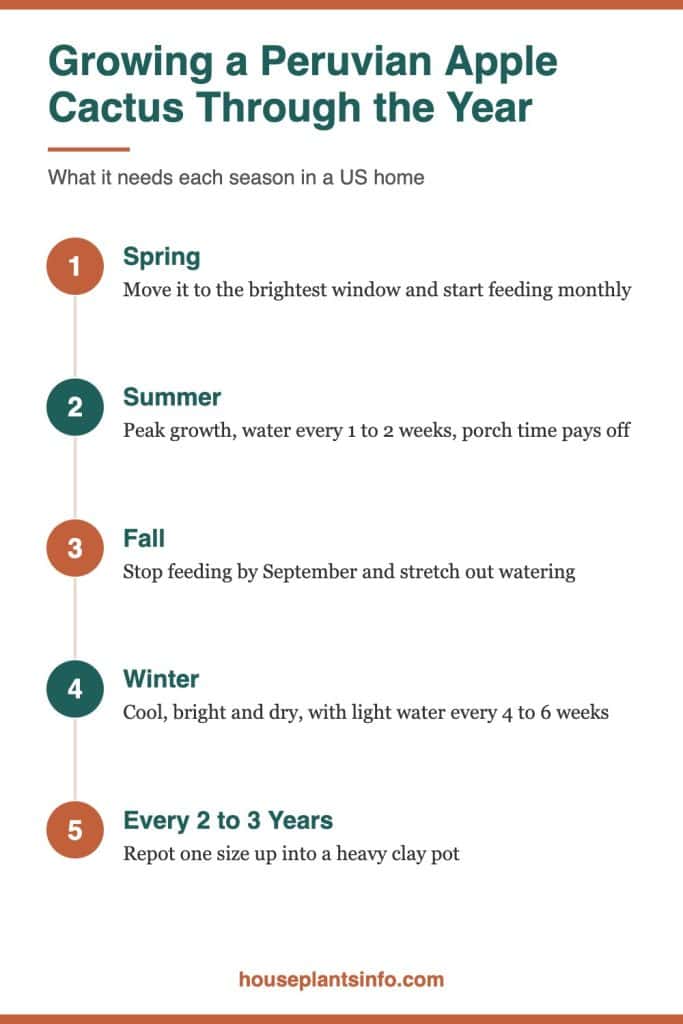
- Move it to your brightest spot if it spent winter somewhere cooler.
- Go back to a regular watering routine: soak when the soil is dry all the way down, usually every 2 weeks or so.
- Start feeding once a month with a cactus fertilizer at half strength.
If you plan to put it outside for summer, wait until nights stay above 55°F. In much of the US that’s mid to late May.
In the Southeast and California it can be April. Don’t put it straight into full sun.
A cactus that spent winter behind glass will sunburn, leaving tan or white scorched patches that never go away. Start it in bright shade for a week, then morning sun for a week, then full sun.
Summer: Peak Growth
This is when the plant puts on most of its year’s height. A potted plant outdoors in full sun in summer can easily grow several times as much as it would on a windowsill over the same months.
Water every 7 to 14 days during hot weather, always letting the soil dry out between soakings. If it’s on a porch or patio and you get a long rainy spell, move it under an overhang.
Rain every day plus a heavy pot is how summer rot starts.
Indoors, summer is still the main growth season. A south window with the AC running is fine. Keep it out of the direct blast of a window unit, though, because constant cold air on one side slows growth on that side.
Keep feeding monthly through July. That’s the last feed for the year in most homes.
Sophia’s tip: watch the joints between this year’s growth and last year’s. A sharp narrowing at the point where it went back outside in spring, or came in for winter, is normal.
A long pencil-thin section means it spent too long in poor light, and that’s the cue to find it a better spot.
Fall: Slow It Down
By September, stop fertilizing. Late feeding pushes soft new growth that won’t harden before winter.
Stretch watering to every 2 to 4 weeks as nights cool. Bring outdoor plants in before nights drop to about 45°F, which is late September or early October for much of the Midwest and Northeast.
Check under the ribs and at the base for mealybugs before it comes inside. They look like tiny tufts of cotton.
Winter: Rest, Don’t Grow
Indoors, a Peruvian apple cactus barely grows from November through February, and that’s how it should be.
Give it a cool rest if you can, ideally 45 to 60°F, still in bright light. An unheated sunroom or a bright spot near a cool window works. Water lightly every 4 to 6 weeks, just enough to keep the stem from wrinkling.
In a typical heated apartment it won’t truly go dormant. That’s fine too. Keep it in the brightest window, water every 3 to 5 weeks, and don’t feed. What you want to avoid is warm, dim and wet, which produces weak, stretched growth.
Outdoors in zones 9 to 11, it can stay out all winter. A mature plant can usually handle brief dips into the mid-20s°F, but cover it with frost cloth on hard freeze nights.
If you’re on the edge of that range, will a Peruvian apple cactus grow in zone 8 covers protection in detail.
| Season | Indoors | Outdoors in zones 9 to 11 |
|---|---|---|
| Spring | Every 2 weeks once growth starts | Every 1 to 2 weeks in dry weather |
| Summer | Every 1 to 2 weeks | Every 7 to 10 days in heat |
| Fall | Every 2 to 4 weeks | Every 2 to 3 weeks |
| Winter | Every 4 to 6 weeks, cool room | Rainfall is usually enough |
For more detail on timing and how much to give, read how often to water a Peruvian apple cactus.
What Growth Looks Like Year by Year
From a 6- to 8-inch rooted cutting in a pot, here’s a realistic pace under good indoor conditions with summers outside:
| Age | Typical height in a pot |
|---|---|
| Year 1 | Roots in, 2 to 6 inches of new growth |
| Year 2 | 1 to 2 feet total |
| Years 3 to 5 | 2 to 4 feet, first side branches may appear |
| Years 5 and up | 4 to 6 feet or more, limited mostly by pot and ceiling |
Indoors year-round with no outdoor summers, add a year or two to each stage. In the ground in Arizona, Southern California or South Texas, it can go much faster and eventually reach 15 to 30 feet.
Cuttings grow faster than seedlings in the early years. A seed-grown plant can take a year or more just to reach a few inches. If you’re starting fresh, how to grow a Peruvian apple cactus from a cutting is the quicker route.
Flowers and fruit come late. Expect large white night-blooming flowers only on mature plants, usually once they’re several feet tall and getting plenty of sun. Indoor plants rarely flower. If yours does, see is the Peruvian apple cactus self-pollinating before you hope for fruit.
Soil, Pots and Repotting
Use a fast-draining cactus mix and cut it with extra pumice or perlite, about one part to three. Peruvian apple cactus has a fairly shallow root system for its height, so drainage matters more than depth.

Pick a heavy pot. Terracotta or thick ceramic stops a 4-foot cactus from tipping over when you water it or brush past it. A wide base helps more than a deep one. Always use a pot with a drainage hole.
Repot every 2 to 3 years in spring, going up just 2 inches in diameter. Wrap the column in a folded towel or several sheets of newspaper to handle it. Wait a week before watering after repotting.
A plant that keeps falling over may be top-heavy in a pot that’s too small, or rotting at the base. Why cactus get top heavy helps you tell which.
Feeding
Feed once a month from April through July with a cactus fertilizer, or a balanced liquid fertilizer mixed at half strength. More isn’t faster. Too much nitrogen gives soft, green, easily damaged growth and invites pests.
Skip feeding entirely in fall and winter, and for a month after repotting.
When It Hits the Ceiling
Most apartments have 8- to 9-foot ceilings, and a happy Peruvian apple cactus will reach that in a handful of years. You have two choices.
You can top it. In late spring or early summer, cut through the column with a clean, sharp knife at the height you want.
The cut end callouses over in a couple of weeks, and the plant often sprouts one or more new arms just below the cut. That’s the trick to a fuller, branching plant instead of a single pole.
Don’t throw away the piece you cut off. Let it dry in the shade for 1 to 2 weeks until the cut end forms a hard callus, then plant it in dry cactus mix. It roots readily and becomes a new plant.
Sophia’s tip: cut on a slight angle so water runs off the wound instead of sitting on it, and wear thick gloves. The spines on older growth are sharp and come in clusters.
Why It Might Not Be Growing
- Not enough light: by far the most common cause. A north or east window, or more than a few feet from glass, will stall it.
- Too much water in a cool room: the roots sit wet and stop working. Look for yellowing or a soft base. Why a Peruvian apple cactus turns yellow has the details.
- Root-bound or never fed: after 3 years in the same pot, growth often slows to a crawl.
- Cold roots: a pot on a cold floor or a drafty sill in winter keeps the roots too chilly to grow even when the stem is in sun. A plant stand or a cork mat under the pot helps.
- It’s winter: no growth from November to February is normal.
Pet safety: Peruvian apple cactus isn’t known to be poisonous to cats or dogs, and people eat the fruit. The real risk is the spines, so keep it away from where pets play. More in are Peruvian apple cactus poisonous.
Your Next Steps
- Move it to your brightest south or west window this week, as close to the glass as it can sit.
- Note today’s height on a strip of tape on the pot, and measure again next October.
- Stop fertilizing now if it’s fall, and restart in April.
- Plan a summer outside once nights stay above 55°F, with a slow move into full sun.
- If it’s within a foot of the ceiling, plan to top it next June and root the cutting.
- For full care beyond growth, see how to care for a Peruvian apple cactus.
Common Questions About Peruvian Apple Cactus Growth
How tall does a Peruvian apple cactus get indoors?
Most indoor plants top out around 5 to 8 feet, mostly limited by pot size and ceiling height. Outdoors in the ground, it can reach 15 to 30 feet or more.
Can I make it grow faster?
More light makes the biggest difference. A summer outdoors, monthly feeding from April to July, and a pot that isn’t root-bound all help. Warmth without extra light only produces stretched, weak growth.
Why is the new growth thinner than the old growth?
That’s etiolation from too little light. The narrow section stays narrow. Give it a brighter spot and new growth will be full width again.
How long does a Peruvian apple cactus live?
With decent care, it can live for decades, indoors or out. Repotting every few years and a yearly summer outside keep older plants growing.
Does the monstrose form grow at the same rate?
No. The lumpy, twisted monstrose form grows noticeably slower and rarely gets as tall, which is why many people pick it for indoors.

Hi! I’m Sophia, and I love plants – especially an expert in growing house plants. I stay in Chicago, United States of America, and through my blog and social media platforms, provide tips and tricks on how to grow healthy, vibrant plants indoors. Check out more here.