
Your cactus sits on a sunny windowsill, its ribs lined with neat clusters of spines that catch the light and snag your sleeve when you reach past it.
The short version: A cactus has thorns, more accurately called spines, because they are modified leaves that protect the plant from animals, shade its skin, and slow water loss. Spines let a cactus survive heat and drought where broad leaves would dry out and die.
This guide covers what spines are, the jobs they do, how indoor conditions change them, and how to handle a spiny plant safely.
At a Glance
| Factor | What it needs |
|---|---|
| Light | 4 to 6+ hours of direct sun, or a strong grow light 6 to 12 inches above |
| Water | Soak thoroughly, then let soil dry completely; far less in winter |
| Humidity | Low; typical dry apartment air is fine |
| Temperature | 65 to 90°F in the growing season; 45 to 60°F winter rest for many desert species |
| Soil | Fast-draining cactus mix with added grit or perlite |
| Pet safety | Spines cause physical injury; check the ASPCA listing for your exact species |
| Difficulty | Easy, as long as you avoid overwatering and low light |
Why Does a Cactus Have Thorns?
A cactus has thorns because its ancestors traded leaves for spines as they adapted to dry, sunny habitats. Leaves lose water through their large surface, while spines lose almost none and still defend the plant.
Leaves That Changed Their Job
Spines develop from the same tissue that would form leaves in other plants. Over a very long evolutionary history, cacti in the Americas lost broad leaves and kept these hard, narrow structures instead.
For a deeper look at that trade, see why do cactus have spines instead of leaves.
Mature spines are dead tissue, made mostly of tough fibers. They contain no living cells that need water, which is exactly why they suit a plant built to hold on to every drop.
What That Means on Your Windowsill
Indoors, those same spines still respond to light. A cactus under a bright south window or a strong grow light tends to grow denser, stronger spines than one stuck in a dim corner.

Since spines do not photosynthesize, the green stem does all the food making. That is why stem health, not spine count, tells you most about how your plant is doing.
Sophia’s tip: Keep a pair of long kitchen tongs near your cacti. They let you rotate, lift, or steady a plant without putting your fingers anywhere near the spines.
Are Cactus Thorns Really Thorns? Spines, Glochids and Areoles
Botanically, cactus “thorns” are spines, not thorns. True thorns are modified branches, while spines are modified leaves, and on cacti they always grow from small cushions called areoles.
Spines Versus Thorns Versus Prickles
Plant scientists separate three types of sharp structures. Thorns come from stems, as on a hawthorn. Prickles grow from the outer skin, as on a rose. Spines come from leaves, which is the case for every cactus.
Most people still say “cactus thorns,” and that is fine in everyday speech. The difference matters mostly when you want to understand how the plant grows.
The Areole Is the Giveaway
An areole is a small bump or pad, often fuzzy, that produces spines, new stems, and flowers. Every true cactus has areoles, even species with very short or nearly invisible spines.
The fuzz on areoles is often normal wool. If you see cottony material spreading across the stem rather than sitting on areoles, read why your cactus has white fuzz, since mealybugs can look similar.
Glochids: The Tiny Ones That Hurt Most
Prickly pears and chollas carry glochids, which are tiny, barbed hairs in clusters at the areoles. They detach at the lightest touch and lodge in skin.
Glochids often cause more irritation than large spines because they are hard to see and remove. Treat any prickly pear as if it can sting you, even when it looks soft.
| Structure | Origin | Common example |
|---|---|---|
| Spine | Modified leaf | All cacti |
| Glochid | Tiny barbed spine | Prickly pear, cholla |
| Thorn | Modified branch | Hawthorn, citrus |
| Prickle | Outgrowth of skin | Rose, raspberry |
How Spines Help a Cactus Survive the Desert
Spines do several jobs at once: they defend, shade, insulate, collect moisture, and in some species spread the plant. Each job helps a cactus keep water and survive harsh sun.
Defense Against Thirsty Animals
A cactus stem is a water tank in a dry landscape. Without protection, animals would chew it for moisture. Spines make the plant painful to eat, which is the most obvious reason they exist.
Shade on Hot Skin
Dense spines cast a fine net of shade across the stem. That shade lowers surface temperature and reduces sun damage, much like a mesh screen over a window.
Some species are covered in white spines or hairs that reflect strong light. Old man cactus and many mammillarias show this well.
A Layer of Still Air
Spines trap a thin layer of calm air against the stem. This slows air movement across the skin, which reduces water loss and buffers the plant against sudden heat or cold.
Catching Dew and Fog
In some habitats, spines help gather moisture from fog or dew. Droplets form on the spine tips and run down toward the stem or the soil around the roots.
Spreading to New Ground
Certain chollas have stem segments that break off easily and cling to passing animals with their spines. When a segment drops, it can root and grow into a new plant.
| Spine job | How it helps |
|---|---|
| Defense | Discourages animals from eating the stem |
| Shade | Lowers stem temperature and limits sunburn |
| Insulation | Traps still air, reducing water loss |
| Moisture collection | Directs dew or fog droplets toward the plant |
| Dispersal | Helps segments hitch rides and root elsewhere |
| Camouflage | Breaks up the plant’s outline among rocks |
What Other Adaptations Help Cacti Thrive With So Little?
Spines are only one part of the system. Cacti also store water in their stems, photosynthesize at night, wear waxy skin, and grow wide, shallow roots.
Water-Storing Stems and Ribs
A cactus stem holds water in spongy tissue. Many species have ribs or pleats that let the stem expand after rain and shrink during drought without splitting.
Indoors, a slightly shriveled cactus in late winter is often just using its stored water. It should plump up within days to a few weeks after a good watering in spring.
Night-Time Breathing
Most cacti use a process called CAM photosynthesis. They open their pores at night, when air is cooler, take in carbon dioxide, and close the pores during the day to save water.
This is one reason cacti grow slowly. It is also why they handle dry indoor air so well.
Waxy Skin and Small Surface Area
A thick, waxy outer layer seals in moisture. Rounded or columnar shapes hold a lot of volume with relatively little surface, so less water escapes.
That wax can rub off where you handle a plant. Pale or scuffed patches are sometimes just worn coating, though you can compare symptoms with why your cactus has white spots.
Shallow, Spreading Roots
Many cacti grow wide, shallow roots that soak up water quickly after a brief rain. Some also grow fine new roots within hours to a few days of moisture returning.
In a pot, this means a wide, shallow container with fast drainage often suits cacti better than a deep one. Deep, wet soil below the roots invites rot.
How Indoor Conditions Affect Spine Growth
Light has the biggest effect on spines indoors. Strong light produces thick, colorful, closely packed spines, while low light produces pale, thin, widely spaced ones.
Light and Window Direction
In a Chicago apartment, a south or west window gives most cacti the sun they need. East light works for smaller species. North light is rarely enough without a grow light.
Distance matters too. A cactus 2 feet from the glass gets much less light than one right at the sill, and winter sun is weaker and lower.
Stretching Changes the Spines
When light is too low, a cactus stretches toward the window. This is called etiolation. The new growth is narrower, paler, and spaced out, with areoles and spines farther apart.
Stretched growth does not shrink back. The fix is better light for future growth, so the new section returns to normal shape and spine density.
Sophia’s tip: When you move a cactus into stronger light, do it over 1 to 2 weeks. A sudden jump from a dim room to full sun can scorch the stem.
Heat, Drafts and Dry Winter Air
Radiators and forced-air vents dry the soil faster but rarely hurt spines directly. Still, keep cacti at least a few feet from a hot radiator so the stem does not cook on one side.
Cold glass is the bigger winter risk. Many desert cacti handle 45°F, but a stem pressed against icy glass can get chilled. Leave a small gap between the plant and the window.
Water and Feeding
Healthy roots support strong new spines. Overwatering leads to root rot, and a rotting cactus stops producing healthy growth.
A light feeding with a diluted, low-nitrogen fertilizer during spring and summer supports steady growth. Skip feeding in winter, when most cacti rest.
Is Something Wrong With My Cactus Spines? Common Changes and Fixes
Most spine changes come from age, handling, light, or pests. Spines themselves rarely signal disease, but the stem around them often does.
Spines Falling Off
Spines can break or drop when bumped, brushed against, or knocked during repotting. A spine that falls off an areole usually does not regrow there, but new growth will carry fresh spines.
If spines fall out along with soft, mushy tissue, the cause is rot, not handling. Check the base and roots right away.
Spines Turning Gray or Brown
Older spines often fade to gray or tan with age. That is normal, especially lower on the plant.
Brown or black patches on the stem itself are a different issue. Learn what they mean in why your cactus has brown spots and why your cactus has black spots.
Corking at the Base
Many older cacti develop a tan, bark-like layer near the soil line. This corking is often natural aging. It starts at the bottom and moves slowly upward, and the tissue stays firm.
Firm corking is fine. Soft, dark, or wet tissue is not, and calls for unpotting and checking the roots.
Thin, Weak New Spines
Thin, sparse spines on new growth almost always point to low light. Move the plant closer to a bright window or add a grow light for 12 to 14 hours a day.
| What you see | Likely cause | Fix |
|---|---|---|
| Spines snapped off | Bumping or handling | Move plant out of traffic paths |
| Gray, faded old spines | Normal aging | No action needed |
| Thin, widely spaced spines | Low light | More direct sun or a grow light |
| Spines falling with soft tissue | Root or stem rot | Unpot, cut away rot, repot dry |
| Cottony clumps between spines | Possible mealybugs | Dab with rubbing alcohol, isolate plant |
How to Handle and Repot a Spiny Cactus Safely
Use barriers between your hands and the spines: a folded towel, newspaper, or thick gloves, plus tongs for small plants. Never grab a cactus bare-handed, even a small one.
What to Use
A strip of folded newspaper or a dish towel wrapped around the stem gives you a safe grip. Leather or thick rubber-coated gloves help, though fine spines and glochids can still work through fabric.
For tiny cacti, tongs or chopsticks give better control. A soft brush helps clear soil from between spines after repotting.
Repotting Step by Step
- Wait until the soil is dry so the root ball slips out easily.
- Wrap the stem with a folded towel or newspaper strip.
- Tip the pot and ease the plant out, loosening the sides if needed.
- Shake off old soil and trim any dark, soft roots.
- Set the plant in fresh, dry cactus mix at the same depth.
- Wait about a week before watering so any damaged roots can heal.
Sophia’s tip: To pull glochids from skin, press a strip of wide tape over the area and peel it off, then repeat. Tweezers work better for larger single spines.
Removing Spines From Skin
Pull larger spines straight out with tweezers, following the angle they went in. Wash the area with soap and water afterward.
If a spine breaks off deep in the skin, or the area gets red, warm, or swollen, contact a medical provider. Spines can carry soil bacteria into the wound.
Are Cactus Spines Dangerous to Pets and Kids?
For most cacti, the main danger is physical injury from spines rather than poisoning. Curious cats, dogs, and toddlers can get spines in paws, mouths, or fingers.
Toxicity Versus Injury
The ASPCA lists Christmas cactus as non-toxic to cats and dogs. For other cacti, check the ASPCA listing for your exact species, since toxicity varies and many common names overlap.
Even a non-toxic cactus can hurt. Glochids in a dog’s mouth or spines in a cat’s paw can need a vet visit to remove.
Safe Placement at Home
Place spiny cacti on high shelves or windowsills pets cannot reach. Avoid low tables or floor pots near play areas or walkways.
Cats that like windowsills may brush against cacti there. A hanging shelf, a plant stand behind furniture, or a window that pets cannot access works better.
If a Pet or Child Gets Spined
Stay calm and keep the animal or child from rubbing the area. Remove visible spines with tweezers if you can do so safely.
Call a vet or doctor for spines in the mouth, eyes, or throat, or for any spine you cannot reach. Glochids in soft tissue are especially hard to remove at home.
Your Next Steps
- Identify your cactus by species so you can check its ASPCA status and care needs.
- Move it to a south or west window, or set a grow light 6 to 12 inches above it.
- Look at new growth for thin or widely spaced spines, a sign it needs more light.
- Check the stem near the soil for soft, dark tissue that could mean rot.
- Keep tongs and a folded towel nearby for handling and repotting.
- Move spiny plants out of reach of pets, kids, and busy walkways.
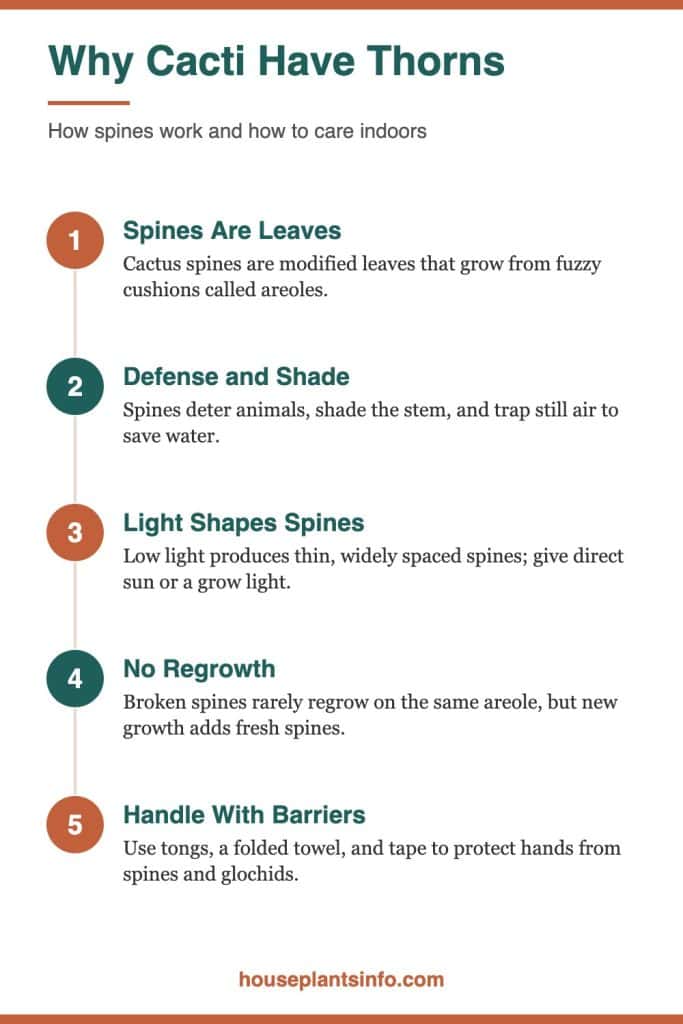
Common Questions About Cactus Thorns
Do cactus spines grow back?
A spine that breaks or falls off usually does not regrow from the same areole. New growth at the top or sides of the plant will carry fresh spines, so the cactus fills back in over time.
Can I cut the spines off my cactus?
You can trim spines with small scissors, but they will not regrow on those areoles and the plant loses some protection and shade. I recommend leaving them alone and moving the plant to a safer spot instead.
Why does my cactus have soft spines?
Some species naturally have soft, hair-like spines, such as old man cactus and some mammillarias. If spines on new growth are suddenly thinner or softer than older ones, low light is the most likely cause.
Are cactus spines poisonous?
Cactus spines are not venomous and do not inject poison. The risk comes from puncture wounds, irritation from glochids, and possible infection from bacteria carried into the skin.
Do all cacti have spines?
All true cacti have areoles, but not all have obvious spines. Christmas cactus and some other jungle cacti have tiny bristles or none at all, and a few desert species, such as some astrophytums, are nearly spineless.

Hi! I’m Sophia, and I love plants – especially an expert in growing house plants. I stay in Chicago, United States of America, and through my blog and social media platforms, provide tips and tricks on how to grow healthy, vibrant plants indoors. Check out more here.